


Cat Housing, Or The Cattery
Description
This section is from the book "The Cat: Its Points And Management In Health And Disease", by Frank Townend Barton. Also available from Amazon: The Cat: Its Points And Management In Health And Disease.
Cat Housing, Or The Cattery
UNDER ordinary circumstances the cat takes up its abode in the family circle, sleeping either in or out of doors at night - though it must be confessed that it is an undesirable practice, and to some extent unkind to allow cats to roam about out of doors all night. Such leads to fostering the roving disposition, and, once acquired, a cat is seldom much use for the destruction of smaller vermin within the house. Moreover, it has a detrimental influence in other ways, such as the contraction of mange, distemper, and too frequent gestation.
When a number of pedigree cats are to be kept, the erection of a cattery, either in or out of doors, becomes essential, but it is much preferable to have it out of doors, being healthier for the cats and certainly less objectionable to members of the household.
If the cattery is carefully constructed, it can be kept out of doors at a more equable temperature than even a room in the house, whilst the necessary artificial warmth can be provided in the outdoor cattery just as well during the cold weather.

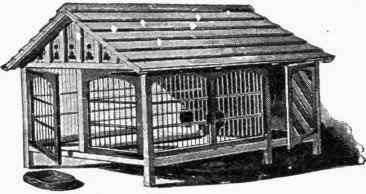
Fig. 1. - Portable Outdoor Cats' House and Run.
The construction of it will necessarily depend upon the ground at the owner's disposal, the number of cats it is desired to accommodate, and the disbursement of capital at command.
Most of the manufacturers of dog and poultry houses make various forms of catteries, some of which, however, are of a very elaborate design. Probably those made by Messrs. Boulton and Paul, Norwich, and Spratt's Patent, London, have no superiors, but this, of course, is a matter for individual judgment.
Fig. 1 represents a portable outdoor cats' house and run, and is an extremely ornamental structure. The run is covered with galvanized iron netting, and there is a shelf in the run with a door at the end.
The size of the house is 2 yards long by 4 feet wide, and is 5 1/2 feet high at the eaves. The roof is covered with corrugated iron, and the house is made of weather-boarding, whilst the floor is also wooden, as well as the shelves for sleeping upon.
Its cost is £6 10s.
A similar house to the above could be constructed by a skilful workman.
If convenient, it is always better to place the house and run upon a concrete or asphalt foundation. Place it in a position that will ensure it the maximum amount of warmth and sunlight.
Fig. 2. - This represents a lean-to cattery of excellent construction, and comprises two houses, each with a run, the size of each house being 3 feet by 4 feet from back to front, and each run is 4 feet square; the whole occupying a space of 14 feet by 4 feet, and 6 feet high at the back.
This is a beautiful house, but expensive. The roof is of corrugated iron, the runs of galvanized iron network, and the walls of rustic jointed weather-boards, painted and fitted with shelves in the houses and runs.

Fig. 2. - Lean-to Cattery.
In Fig. 3 the illustration represents another cathouse with a run, made both as a single and a double house. The single house is 7 feet 6 inches by 2 feet 6 inches; whilst the double is 5 feet wide. Both the run and house have a door for cleaning it out; the roof is covered with weather-boarding. The cost of a single house is £3, and the double is £5.
Boulton & Paul.
Dec ber 1st 1895
Fig. 3. - Cats' House with Run.
Any local carpenter will construct a cattery according to the owner's plans, but such construction must be regulated by certain principles, applicable to a cattery only, which, if left to the devices of the carpenter, are almost certain to be found wanting in the essentials of a good house.
First of all there must be a large air-space above, as cats require plenty, of pure air.
The joints of the boarding must be either overlapping one another, or else the house must be lined with match-boarding with a layer of felt between, the latter certainly repaying the extra outlay by the additional comfort it affords.
The outlet for impure air should be in the roof; and the inlet, in the form of a small window, fixed in the door. Both house and run should have a separate door, taking care that the door in the house has a south or south-west aspect, whilst the door in the run is preferably at the end. The run should be enclosed with 1/2-inch galvanized wire netting fixed on to the sectional framework of the run. 4 feet by 4 feet may be allowed for the run; for the house, 6 feet by 4 feet; and the height at the eaves, 6 feet. Doors should open outwards. Use well-seasoned red deal for its construction, and have the roof either slated or tiled upon wood, corrugated iron being too hot in summer, and too cold in winter. The floor of the house should be of boards, with a shelf or bench for the cat to sleep upon, whilst the floor of the run may be either of concrete, gravel, wood, or grass, etc.; but in any case it should be freely sprinkled with moss, litter or some other absorbent.
There should also be a shelf fitted up in the run for the cat to bask upon during the day.
The whole structure should have a couple of . coats of anti-corrosion paint. The place must be absolutely damp-proof.
Continue to:


My Books

