


The Whippet. Part 3
Description
This section is from the book "British Dogs, Their Points, Selection, And Show Preparation", by W. D. Drury. Also available from Amazon: British Dogs: Their Points, Selection And Show Preparation.
The Whippet. Part 3
Up to the present the handicap is the only form of racing in vogue; but there is no reason why this should be so, for, as Mr. Tatham in a most interesting series of papers that he contributes to the Dog World points out, the possibilities of this sport, if not endless, are at least great. He says that: -
"When the sport obtains the support it is entitled to, I have no doubt whatever races other than handicaps will crop up. They cannot be introduced too soon, for obvious reasons. Moreover, numbers of persons ignorant of the niceties of dog-racing, yet anxious to own and run dogs, hold back through being lost amid the intricacies of handicaps. The class of race I allude to would initiate them into the mysteries of yards and pounds in a very short time, and they would then know what mark their dogs would have just as readily as an owner of racehorses knows what weight his animal will have to carry in a weight-for-age race.
"To put forth a race, say, for dogs and bitches any weight, yards or pounds, bitches allowing dogs three yards to the pound, would be, of course, a foregone conclusion, and there would be very few starters. But a person putting forth a programme of a meeting is supposed to know what conditions to make in order to provide good sport, and by the insertion of those conditions quite a new complexion is put on the matter, the race at the same time being essentially according to the scale of yards for pounds. By such means high-class dogs will be meeting high-class dogs, and in races meant for them; the moderate ones also would find races suitable for them, and the handicap would still remain for any class of animal.
Again, no more interesting race could be inaugurated than one for dogs whelped in the spring of one year and entered for a yards-for-pounds race to be run in the spring of the following year. Equally interesting would be a similar race for bitches, and more interesting still would be one for dogs and bitches run some months after, say in the autumn. The difficulty as to time of whelping would be no greater than it is in coursing or time of foaling in horse-racing. In fact, there are no difficulties in dog-racing greater than those found in coursing and horse-racing, and they can be overcome by the same means as the National Coursing Club and the Jockey Club employ in overcoming their difficulties."
Mr. Sutherland next refers to the Whippet as used for rabbit-coursing, as follows: -
"The matches in connection with rabbit-coursing invariably take place in enclosed grounds set apart for that and other sports. These matches are ruled by what is termed the ' 6oyds. Law' - that is, the rabbits are allowed 6oyds. start of the competing dogs. The slipper, who is selected for his known impartiality, grasps the competitors by the napes of their necks, despatching them as evenly as possible the instant the rabbit is dropped at the stipulated mark by the judge, who immediately takes up a favourable position to view the course, and decides in favour of the dog first seizing and holding bunny.
It will thus be seen that the duties of judge are not so intricate as those of the Greyhound judge, who is called upon to decide the knotty points of pace, the working turns, go-byes, and merits of the kill.
The weight of the dogs is generally the guide in match-making, the heavier dog having to give his opponent a certain number of dead rabbits; but height in some districts rules the handicap. In rabbit-coursing, however, as in straight-running, there are at all times a few dogs more proficient than others; these are handicapped by dead rabbits, according to merit; and, as in the latter sport, bitches, being considered greater adepts at the game, are handi capped accordingly. A good weight for a Snap-dog is from 22lb. to 251b."
The Whippet for straight-running needs to be trained much upon the same lines as his near relative the Greyhound. Upon this subject Mr. Freeman Lloyd has a good deal to say in his monograph. Suffice it for the purpose here to refer to his directions in a condensed form. Sharp walking is advocated, the actual distance depending upon the individual dog's feeding and constitution.
These the owner will know all about. If the dog be a heavy feeder, he will need to be galloped oftener than a less hearty one. He should be taken on to a piece of level grass and allowed to play and to gallop himself into form, getting over a lot of ground, and at the same time doing some sharp work, which latter is very important. If long walking exercise be indulged in, the Whippet not only gets slow but also loses dash at the finish. In commencing to train, care must be taken to avoid galloping a dog too often before he is fit enough to sprint the distance without showing signs of tiring; this makes an animal finish badly and grow false. Puppies should not be galloped too far. Fifty yards will be quite a sufficient distance for youngsters, increasing the run as the dog conditions. It is also a bad plan to keep on trying them. If there be a promising one, he should be tried with one that he can beat. He should not be tried against an animal far his superior in pace, or it will take the dash out of him.
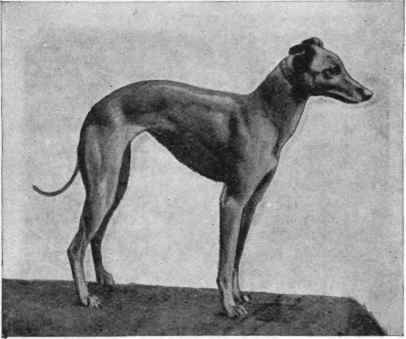
Fig. 34. - A Type of Show Whippet.
In feeding, wholesome and plain food must be the order of the day. Fatty scraps must always be avoided. Sheep's heads well boiled (and once or twice a week an onion and a parsnip may be boiled with these and afterwards mashed) will prove beneficial. Brown bread a fortnight old should be well covered with the broth from the heads, and a new-laid egg be beaten in with it. This dietary will suffice for a few days, when beef, boiled to "rags" or else cooked in the Dutch oven to such a condition that when cut the gravy follows the knife, should be given. If the Whippet be a bad feeder and somewhat delicate, he may have an egg beaten up and given with a little toast before taking him out for the morning's work. In the last few days before running a cut out of the middle of a leg of mutton, nicely stewed, with some toast made from a brown loaf, a little of the broth, just a sprinkling of the vegetables already named, and an egg beaten in the broth, are advocated. All stimulants should be avoided.
As a companion the Whippet has many superiors, though to some he has his good points - not the least attractive of which are his conformation, speed, the fact that he occupies but a very small space indoors, and has no long coat to lick up the mud. Nor as a sporting dog is he without his admirers, though the possession of a brace, it must be confessed, is not unfrequently regarded with suspicion by farmers and game-preservers. For rabbit-catching the rough-haired variety is more fancied, such a coat standing them in better stead than the smooth one. When employed for rabbit-catching it is usual to work a brace of Whippets with a smart terrier.
As a show dog the Whippet does not meet with a large share of support, though there is no reason why so easily kept a variety should not. For this purpose one from 161b. to 2olb. is about the correct weight; but to win the dog must be built upon the lines of the Greyhound, and look all over like a racer. He must be shown in good, hard condition, but not so finely trained as if he were intended for straight-running. Exercise behind a trap or a cycle, if judiciously given, combined with good grooming on return, in which there is plenty of hand-rubbing employed, will soon bring a typical Whippet into really excellent show form.
The following is the description of the Whippet as drawn up by the Whippet Club: -
Head
Long and lean, rather wide between the eyes, and flat at the top. The jaw powerful yet clearly cut. Teeth level and white.
Eyes
Bright and fiery.
Ears
Small, fine in texture, and rose shape.
Neck
Long and muscular, elegantly arched, and free from throatiness.
Shoulders
Oblique and muscular.
Chest
Deep and capacious.
Back
Broad and square, rather long, and slightly arched over loin, which should be strong and powerful.
Fore Legs
Rather long, well set under dog, possessing fair amount of bone.
Hindqtiarters
Strong and broad across, stifles well bent, thighs broad and muscular, hocks well let down.
Feet
Round, well split up, with strong soles.
Tail
Long, tapering, and nicely carried.
Coat
Fine and close.
Colour
Black, red, white, brindle, fawn, blue, and the various mixtures of each.
Weight
20lb.
In selecting a Whippet, practically the same rules hold good as in the case of a Greyhound.
Continue to:


My Books

