


Chapter I. The Scotch Colley
Description
This section is from the book "British Dogs: Their Varieties, History, Characteristics, Breeding, Management, And Exhibition", by Hugh Dalziel. Also available from Amazon: British Dogs.
Chapter I. The Scotch Colley
I do not think it possible to say much - if, indeed, anything - new about the colley; but as there has been almost as much nonsense written about this dog as on the subject of teetotalism, I shall try to shovel a lot of the accumulated rubbish aside, that we may have a clearer view of the dog as he was and still is when "unimproved" by the descriptive eloquence of the advertising and ignorant dealer, and "undescribed" by the ready pen but too often superficially informed dog show reporter.
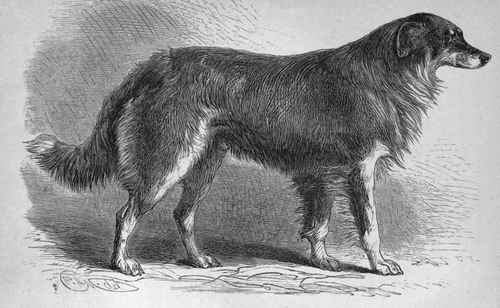
MR. A. G. JAMES' ROUGH-COATED COLLEY "CARLYLE" (K.C.S.B. 8505).
Sire Perthshire Bob - Dam Old Lassie.
I do not say that these classes, even with the influence of the incompetent judge thrown in, have destroyed the colley, but they have done their utmost, and succeeded so far that the dust they have kicked up has got into the eyes of the public, and with the public, in consequence, a usurper rules where the true colley should reign.
It is, perhaps, not my province to award the proportions of blame among the three classes of delinquents referred to, but I decidedly think the reporters are most deserving of censure. The constant iteration of what are evidently considered smart and clever sayings, regardless of their relevancy or truth; the flippant delivery of the ipse dixit - in fact, the constant chatter and gabble, as of spring geese, which is often met with in the pages of fanciers' papers, are sickening to a degree, and as damaging as such twaddle can be to true canine interests. They convince me that the present system of dog show reporting is as vicious as it is nauseous, and that there is no class, except, perhaps, the judges, which the world could so well spare as the common run of dog show reporters.
I need scarcely say I do not write indiscriminately of all judges and all reporters. I have often seen the work of both, which proved conclusively that the performers not only knew their business but took pains to do it well. These, however, are still comparatively few, and are the mere salt and pepper which prevent the general body from becoming fly-blown.
Some years ago, when the "Field" was the only paper reporting dog shows, constant descriptions of colleys, with beautiful jet black coats and rich orange tan markings were given; and in advertisements and elsewhere we still occasionally hear the reverberation of the silly sing-song. What stronger incentive could there be to dealers to offer half-bred Gordon setters as pure colleys, when the leading journal was teaching the public such a false lesson, and thereby creating a demand for the graceful mongrels with thin coats, "soft as a lady's hand," feathered legs, draggle-tails, saddle-flap ears, and a rich mahogany coloured kissing spot on each cheek, that have been so plentiful ever since. Nice articles these toys would be "to bide the pelting of the pitiless storm," to bravely face the snow-drift and the sleet through heather and moss hag, in tentie care of the ourie cattle, Or silly sheep that hide the brattle
O' winter war; And through the drift deep lairing sprattle,
Beneath a scaur.
I qnote from memory, and therefore not literally, but I believe it was "Idstone," in one of the charming papers he used to contribute to the "Field," who told the story of the Scotch shepherd on the hill side falling in love with his Gordon setters, and saying he would "like a cross o' yin o' them wi' his colley, for they would throw unco braw whalps." Oh! "Idstone!" "Idstone!" how could you let my countryman draw the white feather over your eyes so? The "pawky auld carle" had ulterior designs on your whisky flask, and was not unmindful of the proverb, "Love me, love my dog;" but a shepherd who would make such a proposition in earnest is not fit to take care of a hirsel.
Further, in reference to this question of colour, I, for my part, put aside, as purely fanciful and with facts all against them, the opiniona given in both the earlier and the last edition of "Dogs of the British Islands." In the former I find it stated the colon rs are various, "sometimes sandy or of various mixed greys, some of which are singularly beautiful and picturesque. There is generally a very fine white line down the forehead, not amounting to a blaze as in the spaniel."
Who wrote the article on colleys in the first edition I do not know, but feel certain it was not "Stonehenge," for he could not by any possible slip conceivable to me be guilty of the absurdities with which it abounds - to wit, the following quotations, the statements in which were gravely made in a book for many years the standard work on dogs, given as information to the British public, and not as jokes, ponderous as they would have been: "Their [the colleys] homing faculty is very extraordinary, and it has been asserted that the Scottish drovers would send them back alone from Smithfield to the Highlands with a wave of the hand." Would that the Ettrick Shepherd and Kit North had read the above together - we should have had an additional chapter in the Noctes. Again we have the following evidence of hearsay usurping the practical: "If a dog is of a marked intelligence, he may even be trusted to lie upon an eminence all day and to watch the movements of thousands of sheep grazing below him, for he will keep all in their proper district; and when he hears his master's shrill whistle he will ' go round' and drive them home." I once read the foregoing balderdash to a Scotch shepherd, which elicited the criticism, "Hoots! fulebody; does he think a' the hirsel lie in ae' hollow, and that we drive them a' hame at 'een like kye tae the byre?" The fact is, the writer borrowed the story from an earlier writer, "John Meyrick," and enlarged and embellished it with the exuberance of his own fancy as a bit of padding; and that was the sort of intellectual pabulum offered to the inquiring mind on colleys by the "Dogs of the British Islands."
Continue to:


My Books

