


Chapter XIX. The Gordon Or Black And Tan Setter
Description
This section is from the book "British Dogs: Their Varieties, History, Characteristics, Breeding, Management, And Exhibition", by Hugh Dalziel. Also available from Amazon: British Dogs.
Chapter XIX. The Gordon Or Black And Tan Setter
Whether the dog under consideration should be called the black and tan setter or the Gordon setter is a subject open to controversy, but of one thing there is no doubt, as the authentic records of breeders prove, that many of the best modern black and tan setters have a large commixture of that Gordon Castle blood which became half a century ago so famous as to stamp the generic name of Gordon Setters on its possessors. What the original colour of the Gordon setter was is still a disputed point, which was ably argued in the Field some years back, the weight of evidence produced being decidedly against the black and tan and in favour of the black, white, and tan, as the prevailing colours in this celebrated kennel, but if it was difficult to get an unanimous consent as to the colour of dogs distributed thence at comparatively so recent a date, it becomes a still more difficult problem to solve how the breed was first established. Many hold that it was originally a cross of our English setter with the red Irish setter, and, in support of this view, advance the fact that in many litters pure red puppies are met with. This does not occur so often now as we get further from the source of the red blood, but it is fair presumptive evidence of the cross having taken place.
On the other hand, it has been asserted that many of the good qualities of the Gordon Castle setter were inherited from a celebrated colley of poaching proclivities; and there are more unlikely things than that such a cross might be tried, for no one, seeing the sagacity of the sheepdog as displayed in his management of his charge, can fail to be impressed by it, and if that wonderful sense could be infused into a setting dog and undesirable points bred out whilst retaining it, it might be a consummation devoutly to be wished. And such an attempt is far from unlikely to have been tried, so that it is not at all improbable that the Gordon and our modern black and tan have both Irish setter and colley blood in them. This pre-supposes that the Irish setter has been longer in existence as a distinct breed than the Gordon, and this, I think, can be established, although that breed, like all others, has probably been considerably modified.
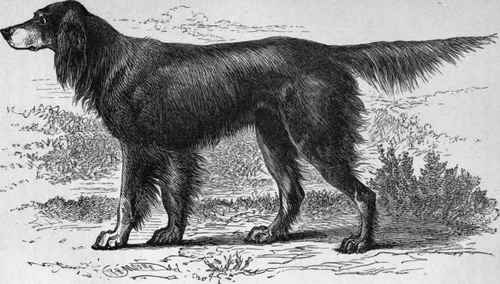
MR. H. B. GIBBS' GORDON SETTER "YOUNG LORNE" (K.C.S.B., 4310). Sire Mr, J. Wakefield's Jock - Dam Mr. Bennie's Sally.
The Gordon or Black and Tan Setter. 113 tail, 14in.; girth of chest, 28in.; girth of loin, 21in.; girth of head, 16in.; girth of forearm, 7½in.; length of head from occipnt to tip of nose, 10in.; girth of muzzle midway between eyes and tip of nose, 10in.
As it is generally - I may say universally - acceded that the spaniel is the foundation on which all our varieties of setters has been built, and there is no means of proving positively the modus operandi adopted, it is a fair field for conjecture to those so disposed; but one thing is clear, the lines followed in breeding, whether as regards crossing or selection, must have differed to create three varieties with such distinctive features as the English, Irish, and black and tan, and it is with the latter I have at present to do, for, although I take black, white, and tan to have been the prevailing colour of the Gordon, these have been elbowed off the show-bench by their darker brethren for good or ill, for by all recent judging a dog with a white frill even would stand no chance at shows where the class is still described as black and tan, or Gordon setters, and under these circumstances I think it a great pity that a class is not provided for the handsome tri-coloured dog.
It is a fact worth noting that black and tan setters took the prizes against all comers at the first two shows for setters ever held, these being Mr. J. Jobbing' s Dandy, first at Newcastle, 1859, and Mr. F. Burdett' s Brougham, first at Birmingham in the November following. Dandy's grandsire was the Duke of Gordon's Grouse, and both his stock and that of Brougham have since frequently appeared in the prize lists.
As a working dog the black and tan is excellent; he is possessed of a fine nose, with staunchness; he is not so fast as the Laverack, and in the opinion of many, not so enduring, but on this latter point I have a different opinion, having known dogs of this breed work constantly in rough hill shooting without being knocked up, and for this kind of work his superior bone and muscle seem to adapt him better than the lighter and more elegant Laverack.
The black and tan differs from the English, and especially the Laveracks, in presenting a rather heavier appearance; the head is decidedly heavier,
The Gordon or Black and Tan Setter. 115 with a nearer approach to the bloodhound type, the lips in many good specimens showing a good depth of flew, but in general points the two varieties should agree, colour of course, excepted. This should be an intense, yet brilliant black - not a dead absorbing black - relieved by a very rich warm mahogany red, and as free from white as possible. This deep tan could not be inherited from a colley cross, the prevailing colours in which are black and white, and those that are tan marked have that colour very pale. The tan should appear clear and distinct on the feet, feather of the leg, under the stern, on the vent, cheeks, lips, and in spots over the eye, as in black and tan terriers.
As I do not believe in the wisdom, utility, or good taste of making a decision in judging sporting classes depend so exclusively on colour and markings, and consider it bad policy to exclude, as in this case, black, white, and tan, which many think the legitimate colour of the breed, and prefer both for beauty and work, I hope to see a class formed for them. There might, after the damaging effects of show judging on them for years past, be few exhibited at first, but in a few years this really handsome variety of the setter would take a foremost place. It was some years after shows were started that a class for fox terriers was instituted, and now they are the most numerous at all shows.
The main points of difference between the black and tan and the modern English setter, after colour, are that the former are heavier built, larger in head (which is added to in appearance by tendency to throatiness and flew), a rather harsher quality of coat, and shorter stern. The hind-quarters should be particularly strong, and the stifles wide apart and well bent. A dog that appears tied in the hams, as toy spaniels are, is of no use for work.
The subject of our engraving is Mr. H. B. Gibbs' Young Lome, one of the most perfect specimens of the breed. Young Lome has not been much exhibited, but has been fairly successful, and his stock have turned out well. He is also, I am given to understand, for I have not seen him work, an excellent performer in the field.
Measurements of black and tan setters:
Mr. E. L. Parsons' champion, Floss: Age, 5 years; weight, 591b.; height at shoulder, 22½in.; length from nose to set on of tail, 39in.; length of tail, 15in.; girth of chest, 27½in.; girth of loin, 22in.; girth of head, 16in.; girth of forearm, 6¾in.; length of head from occiput to tip of nose, 9½in.; girth of muzzle midway between eyes and tip of nose, 9¾in.
Mr. J. H. Salter's Rex II.: Age, 5 years; weight, 71¾lb.; height at shoulder, 25in.; length from nose to set on of tail, 42in.; length of tail, 18in.; girth of chest, 32in.; girth of loin, 22in.; girth of head, 18in.; girth of forearm, 8in.; length of head from occiput to tip of nose, 10in.; girth of muzzle midway between eyes and tip of nose, 11in.
Mr. T. Jacobs' Marquis: Age, 2 years 3 months; weight, 551b.; height at shoulder, 22in.; length from nose to set on of tail, 38in.; length of tail, 14in.; girth of chest, 29in.; girth of loin, 22 ½in.; girth of head, 15½in.; girth of forearm, 7½in.; length of head from occiput to tip of nose, 10in.; girth of muzzle midway between eyes and tip of nose, 9½in.; black and tan, correctly marked, free from white.
Mr. T. Jacobs' Earl: Age, 2 years 3 months; weight, 651b.; height at shoulder, 23½in.; length from nose to set on of tail, 38½in.; length of tail, 14in.; girth of chest, 30½in.; girth of loin, 23½in.; girth of head, 16½in.; girth of forearm, 8in.; length of head from occiput to tip of nose, l0½in.; girth of muzzle midway between eyes and tip of nose, 10in.; colour and markings, black and tan, correctly marked, free from white.
Mr. H. B. Gibbs' Young Lome: Age, about 5½ years; weight, 611b.; height at shoulder, 23in.; length from nose to set on of tail, 3ft. 5in.; length of tail, 1ft. 3in.; girth of chest, 30¼in.; girth of loin, 22½in.; girth of head, 1ft. 6in.; girth of arm lin. above elbow, 10in.; girth of leg lin. below elbow, 8½in.; length of head from occiput to tip of nose, 11in.; girth of muzzle midway between eyes and tip of nose, 10½in.; colour and markings, black and rich sienna tan, correctly marked and free from white.
Mr. H. B. Gibbs' Norah: Age, about 3 ½ years; weight, 471b.; height at shoulder, 21in.; length from nose to set on of tail, 2ft. 10in.; length of tail, 1ft. 2in.; girth of chest, 2ft. 2¾in.; girth of loin, 20½in.; girth of head, 15½in.; girth of arm lin. above elbow, 9in.; girth of leg lin. below elbow, 8in.; length of head from occiput to tip of nose, 9½in.; girth of muzzle midway between eyes and tip of nose, 9in.; colour and markings, black and tan of a rich sienna colour, correctly marked and free from white.
Continue to:


My Books

