


Chapter XVIII. The Irish Setter
Description
This section is from the book "British Dogs: Their Varieties, History, Characteristics, Breeding, Management, And Exhibition", by Hugh Dalziel. Also available from Amazon: British Dogs.
Chapter XVIII. The Irish Setter
"A Veteran Sportsman," author of "A Correct Delineation of the Canine Race," writing in 1803, says: "The sporting gentlemen of Ireland are more partial to setters than pointers, and probably they are better adapted to that country. Setters, it is presumed, cover more ground than pointers, are not so liable to be footsore, and can bear the changes of weather much better than the latter, which they term the smooth spaniel. The fields in many parts of Ireland are large, very rugged, and stony; the rains sudden, sharp, severe, and driving. Setters, therefore, particularly suit the country they go over; to this may be added the grouse shooting, which is excellent, and it is a universally-received opinion that this species of dog only is equal to the fatigues of it." The writer I have quoted from does not attempt any description of the setter in use in Ireland in his sporting days, nor dwell on his points after the manner of our modern dog show critics; but, instead, he gives briefly the fact that the dog selected by Irish sportsmen was one specially adapted to the circumstances of the country and climate in which he had to work, a most important fact, which I think dog show managers, judges, and others cannot have too often brought under their notice, for there is undoubtedly an evil tendency in our dog show system to forget the fitness of the dog for his work, which should exist, and indeed should be made a sine qua non, and to exalt far above their legitimate value, points of beauty and arbitrary standards of perfection, giving undue weight to matters of comparatively little moment, such as the existence of a few dozen white hairs, more or less, the colour of the eyelashes, and the precise carriage of the tail to a line minutely described and insisted on.
I by no means say that beauty and utility should not be combined, but great care should be exercised that in setting up a fancy standard we do not sacrifice to it absolutely essential or even desirable characteristics. I for one have little faith in the fabulous pedigrees I hear of, and as little in the assertions that a shade of colour is a proof of long descent in this or any other breed. Such a thing as well kept stud books must, at least, have been rare indeed, as so far as I know there is not a dog living of any breed whatever, if we except hounds, whose pedigree can be traced in a manner that could be considered as proven for even one hundred years, and it would still further mightily surprise me to find that the points of all, or even one of the progenitors, had been as minutely described as modern fanciers require. Hence, I fall back on general facts, and firmly believe, with the writer I have quoted, that Irish sportsmen chose the setter as best adapted to their purposes, and no one who has seen Irish setters, especially as they are to be seen at Irish shows, will doubt that the selection was a wise one, whether the originals were red or white and red, for it is the general characteristic of both; but I must say, to my mind especially, of the reds, they impress one with their powers of hardihood and endurance and defiance alike of rough country and rough weather; they have a "devil-may-care " look about them which plainly says it is neither hard work, hard weather, nor hard living that will stop us, although at the same time this same look creates a suspicion, if not of actual stubbornness, at least of a wilful rollicking disposition chary of too close restraint.
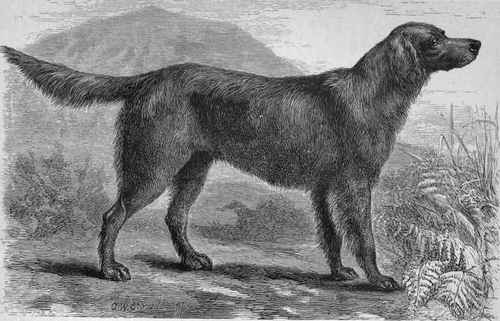
MR. J. FLETCHER'S IRISH SETTER "GROUSE" (K.C.S.B., 7269). Sire Mr. Erwin's Rant - Dam Mr. Morton's Kate.
Colour is the point which has been most warmly discussed since shows were introduced, and, without going through the arguments and assertions pro and con, I will merely observe that, so far, at least, as English shows and English judges go, the deep blood-red, free from any black on ears, ridge of back, or tail, and with as little white as possible - a mere line down the face and star on chest - has gained the day, and any dog with much white would in prize competition, judging from decisions of the last few years, be very heavily handicapped, if not absolutely disqualified, and I doubt very much if Dr. Stone's grand old dog Dash were to visit the scenes of his former triumphs, whether that "white snake round his neck" would not mar his prospects. Our Irish friends provide distinct classes for the reds and red and whites, they being two distinct types of the Irish setter breed - a course highly to be approved; for, however little faith may be placed in a vague tradition that would rest purity of blood in a shade of colour, the very existence of such traditions proves that such points had existed in good dogs, and had been consequently noted and valued by old breeders.
Speaking personally, I prefer the blood red, with as little white as possible, as it gives to the dogs a more distinct character, or rather it adds to their pronounced family character and I can see no reason why such a point cannot be bred up to without a sacrifice of higher and more essential qualities.
In general appearance the Irish setter is rather lighter and more wiry-looking than the English. The head is long and narrow, the nose wide, not snipey or terrier-like; the ears set on well back, rather narrow, hanging close and lightly feathered; the eye should be brown, corresponding with the dark flesh-coloured nose; the lips deep, but not so much so as to be hound-like; the neck neat, light, and well placed; the shoulders sloping; the chest deep, but not wide, as a wide chest indicates slowness; the fore ribs deep, the sides rather flat, loins strong and very muscular, and the flank rather tucked up; hind quarters strong and muscular, but not heavy; the tail set on rather low and well carried, fine in bone, and the feathering rather lighter in colour than the body; coat is rather fine, but more wiry than an English setter; the feather is longest about the middle of the tail, tapering off gradually towards the point; the legs straight, feet hare-like, and fairly feathered between the toes; the hocks strong, stifles well bent; the feathering on the legs abundant, fine in texture, and same shade as on the tail; the body coat is harder, of a wet-resisting text are.
Many of the Irish setters of the day can be traced back with more or less certainty to kennels of renown during the early part of the century, and the number of good dogs, it is reasonable to assert, has increased since the advent of shows gave an impetus to the breeding of them; and now it is a rare thing to find an English show where this breed is not represented. In the United States of America this dog is a great favourite, almost as much so as the Laverack, and specimens are constantly being sent across the Atlantic from Irish kennels. The most celebrated dogs of this breed of recent date, which have been exhibited, are Mr. Hilliard's Palmerston, Dr. Kennedy's Dick, Mr. Macdona's Plunket, Mr. Nuttall's Maybe, Mr. M'Haffie's Mina, Miss Lizzie War-burton's Lily, Dr. Stone's Dash, Mr. Lipscomb's Shawn Bragh, Mr. Jephson's Dash, Major Hutchinson's Bob, Major Cooper's Banger, and others too numerous to mention.
Among the most successful breeders I may mention Miss Warburton, Mr. Cecil Moore, Mr. Henry Jephson, and these and several other breeders trace the pedigree of some of their dogs to the beginning of the present century, going back through the kennels of Messrs. Evans and Lloyd, of Dungarvan, to the kennels of Lords Antrim and Enniskillen and a noted breeder, Mr. Hazard, of Fermanagh; and of other old strains there is the La Tonche, Lord Clancarty's, and the Marquis of Waterford's. Mr. Jephson was the breeder of Lilly II., Eily (both first prize winners at Birmingham and Crystal Palace), Nell (second Crystal Palace), Sheelah (ditto, 1876), March (champion cup, Dublin, 1875), Rufus (first puppy class, Crystal Palace), and other good ones less well known.
The subject of our engraving is Mr. J. Fletcher's Grouse, bred by Mr. W. J. Smith. He made his deout at the Dublin Show, 1877, when he took premier honours, and has since had a victorious career, having won many prizes for his present owner under various judges. Grouse is a deep red, with capital straight coat of the right texture, feathering on legs profuse, nice comb-like flag, which he carries well; he has a good deep chest, muscular loins, and good hind quarters, with a head almost perfect.
The following are the measurements of some celebrated Irish setters:
Mr. J. H. Salter's Whisper: Age, 2½ years; weight, 561b.; height at shoulder, 25½in.; length from nose to set on of tail, 42in.; length of tail, 19in.; girth of chest, 28in.; girth of loin, 21in.; girth of head, 17in.; girth of arm, 7in.; length of head from occiput to tip of nose, 10in.; girth of muzzle midway between eyes and tip of nose, 9in.
Mr. T. Hilliard's Palmerston: Age, 11 years; weight, 651b.; height at shoulder, 23½in.; length from nose to set on of tail, 44in.; length of tail, 15in.; girth of chest, 30in.; girth of loin, 24in.; girth of head, 16in.; girth of arm, 9¼in.; length of head from occiput to tip of nose,
10¼in.; girth of muzzle midway between eyes and tip of nose, 10in.
Mr. T. Hilliard's Count: Age, 2 years 9 months; weight, 541b.; height at shoulder, 23in.; length from nose to set on of tail, 37½in.; length of tail, 13in.; girth of chest, 28½in.; girth of loin, 22in.; girth of head, 15½in.; girth of arm, 10in.; length of head from occiput to tip of nose, 9½in.; girth of muzzle midway between eyes and tip of nose, 8¾in.
Mr. T. Hilliard's Tilly: Age, 4½ years; weight, 451b.; height at shoulder, 22in.; length from nose to set on of tail, 37in.; length of tail, 14in.; girth of chest, 27in.; girth of loin, 20½in.; girth of head, 14¼in.; girth of arm, 8iin.; length of head from occiput to tip of nose, 9¼in.; girth of muzzle midway between eyes and tip of nose, 8¾in.
Mr. F. A. Bird's Belle: Age, 3 years 3 months; weight, 471b.; height at shoulder, 22in.; length from nose to set on of tail, 35in.; length of
Continue to:


My Books

