


Chapter X. The Newfoundland
Description
This section is from the book "British Dogs: Their Varieties, History, Characteristics, Breeding, Management, And Exhibition", by Hugh Dalziel. Also available from Amazon: British Dogs.
Chapter X. The Newfoundland
Whenever I sit down to write about any breed of dog I feel disposed to dash off with "Of all varieties of the dog none has created so much public interest, given rise to such wide and protracted discussion, and brought out such variety and divergence of opinion respecting it as the one under consideration." But a moment's reflection shows me that if I use such words at all, I ought to have them stereotyped as applicable to nearly all and every breed.
The Newfoundland has undoubtedly had its full share of public attention, and long before dog shows were in existence, or the finely drawn distinctions respecting "points" called into being, he reigned paramount in the affections of the British public as a companion, ornament, and guard.
But in those days, as I have said, every man had his own ideal standard of excellence, or borrowed a suitable one from a doggy friend, the suitability being ensured by alteration sufficient to make it applicable to his own pet, a process not yet entirely obsolete.
Many of these large so-called Newfoundland dogs of twenty-five to forty years ago had, undoubtedly, like the "Caesar" that Burns immortalised in his poem of "The Twa Dogs," been whalpit some gate far abroad, Whare sailors gang tae fish for cod, or were the immediate descendants of such, but they differed materially in colour, coat and in other minor points from each other, and still more from what is now held to be the Newfoundland proper, as he is bred and exhibited in this country.
I can speak personally to the decided difference between dogs imported from Newfoundland into Liverpool some twenty-five and thirty years ago, each believed to be the pure breed of the island by their owners; that difference, as it exists in a memory naturally tenacious of such things, was more in the sort of coat and the colour than in the other marked characteristics of the breed which they all had in common with the recognised dog of the day.
The marked difference then existing in this country was also common in the island of Newfoundland, and I understand on good authority continues, and this obscures the interesting question, What was the original breed of the island really like? and prepares us for the very wide difference and rather dogmatic expression of opinion on the subject by gentlemen who have had the advantage of a residence there, and who have afterwards joined in public discussion on the question.
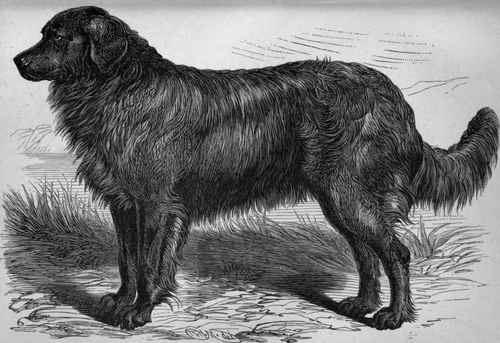
MR. S. W. WILDMAN'S NEWFOUNDLAND "LEO" (K.C.S.B. 5381). Sire Mr. Windle's Don - Dam Meg 0' Meldon, by Bruno out of Mr. Robinson's Meg.
I remember some years ago, after the pleasures and fatigue of a Wolverhampton Show, spending a most enjoyable evening with that eminent and excellent judge Mr. William Lort, a friend, and a churchwarden (one of Sothern's Broseleys), when the former gentleman, who is by no means a "talking machine," for once, opening the gateways of his memory, gave us reminiscences of his Newfoundland life, so graphic and brilliant in their delineations, as to hold us spellbound. Of course the dogs were not forgotten, and I believe I am repeating in effect his views that, although a variety of big mongrels were kept and used there, those that the natives of the island looked on as the true breed were the black or rusty black, with thick and shaggy coats, and corresponding in all other points, although, from want of proper culture, inferior to our best specimens of the day.
Against this testimony I will quote a few other opinions. "Index," who in the "Field," about nine years ago, wrote on this subject with great pertinence, and evidently from personal observation, declared the true breed to be of "an intense black colour," and "with a small streak of white, which is upon the breast of ninety-nine out of every hundred genuine dogs."
Per contra "Otterstone," in the "Country," 6th January, 1876, says: "The predominant colour of the ' Newfoundland proper' is white. His marks are nearly invariable, namely, a black head or face mark, a black saddle mark, and the tip of the stern also black." "Otterstone" also wrote from personal observation, I believe, of the dogs accepted as pure Newfoundlands in Canada, and I might go on quoting from others, not only about colour, but texture of coat, some holding it should be curly, others wavy, others shaggy, and the height of the original is variously stated as 24in. to 26in., up to 30in. to 32in.
This, however, would only, I think, occupy unnecessary space. I cannot, however, forego the pleasure of quotations from the "Sportsman's Cabinet," published 1802, which I feel sure cannot fail to interest readers who have not perused that now comparatively scarce book. The engraving of the Newfoundland therein given is from a drawing by Renaigle and engraved by J. Scott, and represents a dog like our modern one in most points, but not so big and square in head, and altogether lighter in build, and almost entirely white. It is to be regretted that the author of the accompanying letter-press did not give a minute description, which he was thoroughly competent to do. Here, however is what he does say: "The dog passing under this description is so universally known in every part of the kingdom, and is so accurately delineated by the united efforts of the artists in the representatior annexed, that a minute description of its size, shape, make, and form may be considered unnecessary. . . . He is one of the most majestic of all the canine variety.
Although at first sight he appears terrific from the immensity of his magnitude, the placid serenity of his countenance as instantly dispels the agitating vibrations of fear." The words of such an authority should be given due weight in considering what is and what is not a true Newfoundland. Whether there was a dog of marked characteristics from other recognised breeds found indigenous to the island on its discovery or not, we may accept the case as proved that they are now from various causes a mixed lot, as inferior to our English Newfoundlands as their Eastern progenitors are to our thorough bred horse. There is, however, a very general agreement that as regards size we have imported two varieties - the one the Newfoundland as now recognised, the other the lesser Newfoundland, or Labrador dog, or which our wavy-coated retrievers are founded; and it is of the former we are now treating.
Continue to:


My Books

