


The Bull-Dog. Canis Familiaris
Description
This section is from the book "Our Dogs And Their Diseases", by G. S. Heatley. Also available from Amazon: Our Dogs and Their Diseases.
The Bull-Dog. Canis Familiaris
The Bull-Dog is classified by all who have had the opportunity of judging of its capabilities to be the most courageous animal in the world, the game-cock excepted.
This dog's extraordinary courage has passed into a proverb, and has so excited the admiration of the British people that we have been pleased to symbolise our peculiar tenacity of purpose under the emblem of this small but most determined animal. In height the animal is but insignificant, but in strength and courage there is no other dog can match him. In fact, there is hardly any breed of sporting dog which does not owe its courage to an infusion of the Bull-Dog blood.
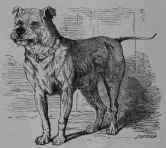
The Bull-Dog.
When those cruel and cowardly combats between the bull amd the dog were a disgrace to this country, "bull rings" were a frequent resort. In these contests the dog was trained to fly at the head of the bull, and to seize him by the muzzle when ho stooped his head for the purpose of tossing his antagonist into the air. But when the dog had made good his hold it was impossible for the bull to shake him off; he clung pertinaciously to his foe, and suffered himself to be swung about as the bull might choose.
There seems to be no animal which the Bull-Dog will not attack without the least hesitation. The instinct for fighting is strong within him, and manifests itself in every feature of this ferocious looking creature.
Now it is as a rule generally assumed that this animal must be of a very dull and brutish disposition, because every specimen indicates this conclusion; however, there can be no doubt that its sagacity and affections are greatly underrated. It is not naturally a quarrelsome creature, and it would certainly bear a more favourable character, providing it were better taught. It is, however, not a desirable or safe companion, for it will with very little provocation attack its master as soon as a stranger, should there be any accidental cause to aggrieve it. Thus a tread on the toes or a kick is quite sufficient to afford it a pretext for attack, and when it does fix its teeth, they cannot be removed unless a barbarous method be resorted to. It may be said, however, in favour of its temper, that the life which the poor dog leads is liable to aggravate its morose nature, being continually tied up for the greater part of its existence. Any animal would become savage, sullen, and revengeful under such treatment, which is insufferable to the poor dog. According to "Stonehenge," a well-bred Bull-Dog ought to present the following characteristics. "The head should be round, the skull high, the eye of moderate size, and the forehead well sunk between the eyes; the ears semi-erect and small, well placed on the top of the head, and rather close together than otherwise; the muzzle short, truncate, and well furnished with chop; the back should be short, well arched towards the stern, which should be fine and of moderate length; the coat should be fine, the chest should be deep and broad, the legs strong and muscular, and the foot narrow and well split up like a hare's."
Continue to:


My Books

