


The Otterhound. Canis Familiaris
Description
This section is from the book "Our Dogs And Their Diseases", by G. S. Heatley. Also available from Amazon: Our Dogs and Their Diseases.
The Otterhound. Canis Familiaris
This animal is exclusively employed for the chase of the otter.
It is a bold, hardy, active dog, which is in every sense requisite, as it has to encounter a fierce and hard-biting creature. Being forced to take the water in search or in chase of its prey, it is necessarily endowed with great swimming powers, otherwise it could never match the most amphibious of quadrupeds. Those who have witnessed an otter disporting itself in its congenial element must have been struck with the exceeding rapidity and consummate ease of its movements, and can therefore appreciate the great aquatic powers that must be possessed by any dog which endeavours to compete with so lithe and active an antagonist.
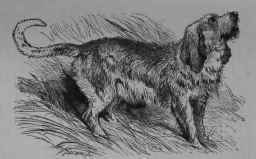
The Otterhound.
Another special requisite is great courage on the part of the dog, because when the otter is irritated it is a peculiarly fierce animal, and can inflict the most painful wounds by its long sharp teeth. It can also twist itself about 'like a snake, and if grasped heedlessly, can writhe itself about quickly, and is as slippery as an eel, and will unexpectedly plant its teeth in its antagonist's nose. Now it must be borne in mind that the nose is rather a sensitive organ of the animal economy, and a bite in that region causes such exceeding pain that none but a well-bred dog can endure the torture without flinching. Such needful courage, then, is found in this dog, but it is apt to degenerate into needless ferocity; in short, there are few animals, with the exception of the Bull-Dog, which will fight as savagely as the Otterhound, or bite as fiercely, and with as terrible results. The attack of the Otterhound is even more dangerous than that of the Bull-Dog, and its bite more to be dreaded; for when this animal bites, it instantly tears its teeth away without relaxing its jaws, and immediately seizes its prey with a second grip. It will be seen, then, that the wounds which it inflicts by this ferocious mode of action are of the most terrible description, lacerating all the tissues, and tearing asunder the largest and most important vessels. The reason for this savage mode of attack is quite apparent; the otter is so quick and agile, that if the dog were to retain its hold, the otter would twist round and inflict a severe, if not fatal wound.
These dogs are obliged to endure the most turbulent weather and the coldest streams; they are furnished for protection with a very strong, wiry, rough coat, which is capable of resisting the combined effects of cold and storm. The face and muzzle are guarded with a profusion of long and very rough whiskers. The Otterhound is a tolerably large dog, measuring nearly two feet in height at the shoulder.
Continue to:


My Books

