


Chapter VII. Training
Description
This section is from the book "Kennel Secrets: How To Breed, Exhibit And Manage Dogs", by Ashmont. Also available from Amazon: Kennel Secrets: How to Breed, Exhibit and Manage Dogs.
Chapter VII. Training
Training is a wide subject, and of much too great importance to warrant mere touch, as would only be possible in this book; moreover, there are but few men capable of handling it as it deserves, for an accurate knowledge of one department simply - that which bears upon field work - can be acquired only by those endowed with eminent qualities, and after years of personal observation and practical experience. The writer might, of course, wander over this vast field and point out some of the landmarks, but there are others more familiar with many parts of it than he; hence he limits his efforts to general rules and admonitions that will favor correct every-day behavior and habits in and about the home, and urges the reader who has a dog that he wishes to train for special work to provide himself with a guide in the form of a treatise by some recognized authority.
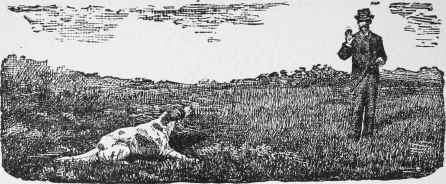
The education of puppies may commence at a very early age, but efforts must for the first few months be largely directed to the cultivation of specific virtues, as cleanliness, obedience, etc. And while aiming to make the exercise of these virtues habitual, bad habits must be anticipated and prevented if possible.
Puppies that have yards connected with their kennels and they are accessible day and night, soon become voluntarily cleanly; and until they do so the droppings should be removed once or twice daily and the floors treated to a deodorizer.
House-breaking should never be thought of during cold weather, as cleanliness in habit is then out of the question, for in order to promote it a puppy must be put out of doors not less often than once an hour. Nor must he be permitted to pass a night in the house before he is five or six months old; at which age this virtue will ordinarily have become fixed if invariably practised during the day. And in the absence of a convenient outbuilding for sleeping quarters he should be put into some other room than that which he is allowed to occupy during the day, together with a shallow box of sawdust or dry earth, to which he will soon learn to turn, provided for a few nights it holds one of his droppings.
A custom of many people who attempt to teach puppies neatness is to bedabble their noses with filth and toss them out of doors. It ought not to be necessary to urge that this is as stupid as it is nasty, and that the infliction is no more effectual than a scolding administered while the offender is held close to the soiled spot. Accepting the facts that dogs inherently are far from being filthy animals, that they are uncleanly in their habits only when their natural tendencies have been perverted by restraint or neglect, also, that they are capable of some understanding at a very early age, such beastly practices as this will never be indulged in by people of sense who undertake to teach them correct deportment.
It is a well-known maxim that first impressions strike the deepest. And he who assumes the education of a puppy will do well to keep this ever in mind. Beginners who are not breeders are, as a rule, at fault in the introduction of puppies to their new homes, where they are generally cordially welcomed and made much of by all in the family, and when night comes given places in the kitchen, the basement, or, perhaps, in the sleeping-rooms of some of the younger members. Innocently enough, being unbroken, they prove something of a nuisance, but are usually tolerated for a few nights, when becoming too much of an infliction they are put into the wood-shed or other outbuilding to sleep. Against this treatment a vigorous protest naturally follows, and oftener than otherwise it is successful ere midnight, and they are brought back to the quarters to which they had so soon grown habituated.
The writer has found it only a pleasure to share his comforts with his humble friends; in fact, during the last ten years not less than four of them have lived under his roof, where they have been literally as much at home as himself; manifestly, therefore, he has no prejudice against allowing dogs in the house. But the line must be drawn at unbroken puppies, or at least all such should be excluded nights until habits of cleanliness have become fixed.
At once after reaching their new homes puppies should in every instance be put into kennels or other quarters prepared for them, and for forty-eight hours they should see but little of their new owners except at feeding times; at the end of which period they will have become accustomed to their changed surroundings and quite content with them. More than likely, of course, they will cry during the first night, but it being accepted that nothing will pacify them except companionship they should be left absolutely to themselves, to "have it out."
Very short visits to the house should be the rule at first, and where this is observed puppies will soon be free from their most objectionable habit. And cleanliness established, one of the greatest difficulties has been overcome, while what is to follow will be comparatively easy if good judgment, patience and perseverance are invariably exhibited.
Dogs are not human, yet they are not far removed, and that they are capable of reasoning at a very early age is plainly evident from the fact that invariably when admitted on the same footing to several persons they single out some one for whom they show a marked preference. The infant barely six weeks old, and while still a stranger to the world, will respond to human expression, for a smiling air or cooing sound raises a smile to his lips, showing that sympathy is already at work. So it is with the puppy. While yet his brain is comparatively inert he is accessible to influences, whether kindly or unkindly, and these impress him more and more forcibly as he grows older. Therefore, in efforts to teach him and regulate his conduct, as with the child, there should be habitually exhibited those qualities which the educator desires him to possess. In other words, that he may be kind, gentle, affectionate, intelligent and courageous, he must grow up under a master or mistress who is naturally all this, or whose conflicting humors are under wholesome restraint.
Continue to:


My Books

