


How To Breed The Best Type Of Short-Nosed Toy. Part 2
Description
This section is from the book "Toy Dogs And Their Ancestors", by Neville Lytton. Also available from Amazon: Toy Dogs And Their Ancestors: Including The History And Management Of Toy Spaniels, Pekingese, Japanese, And Pomeranians.
How To Breed The Best Type Of Short-Nosed Toy. Part 2
The Kennel Club has amalgamated the varieties on the plea that "they produce all four colours in the same litter."1 Condemning Black-and-tans and Blenheims to compete for challenge certificates together, or with Tricolours, because the progeny of the hybrids occasionally produce all colours, is exactly as though horses and donkeys were to compete together on the plea that mules, if fertile, would produce a given percentage resembling each of the parent stock, just as I understand that you get black Andalusians and white Andalusians from Blue Andalusian fowls. The fact that horses and donkeys when crossed together produce mules is no reason that they should compete together or with their (supposititious) progeny.
1 Though the King Charles generally compete against Rubies, and the Blenheims against Tricolours, there is occasionally a challenge prize offered for the best Toy Spaniel of any variety.
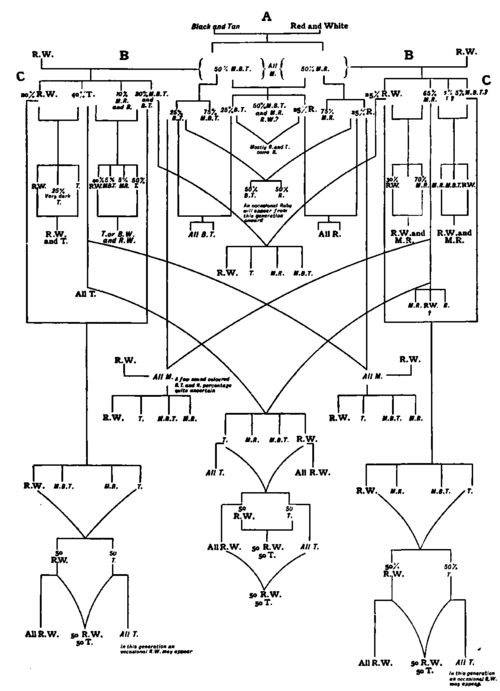
Colour Chart
In generation C there is a high percentage of webbed feet and screw tails, and also of males, especially on the black and tan side
The Blenheim and the Black-and-tan are almost as different in type as the horse and the ass. The mis-marked Toy Spaniel hybrids of the first generation have a blended type like mules and a blended colour like Blue Andalusians, and the Tricolour is the equivalent of the produce of a horse and a mule, were such a thing possible, and it is only in this generation (said to be impossible in mules, but which is general in Toy Spaniels) that we can ever get the four varieties in the same litter, and I must protest against this law of crossbreeding being made a reason for amalgamating the parent stock, which in my opinion is most undesirable.
It must, however, not be assumed at once that the Tricolour is, properly speaking, a mongrel. It appears to be the formation of a new blended color and type which breeds absolutely true, and is a different type from either of the types from which it is bred. The Ruby is the equivalent of the produce of mules bred together without again out-crossing, this also forms a new colour, and the effect of perpetually crossing and re-crossing with the Black-and-tan parent is to get rid of all white markings. It is, however, a curious fact that, just as in the Tricolour, which breeds true when bred to itself, the Ruby breeds no Black-and-tans when bred to itself; but, unlike the Tricolour, it often reverts to the hybrid (t. e., mule) type and markings. For this reason the Ruby cannot be considered a true type like the Tricolour, The Black-and-tan hybrid re-crossed with the Black-and-tan parent stock will sometimes produce Rubies.1
1 I have heard of one case in which a rcd-and-white crossed with hybrid mismarked Ruby produced a Tricolour puppy.
The Red-and-white is a distinct and historical breed. The Black-and-tan is a composite breed which, by force of constant inbreeding, has become a type. The Tricolour is the offspring of the hybrid on the Black-and-tan side re-crossed to the Red-and-white parent stock, and the Ruby the offspring of the hybrids on the Red-and-white side interbred.
This sounds very complicated, but it is really perfectly simple. A reference to my table of colours will be of great assistance in understanding what I have said.
The circumstances in which the actual type and conformation of head will or will not blend also appears to follow definite rules, and it is just this blending of type that we must avoid. The type of Blenheim in generation C is always a blended type, and often has a screw tail, and one out of every few Tricolours of the same generation has the same characteristic. I am assuming that the Black-and-tan of generation A is very short in the face. The Blenheims of generation C have almost always very ugly faces, and are coarse in type, but the Tricolours are refined and good in type. I must say a word more as to the challenge prizes for different colours. If ever a breed deserved separate challenge prizes for itself and for both sexes, the Blenheim does. It is very similar still to the type of 500 years ago, but if it is systematically crossed with Tricolour it will be merged into the same undesirable type of coarse noseless dog which is so fashionable in the Black-and-tan.
It must be remembered that the type of the Blenheim should remain distinct. The varieties must be crossed, as the Tricolour depends on the Red-and-white first for its existence and afterwards for its markings, but the Blenheim does not depend on the Tricolour. The alteration I should suggest to the present rule of challenge certificates is this:
Two challenge prizes for Blenheims, one for each sex.
Two challenge prizes for Black-and-tans or Rubies, one for the best Black-and-tan or Ruby dog, the other for the best Black-and-tan or Ruby bitch, as at present. The Black-and-tan and Ruby cannot fairly compete together, but at present there are hardly enough Rubies to justify separate challenge prizes.
One challenge prize only for Tricolours (dog or bitch, until they are more numerous, when they might have one for each sex.
Under no circumstances should Blenheims or Tricolours compete either against each other or against the whole colours, otherwise the difference of the type will be sacrificed by the Blenheim's head being coarsened and shortened to the Black-and-tan standard.
The difference in type which exists at present between the Black-and-tan and Blenheim is most marked. In the Black-and-tan the body is longer; the hind quarters often sloping; the ribs flatter; chest narrower; back not level, slightly rounded; tail carried very low, often between the legs; huge skull, ewe neck; muzzle very deep from nose to under jaw and coarser in quality; ears set at the base of the skull; nose squashed into skull. Its nature is entirely different and much more apathetic and timid. Action of the hind legs is very distinctive. It may be considerably larger than the Blenheim. The Tricolour takes somewhat after the Black-and-tan in body and set of ears, but is a better shape.
Continue to:


My Books

