


How To Breed The Best Type Of Short-Nosed Toy. Part 3
Description
This section is from the book "Toy Dogs And Their Ancestors", by Neville Lytton. Also available from Amazon: Toy Dogs And Their Ancestors: Including The History And Management Of Toy Spaniels, Pekingese, Japanese, And Pomeranians.
How To Breed The Best Type Of Short-Nosed Toy. Part 3
The Blenheim has a level, broad back; short, cobby body, arched neck, and more nose. His expression is quite different, and his nature bold. The crossing of the breeds encouraged by the Kennel Club new rules is spoiling the Blenheim type, as the true Blenheim is being replaced in the prize ring by the coarse noseless Blenheim of generation C. (See table of colours.)
The Black-and-tan, having no historical standing, is a purely fancy type, but even a fancy type should not be allowed to violate certain rules of proportion. It may be allowed more underjaw than the Red-and-white and a rather lower placement of ear, but the more pronounced the points the smaller the dog should be.
The Red-and-white is essentially a Toy, not a sporting Spaniel, and should be a fairy type, dainty, ethereal, and exquisite in characteristics and small in size, though strong, solid, and healthy in make and constitution. A Red-and-white should never be massive, heavy in head, or "grand," and I must repeat, ad nauseam, that a massive grand type is utterly wrong. Do not breed weeds either, but elephants are simply intolerable.
Breed from larger specimens so as to get the large litters which bring the small puppies, but the show ring is not the place for the big ones unless we have special classes for them. The great difficulty is to make people see the difference between a big dog with quality and a big vulgar type. The big vulgar type should never be bred from at all, if a male. As an instance of the difference between a stud dog type and the show type I may quote my own Champion The Bandolero, who has often been held up by others as a perfect show type. In my opinion he is not as delicately made and exquisitely modelled as a perfect show dog should be, nor is he small enough, but he shows quality and is a good breeding type because all his points are so strongly marked. For the show ring I prefer a small fairy type never seen now, with a less massive head and much finer bone. The same thing applies to Wee Dot. Exhibitors have only one thing to think about, i. e., the perfection of their dogs for exhibition. For breeders the question of type is more complicated, as the perfect show specimens do not get the most perfect puppies, and to get perfect stock the type of sire must go beyond perfection into exaggeration. Perfect dogs get a large percentage of weeds.
Exaggerated dogs get a large percentage of perfect types unless mated to equally exaggerated types, when the result is often simply monstrous. It is these monstrosities which we must keep out of the show ring. A perfect short-faced dog should have a fascinating little face with a tiny bridge to its miniature nose. There is a certain fat, chubby look about the face of a good dog which is not found in bad ones. The modern dogs oscillate between the elephantine, rugged heads, and little, mean, wizened rats of things which are truly only fit to be drowned.
The Red-and-white Toy Spaniel always had a domed skull and comparatively short nose as far back as I can trace the breed. We are, therefore, not going much out of the historical traditions for their colour in breeding to the type of the head in the coloured illustration.
If, however, we continue to breed Black-and-tans with short face and tan markings, they cannot be considered King Charles. In reality the Red-and-white, as well as the Black-and-white (now extinct) were the actual King Charles Spaniels, and the King Charles so-called, of the seventeenth century, was a black, curly dog, presumably identical with the Truffle dog. The present Black-and-tan has no more connection with His Majesty King Charles than the Samoyede. It is a composite animal and should be given a name of its own. I should suggest its being called only by the name of Black-and-tan Toy Spaniel. I strongly advocate that the original curly black King Charles should not be forgotten. This curly King Charles or Truffle dog must be considered the proper representative of the old breed, while the present Black-and-tan can only be treated as an interesting evolution of a new variety; but that it should represent the old breed, while the genuine representative is unrecognized, is rather ridiculous.
It must, however, be understood that when I speak of the type being interesting I am referring to the ideal type of short face, and not to the awful abortions and deformities with which our shows are inundated - dogs with faces like gnomes, cross, sulky, and sullen, or haggard and imbecile; heads that outrage all laws known to mathematics and violate every possible canon of proportion; types which could only be produced by a morbid taste for monstrosities. That our fanciers should tolerate and, in fact, admire animals so stamped with vulgarity and mongrelism as most of our Black-and-tans and Rubies is a thing which astonishes me more and more.
I propose, therefore, that, as we have noseless dogs, we set our minds to breeding them according to the type I have indicated and that we also revive the curly all-black King Charles, which would be quite possible by breeding with the dogs that still exist. I should also like to reproduce the Italian Spaniel by breeding the Papillon according to the type in the portraits of Henrietta or Orleans.
I give a table to show how the Red-and-white has been known to breed out in a certain strain.
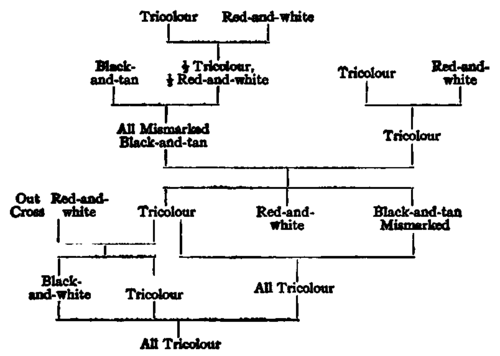
And now I will turn to the practical side of breeding the short-nosed variety. If you wish to breed small specimens, do not breed from very small stock. This may sound absurd, but experience will prove that small bitches are often most unsatisfactory breeders, and that it is not always the smallest sires that get the smallest puppies. Smallness must not be attained by defective growth and a poor constitution, but it must be bona fide smallness. The best plan is to get a bitch which has large litters. If you get a litter of five puppies you are far more likely to get small ones than with a litter of one or two. Very small bitches usually do not breed at all. It is either impossible to get them served or if served they are barren. Should they prove in whelp the chances are there is only one puppy, which, having absorbed all the nutriment to itself, is unduly large and the bitch dies whelping. When a breeder has had the distressing experience of seeing his bitch die in this way, he will not be anxious to renew the experiment.
I have had three exceptions to this rule, and, of course, when one does find it, nothing could be better.
Continue to:


My Books

