


Medical Notes
Description
This section is from the book "Toy Dogs And Their Ancestors", by Neville Lytton. Also available from Amazon: Toy Dogs And Their Ancestors: Including The History And Management Of Toy Spaniels, Pekingese, Japanese, And Pomeranians.
Medical Notes
Clinical thermometers for dogs can be had from Sherley & Co. A dog's normal temperature under the arm or thigh is just over 100°. In the rectum it is ioi° to 101 1/2°. 103° is fever, 105° is very high fever.
Normal respiration is 25 to 30 a minute.
Normal pulse of a Toy dog is about 90 to the minute. The pulse is always somewhat intermittent. 150 is very quick, 70 to 60 is very slow.
Extreme restlessness, when a dog keeps getting up and lying down, or sitting hunched up, or standing with his back arched, is a sign of pain. Many owners do not notice when their dogs are ill till the mischief is far advanced. If a dog won't eat, or seems unexpectedly dull and sleepy, moves languidly or is anxious and restless, there is something wrong. I can always tell when the least thing is wrong with a dog by the expression of the face. It gets a pinched, rather drawn look, and the muzzle appears narrower than usual. Pretty dogs become suddenly plain. After the animal has been asleep you will notice when he lifts his head that the side of his face on which he has been resting remains flattened, and does not recover its usual outline for some minutes. If you have no means of knowing the nature of a case, you can judge the progress and severity of the disease by the "look" of the dog. There is no more reliable guide as to the seriousness of a case than the expression of the dog's face. It will often warn you of complications which the pulse or thermometer would not indicate.
There is a certain look which always means death, but unless it is present, there is still hope, however bad the symptoms and however high the temperature may be.
For fits, give one-quarter of a teaspoonful of bromide of potassium in a little water every two hours. Dogs will stand an enormous quantity of laudanum. Eight drops in a dessertspoonful of lime water is an ordinary dose, but I have known as much as thirty drops to be given to a small unweaned puppy with success. Up to thirty-five and forty drops may be injected with starch into the bowels for a twelve-pound dog in cases of dysentery. To feed a dog by rectum, use a syringe (not one with a glass nozzle, as it is dangerous if it breaks) and inject slowly once every three hours one dessertspoonful of peptonized milk. Meat suppositories may be used as a change. Be careful in filling the syringe not to draw up any air with the food, and before inserting the nozzle oil it with olive oil so that it will pass easily, or you may set up irritation which will prevent the dog from retaining the food.
As soon as the dog can swallow and keep anything down, feed on milk and soda water. For persistent vomiting give one teaspoonful of brandy, one teaspoon-ful of water, and one-half teaspoonful of essence of ginger. Half of this makes one dose. Do not let a dog drink when he is sick. He always wants to, and it always makes him worse. Let him lick ice. A teaspoonful of Pond's Extract also succeeds very well in sickness.
Ergot of rye is dangerous in my opinion for Toy Spaniels, as it is inclined to set up sickness which is often fatal in whelping cases. For an emetic, give one-sixth grain of tartar emetic, or, if not available, mustard and water, in proportion of one teaspoonful mustard to a tumbler of water. For strychnine poisoning, give one-twentieth grain of apomorphia in a couple of drops of water injected under the skin, or double the dose in half a teaspoonful of water by mouth, but a dog with strychnine poisoning often cannot swallow. The symptoms of strychnine poisoning are violent convulsions of the body, alternating with fainting fits and severe panting. During the fainting fits, the heart and the breathing appear to stop altogether. Emetics should be tried, and all noises should be avoided, such slamming doors, as they tend to increase the convulsions. If you cannot procure apomorphia in time, give large doses of laudanum.
Doses For Toy Spaniels
Pulsatilla Nigricans, 5 to 10 drops every two to three hours for whelping.
Tincture of Aconite, 3 drops every three hours for distemper, chills and fever.
Glycerine and Carbolic, 15 to 19 drops every four hours.
Brandy, for very quick pulse, 1 teaspoonful or more as required.
Digitalis (2 drachms), Nux Vomica (1 drachm), 1/2 a teaspoonful to a teaspoonful every three or four hours for very slow pulse. (This medicine is only to be used in emergencies.)
Gregory Powder, 1 eggspoonful, given fasting, for internal upsets and biliousness.
Naldires Powders, 1/3 of a powder for an adult and as much as will lie on the extreme point of a penknife for a puppy six weeks old.
Castor Oil, 1 good teaspoonful is a dose, but it is best to give 1/2 teaspoonful of castor oil and 1/2 teaspoonful of olive oil.

The Best Way of Docking Puppies' Tails i, 2. Make a clove hitch with strong surgical silk. 3, 4. Insert puppy's tail in noose.
(When drawn level, a sharp, strong pull across the tail will take the end off without spilling a drop of blood.
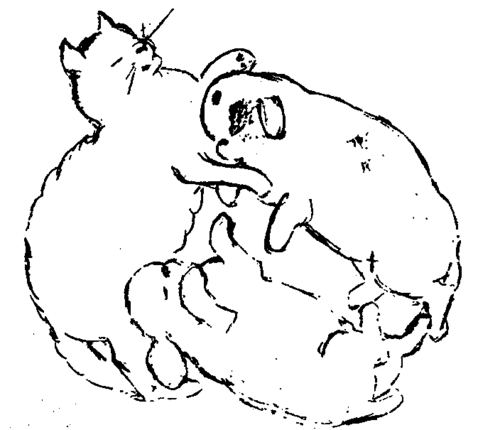
Bird's-eye View of Kitten and Puppies asleep on a Cushion
Often a mild dose of olive oil alone is sufficient, or a banana, which most Toy Spaniels will eat greedily. If the castor oil is too thick and will not run properly, warm the bottle at the fire.
People make a great mistake in giving their dogs constant doses of aperients. Constipation should never be dealt with by drugs, least of all with castor oil, which has the powerful reaction which makes it so useful in cases of diarrhea. Give whole meal bread soaked in gravy and a few green vegetables added to the food. Gingerbread is useful, and much liked. Boiled liver is also a laxative. For stoppage, use injections of warm water with castor oil, one dessertspoonful to one-eighth pint of water.
For rheumatism, cut off meat and sugar and substitute milk, brown bread, biscuits, and a moderate quantity of cheese and vegetables. Do not overfeed.
Continue to:


My Books

