


Hand-Rubbing
Description
This section is from the book "Stable Management And Exercise", by M. Horace Hayes. Also available from Amazon: Stable Management And Exercise.
Hand-Rubbing
In England, the expression "hand-rubbing" is used in almost all cases, only in connection with the legs of a horse. The extension of this process to the body of the animal, in the manner practised in India, would make a great improvement in English grooming. It has the special advantage of being in no way irritating to the skin, and consequently it is seldom resented by a horse. I am of opinion that it is a better stimulant to the skin than any other form of grooming.
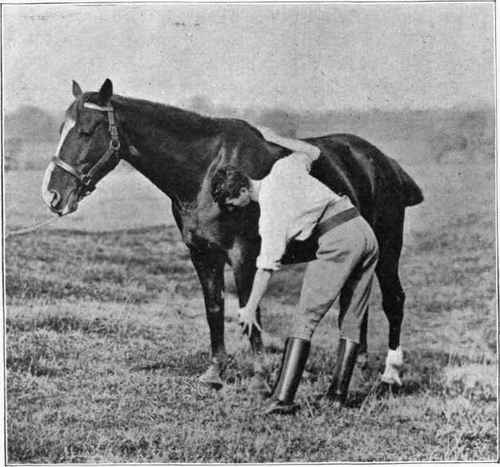
Fig. 53. Hand-rubbing the body.
It is certainly the best means of putting a brilliant gloss on the coat.
In hand-rubbing above the knees and hocks, the stroke should be commenced by bringing the flat of the hand - each hand to be used alternately - well under the belly down the fore-arm (Fig. 53), thigh or gaskin, or between the fore-legs, as the case may be; and it should then be drawn up with an even and firm pressure. As the hand is raised, the elbow should be turned out (Fig. 54), and the under part of the bared fore-arm should be brought into play against the grain of the coat. In doing this, the weight of the body and the strength of the arm should be utilised.
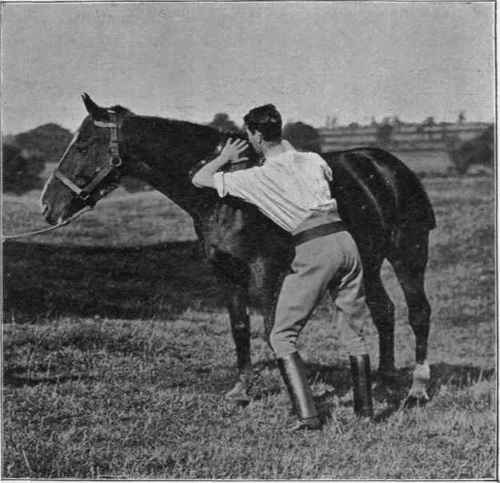
Fig. 54. Hand-rubbing the body.
The usual method adopted for hand-rubbing the legs below the knees and hocks, is to kneel down or sit on one's hams (hunkers) by the side of the leg which is to be manipulated, and make alternate strokes downwards, while grasping the leg between the finger and thumb. When on the near side, the left hand is naturally placed on the front of the leg, and the right on the back of the leg. On the off-side, the position of the hands is of course reversed. The pressure exerted by the hands should be firm, but by no means irritating. The skin at the back of the pasterns should be well rubbed, so as to render it as dry and pliable as possible.
Hand-rubbing the legs is a beneficial practice with the generality of stabled horses. It prevents stagnation of blood in the legs and feet; by the pressure exerted, it promotes the absorption of any effusions that may be present about the back tendons and suspensory ligaments; and it helps to guard the skin against "cracked heels" and "mud fever." Although this ordinary hand-rubbing is sufficient for grooming purposes, it is not nearly so effective in cases of sprain as the method of hand-rubbing from the fetlock upwards, while the limb is held up off the ground. That variety of massage, which I have described in Veterinary Notes for Horse-Owners, is not of such easy application as the more common form of hand-rubbing.
Hand-rubbing the body helps to keep the coat short, which desirable effect is increased by damping the palms of the hands with water. If this be done when hand-rubbing the legs, or if the legs be wet when hand-rubbed, their appearance, in the case of well-bred horses, is apt to be spoiled by patches of hair being removed, owing to the moisture loosening the hair. Hence the hair and hands should be kept dry when the legs are hand-rubbed, unless we want to diminish the amount of hair.
Continue to:


My Books

