


Head Collars
Description
This section is from the book "Stable Management And Exercise", by M. Horace Hayes. Also available from Amazon: Stable Management And Exercise.
Head Collars
An ordinary head collar (Fig. 38) consists of a noseband, two cheek pieces, a throat-latch, a forehead-band (front), an under piece which connects the nose-band and throat-latch together, and a crown-piece which is provided with a buckle, so that it can be lengthened or shortened. The nose-band is divided into three parts, which are connected together by rings that are made square, so as to give rigidity to the nose-band. The ring of the nose-band which is underneath the horse's lower jaw, serves as an attachment for the tying-up chain, rack-chain, or leading rein. The under strap is fixed to the lower ring of the nose-band, and its upper end is provided with a loop, through which the throat-latch slides. The throat-latch is generally made round.
The best head-collars are of leather; and cheap ones, of webbing. For stable use, leather head-collars are almost always made of brown leather, except the forehead-band, which may be of pipe-clayed buckskin or patent leather, either white or coloured. The use of pipe-clayed buckskin fronts is generally reserved for horse - show purposes, and is then as a rule limited to hackneys and cart horses. Patent leather does not wear well, as it is liable to crack.
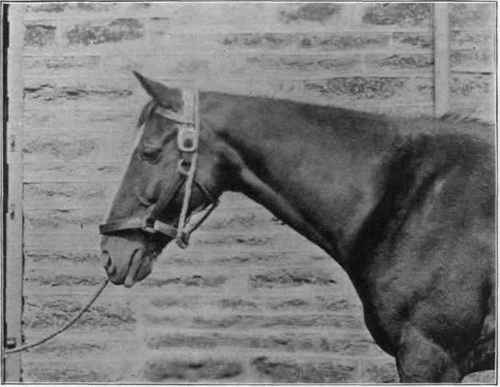
Fig. 38. Manner in which a horse slips his head-collar.
It is evident that the ring formed by the crown-piece and the throat-latch is greater when the forehead-band is employed (Fig. 38) than when it is absent, and when this leather ring is placed more or less at right angles to the horse's neck (Fig. 39), supposing that this leather ring is equally tight in both instances. Hence, removing the forehead-band, drawing back the crown-piece, and tightening it a few holes, is an effective means for preventing a horse from "slipping his head-collar," which is a trick that some horses are much addicted to. This device has the disadvantage that its adoption causes the mane to become worn at the spot over which the crown strap of the head-collar passes. A more elaborate plan of checking the practice of head-collar slipping is to provide the head-collar with a separate throat-latch, which is passed through the rear loop of a strap that is about 4 inches long, and has a loop at its front end for the crown-piece (Fig. 40). Fig. 41 shows another variety of a head-collar with a separate throat-latch.
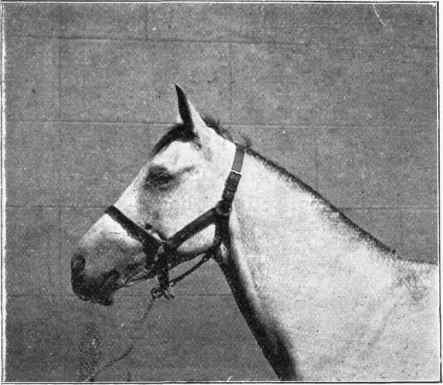
Fig. 39. Head-collar without a front.
Although horses addicted to head-collar slipping are very artful in avoiding observation when they are putting their favourite trick into practice, I have succeeded on different occasions in seeing how it is done, and have found that the horse pulled the crown-piece over his poll by means of his tying-up chain or tying-up rope, which, as a preliminary movement, he got over his neck (Fig. 38).
Fig. 42 shows a head-collar which can be easily slipped on and off, and which is consequently suitable for young animals.
Continue to:


My Books

