


Doors
Description
This section is from the book "The Stable Book: Being A Treatise On The Management Of Horses", by John Stewart. Also available from Amazon: The Stable Book.
Doors
A stable should have only one door. [This is not enough. They should have a door at each end, for the ake of a draught of air when necessary. The stables are much drier for such an arrangement, and more healthy.] It may be placed either at the middle or at the extremity of the gangway. It is most convenient at one end of the stable, affording a direct and easy passage out and in. The entrance should be eight, or eight and a half feet high, and five wide Accidents often happen from having it too low and too narrow. Three feet six inches is the usual width of a stable doorway; a few are four feet wide. There is seldom anything to prevent it from being five, and this width is the best. No care is necessary in taking the horse through. Passing through a narrow doorway, the careless or drunken driver is almost sure to bruise the horse's haunches.
The door-sole should be about three inches above the outer surface, bevelled and grooved. The door itself should be in two or three pieces. It is sometimes cut into four; but one longitudinal section down its middle, and another across one of the halves, are sufficient. One half or three fourths can thus be open or shut according to circumstances. Sometimes the door is divided into two by a transverse section, the lower half of which is usually closed when the groom is performing his stable operations. Whichever way it be divided, it ought to be so hung that it will be out of the way when open; it should swing back of its own accord, and remain unheld; Bel it may have a spring or a catch for retaining it in place, lest it be caught by some part of the harness when the horse is going out or in. This often happens, and sometimes gives the horse such a fright or injury, that he learns the dangerous habit of leaping through the doorway. A self-acting spring can be depended on more than a servant. The doors usually open inward. The bolts should be of wood, and the key and the latch sunk flush with the door. The posts should be rounded. In some stables the middle of the door-post is made to revolve, so that it may turn when struck by the haunches.
This is a useless refinement; it never turns by a blow, though it might if the horse were rubbing against it. Wider doorways, against which there can be no objections, render contrivances of this kind unnecessary. If there were any chance of injury to a valuable horse, the door-posts might be covered with a pad or cushion composed of hay or straw and gardener's matting.
Windows are sadly neglected. They are often too few, too small, or ill placed, even in stables of high pretensions In very many stables, particularly those appropriated to farm-horses there are no windows, nor any apology for them.
The best lighted stables I have ever seen, are those belonging to Mr. Lyon of Glasgow (Fig. 1). They are lighted from the roof.
Fig. 1.
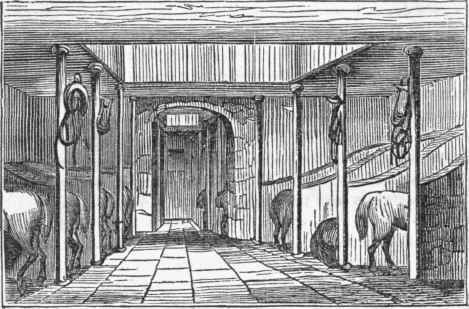
Each contains sixteen horses. The hay-lofts are over the stable. Light is conducted through the lofts to each stable by two wooden tunnels, which are covered by large windows. Mr. Laing's sale stable at Edinburgh is also lighted from the roof. When the hay-loft is above the stables, the windows very much diminish its size. That is the only objection to sky-lights. In single-headed stables side-windows answer quite as well, when properly placed, and of sufficient size. But in double-headed stables it is difficult to place them in such a manner that the light shall not fall directly upon the horses' eyes. To be safe, and out of the way, they must be high in the wall; and, to give sufficient light, they must be numerous, and ranged along each side. This can seldom be managed; indeed it is seldom attempted. Most people seem to think that light is little wanted in a stable; and, truly, after all the horses have become blind for want of it, there is not so much need for windows. There is in general some kind of apology for a window. There may be a pane or two of glass above the door, or a hole at one end of the stable. When the man is working, he has light enough from the door, and the horses have the benefit of that. Besides, it is said horses do not require light.
They thrive best in the dark!
From these and similar abuses, innovation always meets with some resistance. Some miserable plea is offered in favor of an old usage, merely to avoid open conviction of ignorance. Dark stables were introduced, not because men thought them the best but because they had no inclination to purchase light, or because they thought the horse had no use for it.
A horse was never known to thrive better for being kept in a dark stable. The dealer may hide his horse in darkness, and perhaps he may believe that they fatten sooner there than in the light of day. But he might as well tell the truth at once, and say that he wants to keep them out of sight till they are ready for the market. When a horse is brought from a dark stable to the open air he sees very indistinctly; he stares about him, and carries his head high, and he steps high. The horse looks as if he had a good deal of action and animation. Dark stables may thus suit the purposes of dealers, but they are certainly not the most suitable for horses. They are said to injure the eyes. There is not perhaps another animal on the earth so liable to blindness as the horse. It can not be said with certainty that darkness is the cause; but it is well known that the eyes suffer most frequently where there is no light.
Whether a dark stable be pernicious to the eyes or not, it is always a bad stable. It has too many invisible holes and corners about it ever to be thoroughly cleaned. The gloomy dungeons in which coach and boat horses are so often immured, are always foul. The horses are attended by men who will not do their duty if they can neglect it. The dung and the urine lie rotting for weeks together, and contaminating the air till it is unfit for use. The horses are never properly groomed. They can not be seen. One may fall lame, another sick, and no one know anything about them till they are brought to the door to commence a journey. Accidents, choking, getting cast in the stall, tearing open a vein and such like, sometimes happen when the horse's life may depend upon immediate assistance, which can not be rendered in the dark, or which darkness may conceal till assistance is too late. I speak not of what might occur, but of that which is common.
All these things considered, it is evident that the stable ought to be well lighted, and that the expense attending it is a prudent outlay. When side-windows can not be conveniently introduced, a portion of the hay-loft must be sacrificed, and light obtained from the roof. This in ordinary cases will not be greatly missed. Let it be well done if done at all. It is almost as expensive to put in a small window as a large one; and I believe it is more expensive to light a double-headed stable properly from the sides than from the roof. When the stalls are all on one side the case is different, especially if the back wall be unconnected with any other building. Windows above the horses' head generally light the wrong side of the stable, and those at the ends can hardly be made to light more than one or two stalls.
Continue to:


My Books

