


Over-Reaching
Description
This section is from the book "The Stable Book: Being A Treatise On The Management Of Horses", by John Stewart. Also available from Amazon: The Stable Book.
Over-Reaching
The heel and the pastern are sometimes struck by the hind-foot. Most frequently it is the heel, just where the hoof joins the skin. It happens only in fast paces in leaping, or galloping over deep ground. Horses with short backs are most liable. A semicircular wound is made; the skin is raised like, a flap, which folds backward and downward, never upward nor forward. People imagine that this is done by the toe of the shoe, but the shape of the wound shows that it is inflicted by the edge on the inner circumference of the shoe: it is done as the hind-foot is drawn back. Sometimes a portion of the skin is scooped quite out.
This accident is easily prevented, by cutting away the edge of the shoe, as shown in Fig. 20, A. But the proper shoe for the hind-foot of hunters ought to present a half-round surface to the ground, similar to that shown in Fig. 21.
Fig. 20.
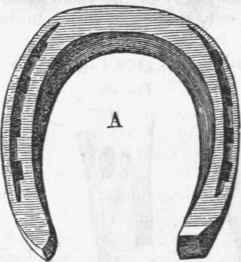

B, represents the ordinary shoe, having the sharp edge, which cuts the heel in over-reaching.
There is a kind of over-reaching, which is termed forging or clicking. In trotting, the horse strikes the middle of the fore-shoe with the toe of the hind one. The noise can be prevented by allowing the toe of the hoof to overhang the shoe a little, but there are no means of preventing the blow unless the horse can be made to alter his pace, by Keeping his head well up.
Fig. 21.

The fore-shoes of clicking horses should be short and having the web broad. When too long, they are apt to be torn off; when too narrow, the hind-foot bruises the sole of the fore one, and may be locked fast between the breaches of the shoe. Hunters, however, must have the web narrow, for a broad shoe makes them slip on tough ground. It must be so narrow that it will not catch the hind foot.
Continue to:


My Books

