


Partitions Between The Horses
Description
This section is from the book "The Stable Book: Being A Treatise On The Management Of Horses", by John Stewart. Also available from Amazon: The Stable Book.
Partitions Between The Horses
In some parts of England horses are permitted to stand two and two, without any partition between them. This rarely happens in .Scotland. He is "poor indeed" who can not afford a stall to each horse. When two are standing together, the one is always doing the other some mischief, either accidentally or intentionally. The strongest robs the weakest both of his food and of his rest; while one is lying the other will trample or lie down on his companion; and mares, while standing double, seldom or never urinate till one is removed. Two that have toiled together for many a day, have fed from the same manger, and crouched under the lash of the same driver, are generally good friends, forbearing, and sympathizing. Still accidents will happen in the dark, or when strangers are put together, or one will fall off, become dull or irritable when separated from an old companion. Each ought to have a stall to himself. Cows do well enough in pairs, or in rows without any separation. But they have no work demanding full and uninterrupted repose.
They lie straight, upon their breast, with their legs bent under them; not like the horse, who seeks repose in various positions, often lying on his side with his legs stretched, and his body across the stall, keeping his neighbor standing, lest he should do an injury in lying down.
Separation is effected by means of standing bales, gangway bales, and travises. The latter form the best, the most complete partition, but in certain situations bales are to be preferred.
Standing Bales are round bars or posts of wood, about three-inches in diameter, and eight feet long. Each extremity is furnished with a few iron links, by which the bale is suspended to the head and to the heel-posts.
Sometimes the bales are of cast-iron. They are more durable, but they are costly, easily broken, and apt to do injury when they chance to fall upon a horse's legs or back. Well-seasoned oak forms a bale of sufficient durability. Two or three of cast-iron may be kept and placed beside those horses that are much disposed to bite and destroy the wooden bale.
Fig 5.

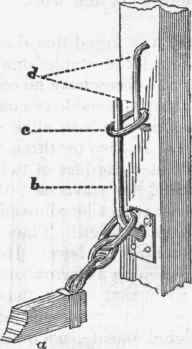
One is placed between each pair of horses. It should be three feet or three feet and a half from the ground. The suspending chains should be about three or four inches long, so that the bale may yield as the horse comes against it in turning round. Bales are employed in almost all the cavalry stables. There, they are furnished with a contrivance which merits notice. It prevents accidents, which are very common in baled stables. The extremity next the manger is not, or need not, be removable; the other, next the heel-post, is attached in such a way that when a horse gets under the bale, and attempts to rise, he pushes it upward, and it loses its connexion with the post; or when he happens to cast his leg over the bale, it can instantly be lowered to the ground without lifting the horse.
Fig. 4 represents the means by which this is effected; a is the bale; b a curved bolt by which it is attached to the post. This turns round upon the post, like the hand of a clock. It is retained in its usual place by the ring c, which slides upon the bracket d. When the bale is to be let down, the ring is raised, and the bolt b turns and frees the bale. The engraving, Fig. 3, shows the manner in which the bale is released when a horse gets under it. An iron bale, when thrown off in this way, is likely to be broken, or to injure the next horse. This engraving, I may mention, was taken from one of the cavalry stables at Glasgow barracks.
Fig. 4.
Continue to:


My Books

