


Stepping Over The Halter-Rein
Description
This section is from the book "The Stable Book: Being A Treatise On The Management Of Horses", by John Stewart. Also available from Amazon: The Stable Book.
Stepping Over The Halter-Rein
This and the last-mentioned accident arise from the same cause. The binding is too long, or tied to the ring unloaded by the sinker, and the horse is apt to get his fore-feet over it. If he be a steady pacific animal, no harm will be done; he will wait for assis tance. But a troublesome or timid horse often injures him self. By attending to the length of the rein, and to the mode of securing it, this accident need never happen. A liberating ring, however, has been invented, and is used in some places to guard against it.
Fig. 14.
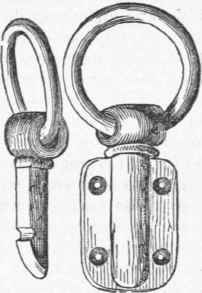
The ring, made of malleable iron, is attached to a cast-iron bolt, which slides into a socket of the same material, and is retained by a spring. This socket is fixed to the manger, with its open end down. As long as the ring is pulled up or back, it remains fast; but when pulled downward, it comes away, and the horse is free. This is useful where the manger is too low, and can not be raised, but it gives little security against halter-casting. When the hind-foot gets over the rein, the strain is rather downward, but chiefly backward; and a back pull will not free the ring. Still it may possibly be drawn out in the horse's struggles. The bolt should be pulled out occasionally and oiled, that it may not rust, and stick too firmly in the socket.
Continue to:


My Books

