


14. - Architecture In Italy
Description
This section is from the book "The American House Carpenter", by R. G. Hatfield. Also available from Amazon: The American House Carpenter.
14. - Architecture In Italy
In the 14th and 15th centuries, architecture in Italy was greatly revived. The masters began to study the remains of ancient Roman edifices; and many splendid buildings were erected, which displayed a purer taste in the science. Among others, St. Peter's of' Rome, which was built about this time, is a lasting monument of the architectural skill of the age. Giocondo, Michael Angelo, Palladio, Vignola, and other celebrated architects, each in their turn, did much to restore the art to its
former excellence. In the edifices which were erected under their direction, however, it is plainly to be seen that they studied not from the pure models of Greece, but from the remains of the deteriorated architecture of Rome. The high pedestal, the coupled columns, the rounded pediment, the many curved-and-twisted enrichments, and the convex frieze, were unknown to pure Grecian architecture. Yet their efforts were serviceable in correcting, to a good degree, the very impure taste that had prevailed since the overthrow of the Roman empire.
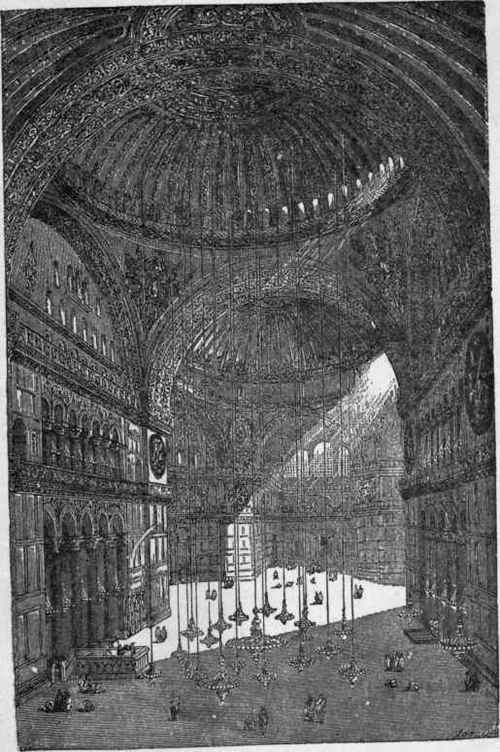
Interior Of St. Sophia, Constantinople.
Origin Of Styles
Continue to:


My Books

