


Problem II. To Draw A Right Line Between Two Given Points
Description
This section is from the "The elements of drawing & the elements of perspective" book, by J. M. Dent & Sons. Also see Amazon: The Elements Of Drawing & The Elements Of Perspective.
Problem II. To Draw A Right Line Between Two Given Points
Let a b, Fig. 6., be the given right line, joining the given points a and B.

Fig. 6.
Let the direct, lateral, and vertical distances of the point A be t d, d c, and c A.
Let the direct, lateral, and vertical distances of the point b be T d', d c', and c' B
Then, by Problem I., the position of the point A on the plane of the picture is a and similarly, the position of the point B on the plane of the picture is b. Join a b. Then a b is the line required.
Corollary I
If the line A B is in a plane parallel to that of the picture, one end of the line A B must be at the same direct distance from the eye of the observer as the other.
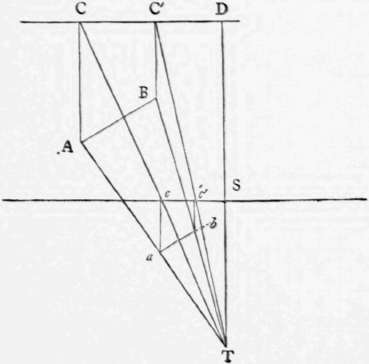
Fig. 7.
Therefore, in that case, D T is equal to D' t.
Then the construction will be as in Fig. 7.; and the student will find experimentally that a b is now parallel to A B.1.And that a b is to a b as t s is to t d.
Therefore, to draw any line in a plane parallel to that of the picture, we have only to fix the position of one of its extremities, a or b, and then to draw from a or b a. line parallel to the given line, bearing the proportion to it that T s bears to T D.
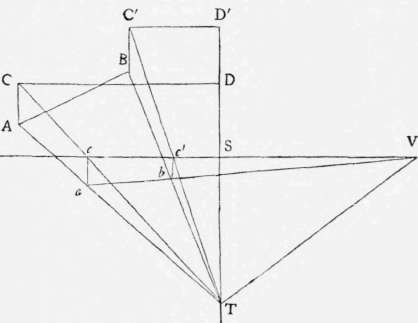
Fig. 8.
Corollary II
If the line A B is in a horizontal plane, the vertical distance of one of its extremities must be the same as that of the other.
Therefore, in that case, A c equals b c' (Fig. 6.).
1 For by the construction A T: a T:: B T: £ T; and therefore the two triangles A B T, a b T, (having a common angle A T b,) are similar.
And the construction is as in Fig. 8.
In Fig. 8. produce a b to the sight-line, cutting the sight-line in v; the point v, thus determined, is called the Vanishing-Point of the line a b.
Join t v. Then the student will find experimentally that T v is parallel to a b.1
Demonstrations Which Could Not Conveniently Be Included In The Text I The Second Corollary, Problem II
In Fig. 8. omit the lines C D, c' D', and D S; and, as here in Fig. 75., from a draw a d parallel to A B, cutting BT in d; and from d draw d e parallel to B C.
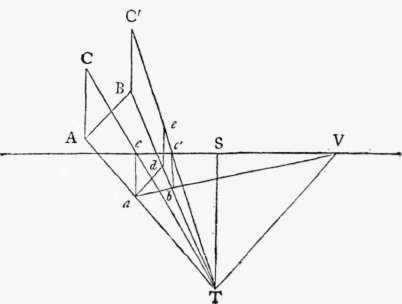
Fig. 75.
Now as a d is parallel to A B AC:a c::B C': d e; but A c is equal to B c' .'. a c - d e.
Now because the triangles a c,V, b c' v, are similar - a c:b c':: a v: b v; and because the triangles d e T, b c' T are similar - d e: b c':: d T: b T. But a c is equal to d e .. a V: b v:: d T: b T,.'. the two triangles a b d, b T v, are similar, and their angles are alternate;
.. T V is parallel to a d. But a d is parallel to A B .. T v is parallel to A B.
Corollary III
If the line A B produced would pass through some point beneath or above the station-point, c d is to d t as c' d' is to d' T; in which case the point c coincides with the point c', and the line a b is vertical.
Therefore every vertical line in a picture is, or may be, the perspective representation of a horizontal one which, produced, would pass beneath the feet or above the head of the spectator.2
1 The demonstration is in Appendix II. Article I.
2 The reflection in water of any luminous point or isolated object (such as the sun or moon) is therefore, in perspective, a vertical line; since such reflection, if produced, would pass under the feet of the spectator. Many artists (Claude among the rest) knowing something of optics, but nothing of perspective, have been led occasionally to draw such reflections towards a point at the centre of the base of the picture.
The Third Corollary
In Fig. 13., since a R is by construction parallel to A B in Fig. 12., and T v is by construction in Problem III. also parallel to A B .', a R is parallel to T v,
.'. a b R and T b v are alternate triangles,.'. a R: T v:: a b: b v. Again, by the construction of Fig. 13., a R' is parallel to M V .'. a b R' and M b V are alternate triangles,
.'. a r': M v:: a b: b V. And it has just been shown that also a R: T v:: a b: b V - .'. a r': M v:: a R: T V. But by construction, a R'= a R .'. M V = T V.
Continue to:


My Books

