


Problem III. To Find The Vanishing-Point Of A Given Horizontal Line
Description
This section is from the "The elements of drawing & the elements of perspective" book, by J. M. Dent & Sons. Also see Amazon: The Elements Of Drawing & The Elements Of Perspective.
Problem III. To Find The Vanishing-Point Of A Given Horizontal Line
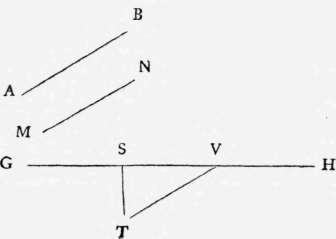
Fig. 9.
Let A b, Fig. 9., be the given line. From T, the station-point, draw t v parallel to A B, cutting the sight-line in v.
v is the Vanishing-point required.1
1 The student will observe, in practice, that, his paper lying flat on the table, he has only to draw the line T V on its horizontal surface, parallel to the given horizontal line A B. In theory, the paper should be vertical, but the station-line s T horizontal (see its definition above, page 214.); in which case T v, being drawn parallel to A B, will be horizontal also, and still cut the sight-line in V.
The construction will be seen to be founded on the second Corollary of the preceding problem.
It is evident that if any other line, as M N in Fig. 9., parallel to A B, occurs in the picture, the line T v, drawn from T, parallel to M N, to find the vanishing-point of m n, will coincide with the line drawn from T, parallel to A b, to find the vanishing-point of A B.
Therefore A B and M N will have the same vanishing-point.
Corollary I
As, if the point b is first found, v may be determined by it, so, if the point v is first found, b may be determined by it.For let A b, Fig. to., be the

Fig 10.
Therefore all parallel horizontal lines have the same vanishing-point.It will be shown hereafter that all parallel inclined lines also have the same vanishing-point; the student may here accept the general conclusion - All barallel lines have the same vanishing point.
It is also evident that if A B is parallel to the plane of the picture, T V must be drawn parallel to G H, and will therefore never cut G H. The line A B has in that case no vanishing-point: it is to be drawn by the construction given in Fig. 7.
It is also evident that if A B is at right angles with the plane of the picture, T v will coincide with T s, and the vanishing-point of A B will be the sight-point given line, constructed upon the paper as in Fig. 8.; and let it be required to draw the line a b without using the point c'.
Find the position of the point A in a. (Problem I.)
Find the vanishing-point of A B in v. (Problem III.)
Join a v.Join B T, cutting a v in b.Then a b is the line required.1
Corollary II
We have hitherto proceeded on the supposition that the given line was small enough, and near

Fig. ii.
1 I spare the student the formality of the reductio ad absurdum, which would be necessary to prove this enough, to be actually drawn on our paper of its real size; as in the example given in Appendix I. We may, however, now deduce a construction available under all circumstances, whatever may be the distance and length of the line given.
From Fig. 8. remove, for the sake of clearness, the lines c' d', b v, and T v; and, taking the figure as here in Fig. II., draw from a, the line a r parallel to A B, cutting B T in R.

Fig. 12.
Then a r is to a b as a t is to A t.as c T is to c T as t s is to T D.
That is to say, a R is the sight-magnitude of A B.1
1 For definition of Sight-Magnitude, see Appendix I. It ought to have been read before the student comes to this problem; but I refer to it in case it has not.
Therefore, when the position of the point A is fixed in a, as in Fig. 12., and a V is drawn to the vanishing-point; if we draw a line a r from a, parallel to A b, and make a r equal to the sight-magnitude of A B, and then join r t, the line r t will cut a v in b.
So that, in order to determine the length of a b, we need not draw the long and distant line A b, but only a r parallel to it, and of its sight-magnitude; which is a great gain, for the line A B may be two miles long, and the line a r perhaps only two inches.
Corollary III
In Fig. 12., altering its proportions a little for the sake of clearness, and putting it as here in Fig. 13., draw a horizontal line a r' and make a r' equal to a R.

Fig. 13.
Through the points r' and b draw r' m, cutting the sight-line in M. Join T v. Now the reader will find experimentally that v M is equal to v t.1
1 The demonstration is in Appendix II. Article II. p. 303.
Hence it follows that, if from the vanishing-point v we lay off on the sight-line a distance, v m, equal to v T; then chaw through a a horizontal line a r', make a r' equal to the sight-magnitude of A B, and join r' m; the line r' m will cut a v in b. And this is in practice generally the most convenient way of obtaining the length of a b.
Corollary IV
Removing from the preceding figure the unnecessary lines, and retaining only r' m and a v, as in Fig. 14., produce the line a r' to the other side of a, and make a x equal to a r.
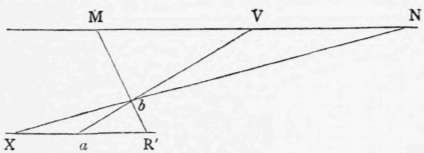
Fig. 14.
Join x b, and produce x b to cut the line of sight in N.
Then as x r' is parallel to m n, and a r' is equal to a x, v N must, by similar triangles, be equal to V M (equal to v T in Fig. 13.).
Therefore, on whichever side of v we measure the distance v t, so as to obtain either the point M, or the point N, if we measure the sight-magnitude a r' or a x on the opposite side of the line a v, the line joining r' m or x n will equally cut a v in b.
The points m and n are called the Dividing-Points of the original line a b (Fig. 12.), and we resume the results of these corollaries in the following three problems.
Problem IV. To Find The Dividing-Points Of A Given Horizontal Line
Let the horizontal line a b (Fig. 15.) be given in position and magnitude. It is required to find its dividing-points.
Find the vanishing-point v of the line a b.
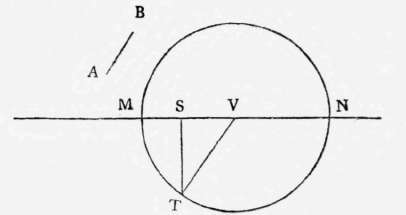
Fig. 15.
With centre v and distance v T, describe circle cutting the sight-line in M and N.
Then M and N are the dividing-points required.
In general, only one dividing-point is needed for use with any vanishing-point, namely, the one nearest s (in this case the point m). But its opposite N, or both, may be needed under certain circumstances.
Continue to:


My Books

