


Problem V. To Draw A Horizontal Line, Given In Position And Magnitude, By Means Of Its Sight-Magnitude And Dividing-Points
Description
This section is from the "The elements of drawing & the elements of perspective" book, by J. M. Dent & Sons. Also see Amazon: The Elements Of Drawing & The Elements Of Perspective.
Problem V. To Draw A Horizontal Line, Given In Position And Magnitude, By Means Of Its Sight-Magnitude And Dividing-Points
Let a b (Fig. 16.) be the given line. Find the position of the point A in a.
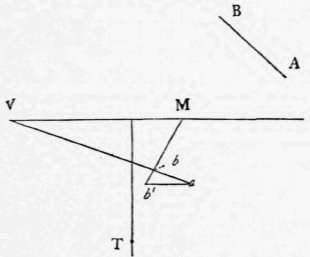
Fig. 16.
Find the vanishing-point v, and most convenient dividing-point M, of the line A B.
Join a v.
Through a draw a horizontal line a b' and make a b' equal to the sight-magnitude of A B. Join b' m, cutting a v in b.
Then a b is the line required.
Corollary 1
Supposing it were now required to draw a line A C (Fig. 17.) twice as long as a b, it is evident that the sight-magnitude a c' must be twice as long as the sight-magnitude a b'; we have, therefore, merely to continue the horizontal line a b', make b' c' equal to a b', join c' m, cutting a v in c, and a c will be the line required. Similarly, if we have to draw a line A d, three times the length of A B, a d' must be three times the length of a b', and, joining d' M, a d will be the line required.

Fig. 17.
The student will observe that the nearer the portions cut off, bc, cd, c, approach the point v, the smaller they become; and, whatever lengths may be added to the line A D, and successively cut off from a v, the line a v will never be cut off entirely, but the portions cut off will become infinitely small, and apparently vanish as they approach the point v; hence this point is called the vanishing point.
Corollary II
It is evident that if the line a d had been given originally, and we had been required to draw it, and divide it into three equal parts, we should have had only to divide its sight-magnitude, a d', into the three equal parts, a b', b' c', and c d', and then, drawing to m from b' and c', the line a d would have been divided as required in b and c. And supposing the original line A D be divided irregularly into any number of parts, if the line a d' be divided into a similar number in the same proportions (by the construction given in Appendix L), and, from these points of division, lines are drawn to m, they will divide the line a d in true perspective into a similar number of proportionate parts.
The horizontal line drawn through a, on which the sight-magnitudes are measured, is called the Measuring-line.And the line a d, when properly divided in b and c, or any other required points, is said to be divided in perspective ratio to the divisions of the original line A d.
If the line a v is above the sight-line instead of beneath it, the measuring-line is to be drawn above also: and the lines b' m, c M, c, drawn down to the dividing-point. Turn Fig. 17. upside down, and it will show the construction.
Problem VI. To Draw Any Triangle, Given In Position And Magnitude, In A Horizontal Plane
Let a b c (Fig-. 18.) be the triangle. As it is given in position and magnitude, one of its sides, at least, must be given in position and magnitude, and the directions of the two other sides

Fig. 18.
Let a b be the side given in position and magnitude.
Then A B is a horizontal line, in a given position, and of a given length.
Draw the line A B.(Problem V.)
Let a b be the line so drawn.
Find v and v', the vanishing-points respectively of the lines a c and b c.
From a draw a v, and from b, draw b V, cutting each other in c.
Then a b c is the triangle required.
If A c is the line originally given, a c is the line which must be first drawn, and the line V b must be drawn from v' to c and produced to cut a b in b. Similarly, if B c is given, v c must be drawn to c and produced, and a b from its vanishing-point to b, and produced to cut a c in a.
Continue to:


My Books

