


Waste Paper Basket No. II
Description
This section is from the book "Busy Hands: Construction Work For Children", by Isabelle F. Bowker. Also available from Amazon: Busy Hands: Construction Work for Children.
Waste Paper Basket No. II
Material: A piece of board 1/4 in. x 3 1/2 in. x 6 in.; one pound of white raffia; one-half pound of green raffia; one spool of wire 1/8 inch thick; a darning needle; scissors, a nail and a hammer.

Fig1

Round the four corners of the board.
With the nail and hammer make a row of holes around the board 1/4 inch from the edge.
Arrange them so that one comes in each corner, and so there is about 3/4 inch between the holes. (Fig. 1.)
Take a bunch of white raffia 1/4 inch thick.
Thread the needle with green, and wind the ends of the little bunch of white with the green raffia.
Place the raffia against the edge of the board at one of the corners, and sew through the hole in the corner of the board with the green. (Fig. 2.)
Sew over and over the white raffia until the next hole is reached, then sew through the hole.
Sew the green over and over the white raffia until opposite the third hole, then sew through the third hole.
Continue sewing through the holes as they are reached.
When the piece of green has been used until only four inches remain, let it mix with the "tails." (a, Fig. 3.)


Thread the needle with green, and lay the end of the piece in with the tails.
About three inches from the end hold the piece of green raffia firmly to the white "tails." (x, Fig. 3.)
Continue to sew the green raffia over the white, and through the holes as the work reaches them.
When the "tails" get thin, add a piece of white raffia every few stitches so that the bunch is always 1/4 inch thick.
To add a "tail," just hold the end of a piece of white raffia firmly to the bunch until the green is sewed over it.
Fasten the second row to the first by sewing over the first row every fourth stitch, that is, sew the green raffia around the white four times, then put the needle between the board and the first row. This will make a long stitch passing over the outside of the two rows. (A-B-C, Fig. 4.)
To make the little knot in the stitch, bring the needle d between the board and the first row, then put the needle between the first and second hows just behind the stitch. (D, Fig. 4.) Sew the green raffia over the top of stitch D. Put the needle between the first and second rows again, and bring it down behind the second row.
Continue to sew around the second row, making every fourth stitch a knotted one.
Make seven rows of green, each row a little larger than the one before it.
To make a row larger than those before, put more stitches between the knotted stitches, and more stitches on the corners.
When the fourth row is reached, put a piece of wire in with the "tails" for the remaining three rows. This strengthens the stand. (Fig. 5.)
Let the "tails" grow very thin near the end of the seventh row, or cut them diagonally across.
Fasten the last of the seventh row to the sixth row by sewing the green raffia over and over many times.
When finished, the stand should look like a solid green band 1 3/4 inch wide.
The method of work in the upper part of the basket is just like that in the stand.
Take another bunch of white raffia 1/4 inch thick.
Sew it over and over with white, and make every fourth stitch a knotted stitch.
Start the white row from the same corner from which the stand was started.
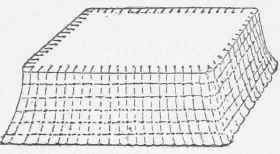
Fig 5

Fig 6
Fasten the white row to the first green row.
Let the basket grow larger as it is worked upward. Following is the order of the rows, their color, and the size the basket should be at each green row:
One white row.
One green row.
Two white rows.
One green row - 10 1/2 inches around.
Three white rows.
One green row - 15 inches around.
Four white rows.
One green row - 31 inches around.
Five white rows.
One green row - 35 1/4 inches around.
Six white rows.
One green row - 39 inches around.
Seven white rows.
The next is a broken green row, and is the beginning of the design at the top of the basket. (Fig. 6.)
Beginning at the corner with the row just above the seven white rows, make two inches of the row white.
Thread the needle with green and make seven inches of the row green.
This strip of green should come in the middle of the narrow side of the basket (A-B, Fig. 6).
Make two inches of white next to the seven inches of green.
This strip of white should come across the corner, one inch of the white strip showing on the narrow side of the basket, and one inch showing on the broad side of the basket.
Next to the two inches of white comes four inches of green. Then:
Two inches white (middle of broad side).
Four inches green.
Two inches white (corner).
Seven inches green (narrow side).
Two inches white (corner).
Four inches green (x-y, Fig. 6).
Two inches white (y-t, Fig. 6).
Four inches green (t-e, Fig. 6).
The next two rows are white except the few stitches of green put in to outline the figures like y-m-s-t, Fig. 6.
The base of the figures like d-g-h-r, Fig. 6, must be worked in the next row.
In the sixth row above the row which was the beginning of the border, work in the tops of the figures like y-m-s-t, Fig. 6. That is, use green to work in the line m-s, for each one of the figures.
The next two rows are white except where green is needed to complete the figures like d-g-h-r.
The last row is solid green all the way around. This row completes the border, which is in all ten rows wide.
Slant off and fasten the last row as was done with the last row of the stand. The last three rows should be wired.
Handles Of wire make two triangles having a 7-inch base and a 4-inch altitude.
Take sufficient white raffia to make the handles 1/4 inch thick.
Cover the wire and white raffia with green.
Sew the handles to the middle of each narrow side.
They should hang from the green stripe a-b to the fifth green stripe.
To make the handles hang exactly even, sew one to the line a-b, and the other to the white stripe just below the row of which a-b is a part.
Continue to:


My Books

