


Drawing. Continued
Description
This section is from the book "Arts And Crafts In The Elementary School", by Joan Dean. Also available from Amazon: Arts And Crafts In The Elementary School.
Drawing. Continued
It should be remembered in doing this sort of work that children develop at different rates and there may be some in the class who are still at the stage of making two circles represent a figure. These children may get nothing of value from this work—on the other hand, it might well be the starting point of a new development in their work. If they are not ready for it, they will produce their standard type of figure symbol, regardless of the pose.
What about perspective? Sometimes I wish it had never been discovered, for children often make it their master instead of their servant. Like local colour, perspective is something to be forgotten when the needs of the picture demand it. There are, however, some people whose work seems to demand correct perspective. Others are much better off left to their own devices, and their incorrect perspective is much more personal and delightful than the correct version would be.
In general, Junior children are not aware of a third dimension and need no knowledge of perspective. Just occasionally, however, one meets an individual child whose work needs this knowledge. He will generally be asking questions about "Why doesn't this look right?" For this child I think some individual teaching about perspective is necessary, providing that he has a good background of experimenting with various media and a fairly developed personal way of working. I find the following knowledge sufficient for my own work. It will certainly be sufficient for the demands of children. Wherever possible it should result from the child's own observation.
Perspective is a way of representing on paper what happens to things when they get farther away from you. The simplest case is that of the road or railway. Here, lines which are parallel in fact get closer and closer together when drawn and eventually meet at the same point (see diagram below).

Street showing parallel lines converging to a centre vanishing point
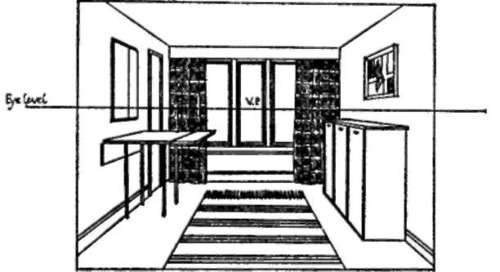
Room showing parallel lines converging to a centre vanishing point
When you have a drawing of a house or room, however, you have several sets of lines, parallel to each other. Each set will meet at a point. All these meeting or vanishing points will be at your eye level, which can be represented by a line drawn across the paper. However many sets of parallel lines there are they will all have vanishing points (meeting points) on the eye level (see diagrams below and on page 148). Uprights will remain upright.
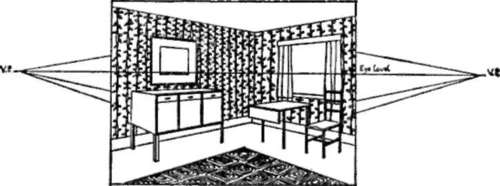
Room interior showing parallel lines converging to two vanishing points
Whatever you do in the way of drawing with children, it is absolutely essential to remember that this is a personal form of expression. Each drawing should be quite different from all the rest and personal to its owner. It is a good idea to remember, for yourself as well as for the children, that if you say anything convincingly enough, it will be accepted. If you draw with conviction, you will get by with some extraordinary pieces of drawing—look through any magazine today, and you will see that much of present-day illustration depends for its appeal on its conviction and personality, not on realistic drawing. Uncertain drawing always looks uncertain. Draw as if you mean it.

House exterior showing parallel lines going to two vanishing points.
Continue to:


My Books

