


Chapter Eighteen. Drawing
Description
This section is from the book "Arts And Crafts In The Elementary School", by Joan Dean. Also available from Amazon: Arts And Crafts In The Elementary School.
Chapter Eighteen. Drawing
What are we going to teach children about the techniques of drawing and about the representation of reality on paper? Arc we going to encourage them to draw from life, or are we not?
These have always been vexed questions. It is obvious that teaching of drawing as such, cannot possibly take place until a child reaches the stage of drawing from observation. After that I think it has a place—with lots of reservations. The reservations arc tied up with the individual children and with the nature of drawing. Very occasionally one meets someone with an outstanding visual imagination, a person full of original ideas of shapes and ways of drawing. His work stands out for its personal qualities from the beginning. It couldn't possibly be the work of anyone else. Such a child may possibly gain little from drawing from observation. His work may even lose a little of its personal quality when he attempts this. I have met few such children, however. The majority need food for their imagination, and one of the kinds of food which most find useful is drawing from observation.
It should be stated at the beginning that there is no "right" way of drawing a tree or a person or a house. Each person sees an object with different emotions and associations. Each person moves differently and so achieves a quite different set of marks on the paper from every other. Everyone, in fact, draws differently from everyone else. I feel very strongly that a teacher should avoid drawing on a child's work, because his or her way of drawing will be quite different from that of the child. If I am forced into explaining something in terms of drawing, I do it on a scrap of paper. In copying it, if this is what is needed, the child produces his own version. Drawing can only be learnt through personal observation.
When children reach the stage of drawing from observation they start to ask, "How do I draw this?" "How do I draw that?" and so on. The only real answer to this is, "Go and look." Often, of course, this is not possible. The object wanted is not available, and for this purpose I have many pictures— photographs as far as possible—at which children can look. Whether we are looking at real objects or photographs, I try to find time to discuss with the child concerned the points I know he will need to observe—"Do you see how the branches join on to the trunk?" "Have you noticed what the windows look like?" and so on.
In this way children are constantly adding to the number of things they can draw with knowledge, and constantly being obliged to look more closely.
There is in some schools an extraordinary idea that all drawing should be "out of your head". This idea seems to me to be great nonsense. It is true that the drawings of young children do, in fact, "come out of their heads", but when children reach the stage of using detailed observation in their drawings, then they require constant feeding with facts about the appearance of things. In any case, no artist or illustrator works continually "out of his head". Look at the hundreds of studies for paintings made by the great masters of the past. If top Juniors are encouraged to find references for the things they find difficult to draw in a picture, their work will improve enormously. I think it is important that the picture be planned first, however, and the reference material then used to help with one particular part. This also turns to practical use the love of copying which one finds in some children. It can be a barren sort of occupation, but allied to picture-making, by using pictures copied as reference material for a small part of a picture, it can be very useful, helping children to build up a vocabulary of things they can draw. It is much better to work from photographs than from drawings, however, because in a drawing the personality of the artist and his methods of representing reality tend to obtrude.

11-year-old. A picture which was started outside and finished in the classroom (Chapter 18)

11-year-old. A picture based on sketch-book studies (Chapter 18)
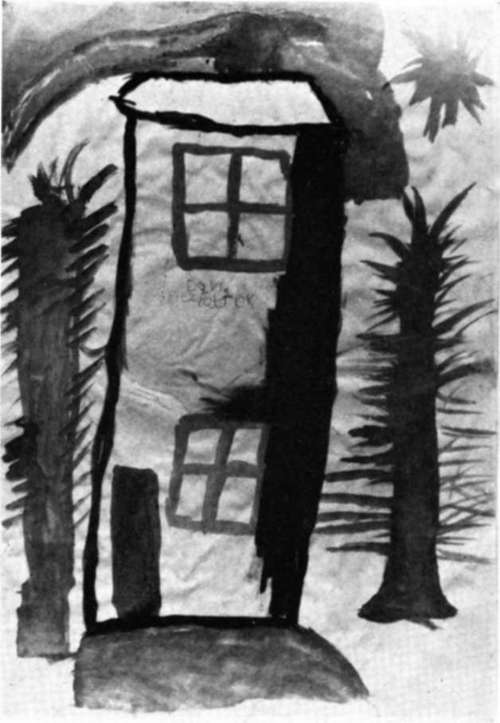
5-year-old. In this painting the child has elongated the house and trees to fit the paper. In this way he has made a far pleasanter composition than would have been possible had the house and trees been in a more lifelike proportion (Chapter 20)
Top Juniors should be encouraged to keep sketch books. These should be of cheap paper rather than good-quality paper, and could easily be made by the children themselves. They can be encouraged to collect examples of the things they see around them—trees, houses, windows, fences, gates, chimney-pots and so on, and to use these in their pictures.
What about more formal drawing of people and plants, drawing where the pose is set up for the children to draw? I feel that the danger of this is rather like the danger of doing "sums" before there is real number knowledge—children may not make the connexion between this and picture and pattern making. Picture and pattern making seem to me to be of manifestly greater importance, containing as they do all the complicated relationships of shape, colour, tone and texture. I think therefore that if drawing of plants or people is introduced, it should be as part of picture making or pattern making. There is, for example, a place for drawing two or three posed figures, each posed for ten minutes or so, and all drawn on the same paper, and then making a picture out of them. Or one could draw a plant and then add the necessary background to make a picture. I speak of drawing, but I mean that this should be done in paint, charcoal or chalk with no preliminary work in pencil. Objects drawn in this way should have real relationship to the pictorial work of the children.
Continue to:


My Books

