


Chapter Fourteen. Pattern And Texture
Description
This section is from the book "Arts And Crafts In The Elementary School", by Joan Dean. Also available from Amazon: Arts And Crafts In The Elementary School.
Chapter Fourteen. Pattern And Texture
Pattern and texture are two words whose meaning is closely allied. The Oxford Dictionary, among many other definitions, gives for pattern, "decorative design as executed on wall-paper, carpet, cloth etc." For texture, it gives "structure", "representation of surface in works of art". Thus a piece of material may have a woven texture, but also have a printed pattern upon it. In general, though not necessarily, pattern implies the idea of repetition. In general also, texture carries with it some feeling for a third dimension. When we attempt, for example, to represent grass, we are, in fact, trying to discover a way of representing something which owes its textured appearance to its three-dimensional properties. The texture of stone appears as it does because it is in three dimensions. We have already noted that few Primary school children have a natural understanding of the representation of three dimensions. In the same way, few have an understanding of texture in the adult sense. When they try to represent it they tend to order it so much that it becomes pattern. For some people, the so-called decorative artists, texture will always be ordered in such a way that it becomes pattern. Occasionally a child at the Junior stage will show real ability to represent texture, but for most of them, this discovery comes later.
There is, nevertheless, a great deal to be done in this field at the Junior stage, and earlier. In the chapter on collage work, we have already discussed the importance of helping children to enjoy the feel of materials, and of helping them to relate one to another. As soon as they reach the stage of drawing from observation we should start to encourage them to observe and attempt to draw in various media, the patterns which show what things are made of—the grain of wood, the stones on the gravel path, the tiles on the roof and so on. All these can be represented by various kinds of marks on the paper, and only by attempting to do it can we discover the particular way which is satisfactory for us. There are no specifics for representing texture—or indeed for anything in drawing. If we start to do this as soon as a child's development makes it possible, he can also start to discover relationships of textures— how much adds to a picture and how much clutters it up. Children must be made aware of these relationships by constant discussion about the work in hand. The teacher should frequently ask individuals questions such as—"What will look well with this piece of plain material?" "This pattern looks too spotty, what can you do to make it look better?" Sometimes work can be planned to give specific help in such relationships; sometimes they will be discovered incidentally.
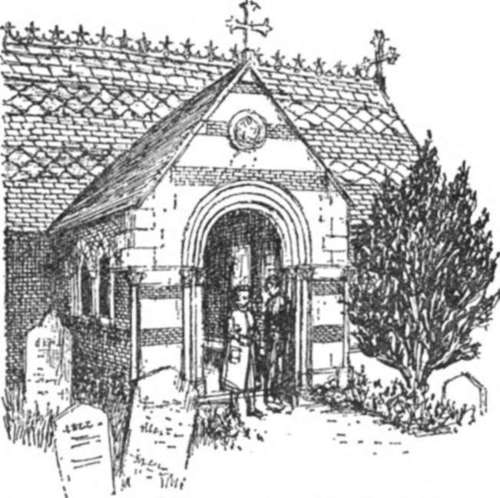
Drawing in which there is an attempt to reproduce texture.
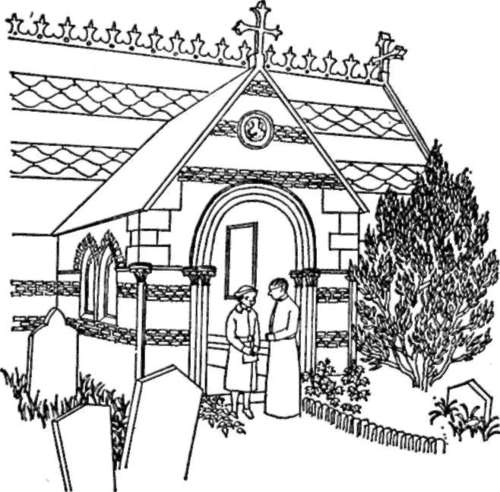
The same subject redrawn and ordered so that pattern predominates
In the last chapter exhibitions of patterns and textures were suggested. This idea might be taken a stage further in a display of materials and objects whose texture is an important characteristic. Children could be encouraged to touch and handle these, to discuss the "feel" of them and perhaps to write about them. Suitable things for such an exhibition might be a length of velvet and one of some shiny material or of tweed; polished wood; leather; glazed and unglazed pottery; pieces of rock or stone; other natural objects, such as shells, fruit and nuts. In fact, anything which appeals to the sense of touch is suitable material for inclusion.
Much can be learnt by top Juniors when they attempt to draw outside, looking particularly for the textures and patterns and trying to find ways of representing them. This sort of drawing is, I think, best started outside and finished in the classroom. Once you come indoors it is a good idea to say, "Now let's forget about what was really there and make a good picture of this. Add or leave out anything that you think will make the picture better."
It is also a good idea to make pictures specially chosen for their pattern qualities—A group of girls in patterned frocks, for example; a wood with different kinds of trees—"how many different leaves can you find?"; a street with houses which all have different kinds of tiles and bricks. In this way children are encouraged to search out the textures and patterns which are all around us.
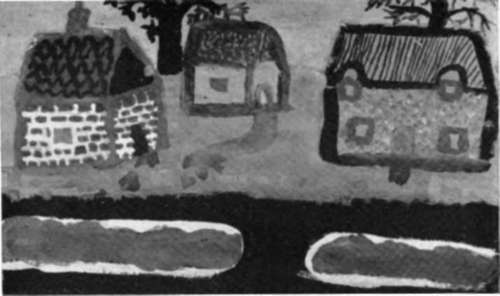
10-year-old. Picture based on an investigation of wall and roof textures
(Chapter 14)
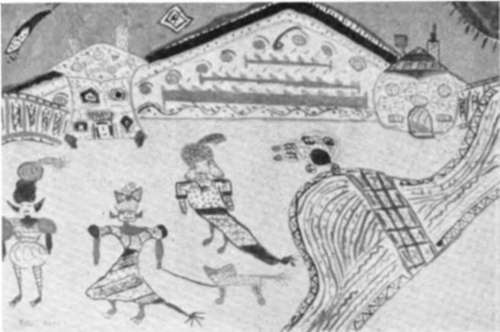
10-year-old. The never, never land. An imaginary picture where pattern has been made of first importance (Chapter 14)
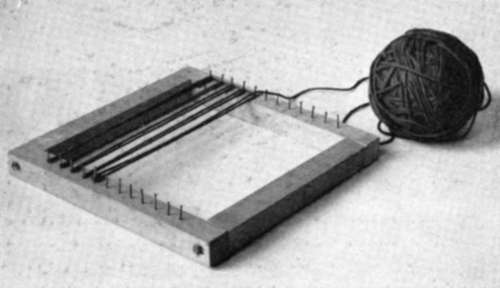
Home-made loom
(Chapter 15)
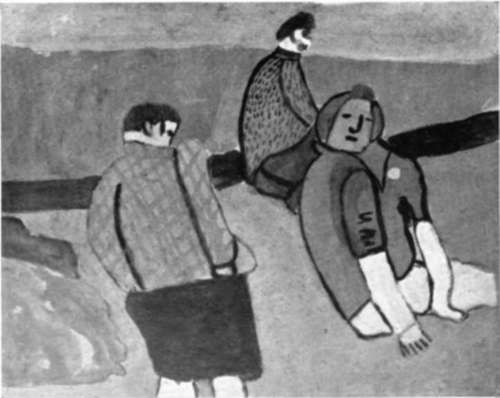
10-year-old. Picture made from three drawings of posed figures
(Chapter 18)
Continue to:


My Books

