


Needlework. Part 3
Description
This section is from the book "Arts And Crafts In The Elementary School", by Joan Dean. Also available from Amazon: Arts And Crafts In The Elementary School.
Needlework. Part 3
Making A Pleated Skirt
1. A straight piece of material and a hand are needed. Fold and pin the material into pleats.
2. Pin, tack and sew the hand in position, allowing an overlap at each end.
3. Turn the hand over. Pin, tack, and hem.


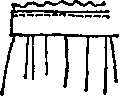
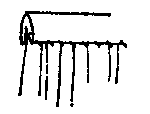
Making A Gathered Skirt
1. A strip of material and a band are needed. Gather the material along one edge and pull up the gathers until they are the length of the distance round the waist. Space out the gathers.
2. Pin and tack the band into position, allowing for an overlap at both ends.
3. Turn the band over the raw edges and hem it down. Join the side seam. Turn up the bottom.
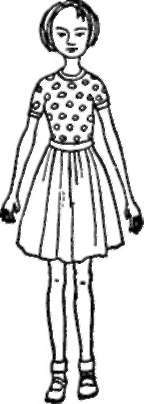
Skirts can be made in many ways. Discuss different kinds of skirts with the children and see how many they can think of. See how many different kinds are being worn in the class, and ask the children to tell you from observation how they think each is made. They should at least be able to work out how gathered and pleated skirts are made. Get one or two children who are wearing these kinds of skirt to measure the distance round the bottom, so that they can see how much material is needed. Gathered and pleated skirts are, in their simplest form, just strips of material pleated or gathered into a band. Gored and flared skirts are a little more difficult. Get the children to look at the shapes which compose them, noticing particularly where the straight of the material comes. Discuss the measurements you will need. The most important of these is length, although you will also need to know the distance round the waist. Draw your pattern as follows:
Draw a line AB which is the length of the skirt.
Continue AB to a point C, BC being equal to one-sixth of the distance round the waist. Draw a line CD at right-angles to AC and the same length. With centre C and radius CA, draw an arc from A to D.
With centre C and radius CB, draw an arc to meet CD at E.
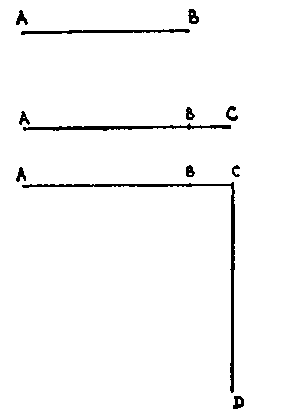
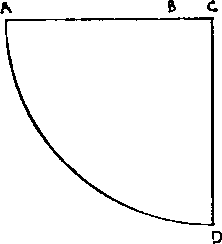
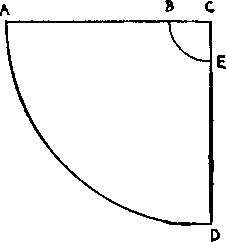
This will form one side of a semi-circular skirt. If you wish to have gores in it, you can divide it up as you wish. The same sort of construction will hold good if you want to make a fully circular skirt or one which is less than semicircular. When you have made the pattern, cut it out in newspaper allowing for turnings, pin it together and try it on. If all is well, cut it in the material, arranging things so that the straight of the material comes either at the sides of the panels, or in the centre of each. It must come in the same place on both pieces. Join the two pieces, allowing for an opening. The skirt can be sewn into a band as before.
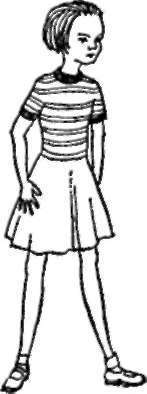
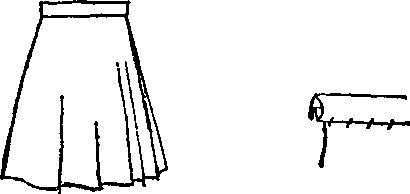
Flared skirt. This can be sewn into a band.
If the skirt is to be sewn on to a bodice, put on the bodice and skirt, both inside out. Notice exactly what the seam between bodice and skirt ought to do. Pin them together. When you are sure that they are right, sew them.
This sort of pattern cutting will not produce a Paris fit. Such is not the intention. The intention is to develop, in children, an attitude of mind towards dressmaking. It is an activity which involves us in observation, estimation and judgement, and its problems cannot be adequately met by the application of a set of rules. Our teaching should help children to recognize the shape and function of each piece of material. They should gain the ability to look at clothes and to deduce from their appearance how they were made. They should be able to look at a dress which does not fit and see what is wrong. I am not suggesting that they should learn to do all these things at the Primary stage, but we can do a great deal at this level to start them on the right road.
This sort of work does not, of course, cover much work in the basic skills of needlework. If the clothes made are used for dressing up, the need for the skills of joining on and off and for making firm seams will be amply demonstrated, but in doing this kind of work the teacher will be too much occupied in helping children with the shaping and fitting of the work to have much time to spare for teaching skills not already known. We must have other work specifically planned to cover this— the work, in fact, which forms the basis of the needlework teaching in most schools.
Continue to:


My Books

