


Primary School Children. Continued
Description
This section is from the book "Arts And Crafts In The Elementary School", by Joan Dean. Also available from Amazon: Arts And Crafts In The Elementary School.
Primary School Children. Continued
What particular characteristics have Primary school children which arc relevant to the teaching of art and craft? In the first place the enthusiasm and readiness to "have a go" of most young children make the Primary school an excellent place for letting children experiment with materials. In fact, I think that children should be familiar with all the materials of picture and pattern making, and with simple forms of most crafts before they reach the self-conscious stage of adolescence. Then they will have sufficient confidence in their own abilities to carry them through the stage when failure matters so desperately and when experiment is stultified by fear of appearing ridiculous.
At the same time Primary school work must be keyed to the children's ability to concentrate. This is growing throughout the Primary school and work must be planned bearing this in mind. As teachers we often have to consider the problem of persuading children to finish work in which they have lost the initial interest. Unless pictures are finished, children never learn to solve the problems which arise at the end of a piece of work. I suppose there is little point in finishing the picture if neither teacher nor child knows where to go next, but if the teacher can see how the work can be brought to a successful conclusion, then I think the child must be persuaded to continue. The teacher's knowledge of die individual child will tell her the degree to which she should insist on a particular piece of work being completed.
Primary school children are less hidebound by convention than their older brothers and sisters. This too, makes the Primary school a good place to experiment. Primary school children are, in general, at a stage when creation is easy, and most of them are full of ideas and need only the opportunity to carry them out, together with an encouraging attitude on the part of the teacher.
Young children enjoy rhythm and repetition, and pattern work gives pleasure from quite an early age, particularly pattern work of the kind that involves rhythmic movement.
In general, I think that Primary school work should be planned at the beginning to give children experience in using different kinds of materials. In the Infant school, work should be of individual choice and teaching should be by suggestions to individuals and by the introduction of new materials at the right moment. Occasionally it is necessary to see that everyone has a go at some particular thing, or it may be a good idea to have a class lesson to introduce something new to everyone, or to arrange that different groups of children try new things in turn. This kind of individual teaching ought to continue in some way or another throughout school life. There ought always to be times when the child chooses the kind of picture he will paint. There is at this time a place in the Junior school for the class lesson, where everyone is starting from the same point. Without class lessons there is a danger that a child's experience will narrow. In my own school we alternated lessons where die children had free choice of work with lessons where they did "what you tell us". In this way, it is possible to see that children absorb the experience gained in more formal lessons and apply it to work of their own choice. The question of group lessons is also one which must be considered. Most teachers agree that there is much to be gained socially when a group of children work on something together. There are dangers in this, however. A timid child may be led by and may learn from a more confident one, but he may, on the other hand, shelter behind him and make little effort on his own. The teacher who knows her children well will be alert to prevent this happening, but it can also be avoided if work is planned so that each child does a complete part of the whole. Thus where a group of children are perhaps making a village, each child may make a complete part of it, perhaps a house or some other building. In this way each child develops his own personal way of working and yet gains from co-operation with others.
At the beginning of the Junior school course, much work will still need to be directed towards experimenting with various media. Children of this age are fascinated by the results of mixing colour—I can think of several who mix colours just to see what happens, with little reference to the painting in hand.
Colour mixing by individuals ought to start in the Infant school.
Work planned to extend a child's knowledge of chalk, pastel, crayon, pen and ink, is also suitable for lower Juniors. So is work with collage materials and with various kinds of printing media. This is the time when children are ready to start more directed work in some of the crafts.
As a child nears the top of the Junior school, two aspects of art become more important. One is composition—putting pictures together. The other is the visual appearance of things. Work in the last two years in the Junior school ought to contain definite teaching about both of these.
All the way through the Primary school the children's own work should be supplemented with work and discussion about the appearance of things. Some of this will be part of the nature work, some part of local study. Much can be done through classroom displays and exhibitions. The task of training children to look carefully and to enjoy the appearance and the feel of things is an important one.
We are becoming accustomed in Primary education today to think of putting children into situations where they will learn by their own activity, in contrast to the ideas of the past where they learnt from the words of the teacher. The situation is arranged by the teacher, but the discoveries and the learning are the part played by the children. This picture of Primary education is as true of art and craft as it is of any other aspect of the Primary school curriculum.

Development of children's painting. 6-year-old. The windy day. This child is using symbolic shapes to represent people and trees, although she has managed also to show the atmosphere of a windy day (Chapter 3).
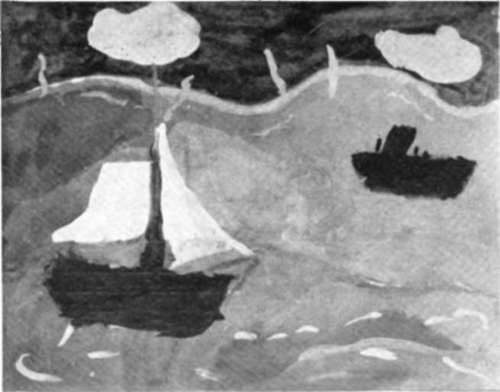
Development of children's painting. 8-year-old. Storm at sea. The undulating horizon line and the streaks of lightning are an attempt to paint what the child knows to be there, rather than an attempt to portray reality (Chapter 3)
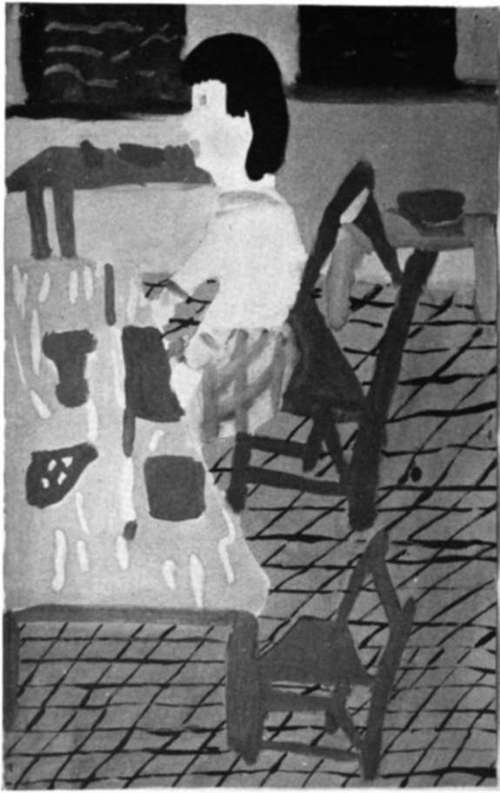
Development of children's painting. 9-year-old. The girl sitting next to me. This child is attempting to paint what she sees. Notice the use of profile and the attempt to show the third dimension (Chapter 3)
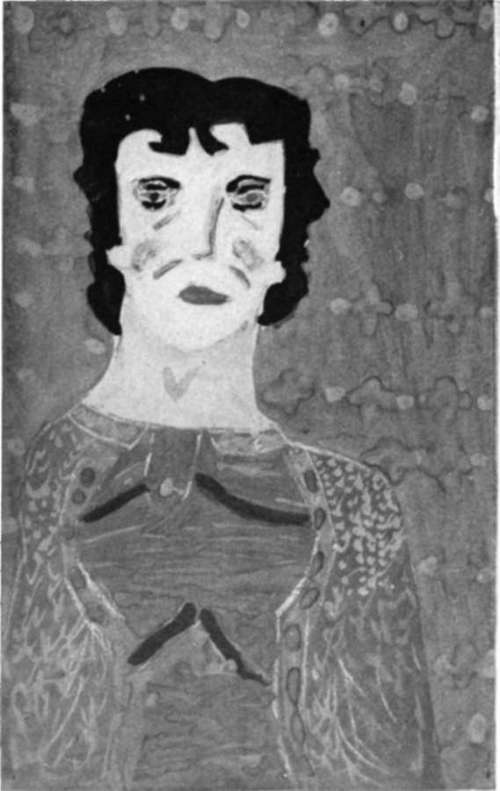
Development of children's painting. 9-year-old. My teacher. This painting, by the same child as the previous one, shows considerable ability to observe and portray detail. She is exceptionally able in this subject and her work more nearly resembles that of an 11-year-old (Chapter 3)

Development of children's painting. Backward 10-year-old. Two people. This child, although not backward in other work, was much retarded in painting, because she had had virtually no teaching in the subject, nor any opportunity to paint until she was nearly ten. Her work in this picture compares with the normal work of the 6-year-old shown earlier
(Chapter 3)
Continue to:


My Books

