


Things To Do For Little Children. Part 2
Description
This section is from the book "If You Live with Little Children", by Carolyn Kauffman and Patricia Farrell. Also available from Amazon: If You Live with Little Children.
Things To Do For Little Children. Part 2
Children can make their own cereal bowl by pressing clay over an inverted wooden salad bowl. When the clay is dry, it will shrink from the bowl. It is ready to be fired, glazed, and fired again.
If you make something for your child out of clay, he will no longer be satisfied with what he can do, and he will want you to continue to create things for him.
But mostly clay is to be pounded and punched, rolled into balls, or rolled out like snakes and thrown back into the stone crock. If you don't have a stone crock, a plastic bag inside a potato-chip can with the lid on tight will do.
Dough
Most children prefer dough to clay "because you can make it pretty colors and it's not so sticky." Dough is 3 cups of flour, 2 cups of salt, and 1 cup of water. This recipe serves four children generously and six adequately. If the dough is sticky, add flour on the table where the child is playing and let him work it in.
You may want to color the whole batch one color, or divide it and have several colors. (Use food coloring or powdered poster paint) A child can discover that his blue wad and his red wad, when mixed together, make a purple wad. He found this out with water paints and finger paints, but didn't know it would be true here, too.
Dough has advantages over clay in that it is spongy and resilient and will not stick to the oil cloth.
Rollers are important here.
When dough is wrapped in a plastic bag, it will keep for several weeks without refrigeration. A tablespoon of salad oil will keep it soft and pliable. Add flour if necessary.
Wallpaper Cleaner
This material is pink and can be bought in small cans from the hardware store. It is very pliable, doesn't stick to hands, and children discover that it makes very funny false noses, which will stay on for a few minutes. After being exposed to the air for a time, it will become somewhat crumbly.
Modeling Clay
Modeling clay comes in many colors, never hardens, and needs no special care. It can be found in variety, dime, and stationery stores. It is too hard to be recommended as a suitable material for children under five, but no household should be without some. Uses for modeling clay are mentioned throughout this book.
Raisins can be added and the dough can be "baked" inside muffin tins or small pie pans in a play oven.
If the child has made something he wants to keep, it will take several days to dry, but it becomes almost as hard as plaster of Paris.
Paints And Painting Smocks
Smocks are to wear while you are doing messy work.
Father's shirts go over heavy winter clothes.
Mother's blouses fit three - year -olds.
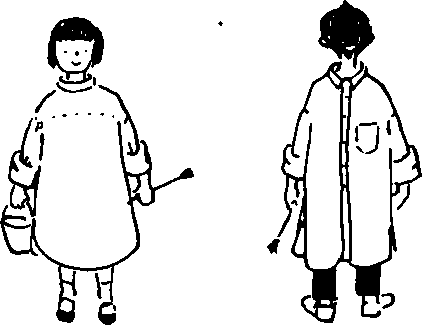
A shirt or blouse is a smock only after it has been put on backwards and buttoned down the back.
This is a picture of an oilcloth smock lying on the ground.
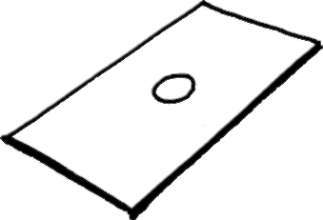
Here is the smock on an easel painter.


Newspaper aprons are also good for painters. (See page 46)
Poster Paint
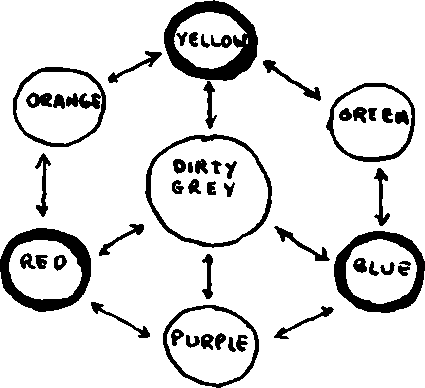
An investment of four cans of powdered poster paint in red, yellow, blue and white will make many more colors when mixed together. When several colors get mixed, the tone will be inescapably brown. Brown is a very nice color, but if the child is using more than one color, suggest that he use a different brush for each can of paint The brush should have a wide handle and stout bristles (No. 12 water color at stationery stores is good). Frozen orange-juice cans make excellent paint cans. One heaping teaspoon of the powdered paint and about 4 tablespoons of water make a fairly thick paint, not so likely to run, and the color will be bright Food coloring can also be used for making color. (Powdered poster paint can be bought in stationery stores for about 90c a can.)
White is important because pink is a favorite color. Red and white make pink.
Blue and yellow make green. Blue and red make purple. Yellow and red make orange.
The smaller the child, the bigger the brush.


Children can paint old newspapers, wrapping paper, newsprint, butcher paper, or cloth. Newsprint is the best material. Newsprint is newspaper not yet printed. It comes in sheets or rolls and can be obtained from your newspaper office. It can be purchased in stationery stores for 25c a pound and it comes in various sizes.
Portfolios
For the child who makes many pictures, a place to keep all his work is important. A very simple envelope-type portfolio can be made by folding three sheets of newsprint and stapling along the two sides, leaving the top open. Write the child's name on the front and let him add a few touches of his own.
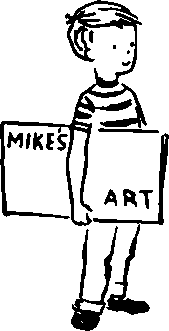
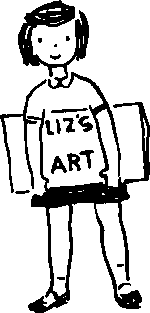
Paste or staple two of the child's paintings on two pieces of poster board. "Hinge" the boards with yarn, tied in three places. (Buy poster board at stationery stores.)

Easel
Even a mother can make an easel. Hinge together two pieces of plywood, approximately 20" x 24". (Get plywood from a lumber yard.) Attach trays to hold paint cans. Paper can be held in place with spring-type clothes pins.
Cover the plywood with You might paint one side of several coats of shellac for or- the easel with blackboard easy cleaning. paint
When the easel is standing, it should not be more than a head taller than the child.
Looking at an easel.

Sideways.

Some children find painting at easels annoying because the paint runs down the paper. Show how to wipe excess paint off the brush onto the side of the can before applying to paper.
Paint on the floor or on the table if you do not have an easel.
Sponge Painting
Cut a cellulose sponge into one- or two-inch squares. Put the dry sponges in a pan of water. Explain to the child that he should squeeze out most of the water from the sponge before he dips it into the powdered poster paint A muffin tin with different colors in each mold makes a good container for the paint Suggest to the child that he pat, rather than rub, the squares onto the paper. The part-dry, part-wet paint leaves an interesting texture, not obtained by any other method of painting. A separate piece of sponge should be used for each color. Sponge paintings look very attractive on walls and can be used to wrap gifts, to cover cans for plants, and to wrap around gallon ice-cream cartons which make durable wastepaper baskets.
Continue to:


My Books

