


You Can Make Your Own Music
Description
This section is from the book "If You Live with Little Children", by Carolyn Kauffman and Patricia Farrell. Also available from Amazon: If You Live with Little Children.
You Can Make Your Own Music
People who make no noise are dangerous.
-La Fontaine
Some children at a very early age reveal a musical talent that parents often overlook.
Rhythms at the table are very popular with young children. Beating the table with the silverware, hitting full glasses of milk with their forks, and blowing bubbles in their tomato juice are but a few. Others are rocking on their elbows and kicking table legs with their feet-and you know a lot more.
Musical instruments around the house are really scarce. If there is a piano, it's not to be banged on. Father's violin is on the top shelf and even he doesn't get it out any more because the children are not content to let just him play it
You may want to channel this talent in a more civilized fashion. The instruments described below are fun to make and fun to use for accompanying dancing or records. They are also good in parades. Chances are you have the entire rhythm band in your own house, though you may have to go to Grandma's cellar for the washboard.
Tambourine
1. Staple two paper plates together facing each other. Tie four or five jingle bells or any pieces of hardware that will jangle when the tambourine is in motion. Let the children color the paper plates with crayons. They will have a surprisingly long life, since paper plates tend to pop back into shape, even after being stepped on.
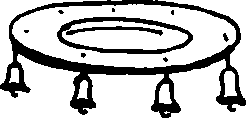
2. Tie "jinglers" to the hollow ring of an old embroidery hoop.
Rattles
1. Fill a baby-food can with seeds, beans, rice, gravel or whatever is handy. Cover the open end with any scrap of material. A piece of plastic, oilcloth or leatherette serves well for this purpose. Secure it by wrapping a rubber band around the end several times. Be sure to let the children help you make this rattle so they will know what's inside before you get the rubber band on.

2. A toilet-paper roller can be filled in the same way with the same things and stuffed with paper at either end and then wrapped so that the extended ends of material can be twisted and tied.

3. Pierce a hole in a dry gourd and fill with beans, rice, shot, or rocks. Tape the hole with adhesive.

4. A clam shell (if you can find a clam shell) filled and glued together, makes a good rattle.
5. Partially fill a small bottle with pebbles and cork it
Triangle
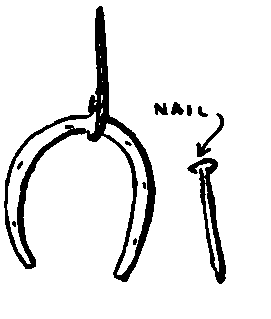
A horseshoe hung by a cord and struck with a long nail is very effective, since it produces a clear ringing sound.
Cymbals
While two pot covers struck together sound like nothing so much as two pot covers struck together, the child thinks they make wonderful cymbals. Tying ribbon or yarn around the handles for decoration will help keep the two you have donated for the occasion separate from your own good lids.

Guitars
Stretch rubber bands around a shoe box or cigar box and pluck or strum.

Harps
Stretch rubber bands around the back of a straight chair and pluck or strum.
Musical Comb
Wrap a piece of tissue paper over a comb and hum.
Rhythm Sticks
If you don't have ten-inch lengths of doweling around, you'll find you have something similar in handles from broken "pushers," long-gone toy lawn-mowers, or chair rungs. When someone in your family has cymbals and someone else has the triangle, it's sometimes kind of hard to get anyone to think that rhythm sticks are very interesting. If you tie strips of crepe paper at the end for a "wand" effect and a swishy noise, these will seem more desirable.

Chimes
Three flower pots that fit inside each other and can "nest" when not in use make chimes. String them together on a rope-clothesline rope works best-and tie a big knot so it will not slip through the hole. Strike the chimes with a nail or piece of metal. It makes kind of a dull thud, and though they look attractive, it's hard to make much music out of clay.

Sandpaper Blocks
Thumbtack sandpaper on blocks of wood. Swish together.
Bass Music
Blow into an empty pop bottle.
Musical Washboard
Find as many thimbles as you can and let the child put them on his fingers and rub them across the bumps of the washboard. Popsicle sticks and wooden ice-cream spoons make good " strum mers" too.

Drums
1. Cut strips of colored paper in triangle shapes and paste on an oatmeal box. Either hold the box between the knees and tap on one end with the fingers, or run a string through a hole near the edge at each end and hang it around the neck.
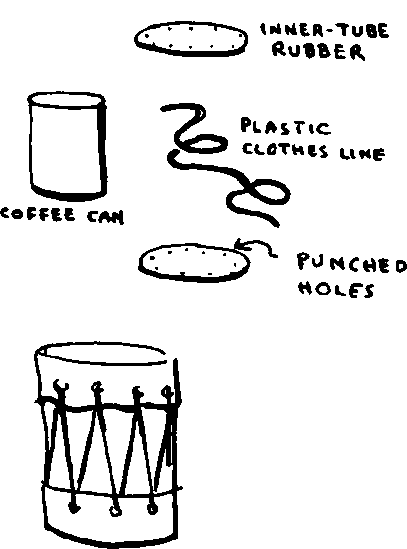
2. A two-pound coffee can may be opened at both ends and inner tubing "rounds" cut to overlap an inch or two. With a punch make holes at equal distances around the edge and lace with plastic clothesline, heavy cord, or shoelaces knotted together.
3. A nail keg can be used in a similar way-stretching the rubber across the open end and securing it with thumbtacks.
4. With a piece of ribbon, hang a kitchen pot by its handle around the child's neck.
Drumsticks
1. Put a wad of cotton or a small rubber ball on the end of a piece of doweling and wrap it with cloth, leatherette, chamois, or a piece of plastic or oilcloth. Secure with a rubber band or a heavy string.
2. A ten-cent dish mop makes a good drum stick when covered with material and secured with string or a rubber band.

Jingle Bells
Jingle bells sewed to a strip of elastic are fun to wear on the wrist or around the ankles.
A Musical Instrument
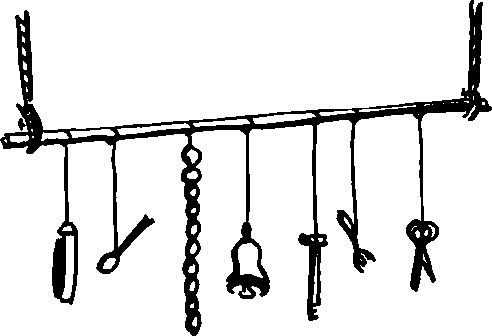
From a ten-inch dowel suspend with string, individually, a tuna can, a deviled-ham can, a string of paper clips, a bell, or a spool. Tie a length of string or rope approximately fifteen inches long to each end of the dowel and use this as a handle to shake the instrument
Woo-Woos
Blow, hum, and sputter through a cardboard tube of any length.

Streamers And Flags
Crepe-paper streamers and flags can be carried by those who do not care to participate in making music, or those who have one free hand, such as the tambourine players or rattle shakers.
Continue to:


My Books

