


Airport
Description
This section is from the book "How To Build Games And Toys", by B. W. Pelton. Also available from Amazon: How To Build Games And Toys.
Airport
It is axiomatic nowadays that, at some period during their development, children will become air minded. This is of course particularly true in a locality over which planes frequently pass, and even more so in the vicinity of a successful airport. In the latter case, young observers become keenly aware of flying procedures and will enthusiastically welcome a miniature setup of their own.
Because it is not considered practicable to whittle and assemble small-scale planes and automobiles when such exact replicas in plastic are available at any dime store, the airport shown in Figure 4.21 is scaled to use this type of toy. Average sized miniature planes have a wing spread of about 41/2 in., and limousines, fire engines, and ambulances seldom exceed a length of 5 in. and a width of 17/8 in. Obviously the toy vehicles should be procured before any buildings are constructed, or a decision made concerning the layout of the airport.
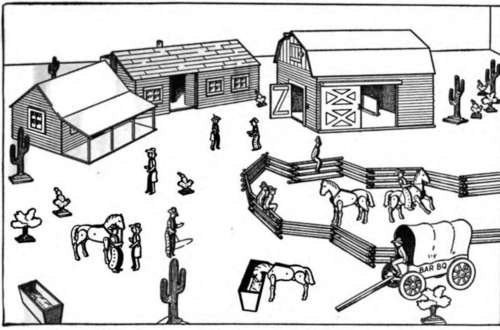
Fig. 4.20. El Rancho Bar-B-Q.
A single piece of smooth hardboard 24 in. by 30 in. makes an excellent surface for the flying field, with 3/4 in. by 3/4 in. wooden strips nailed underneath, flush with the front and side edges as cleats to fit over the edges of the base. In order to facilitate more compact storage, however, the hard-board field may be cut into two halves 12 in. wide, and a linen hinge glued to the underside so that it can be folded up like a game board. The threesided stand or base of 3/4-in. wood 43/4 in. wide, can be hinged as indicated in A (plan of the base), in order that it too can be folded up when the young aviators are abed.
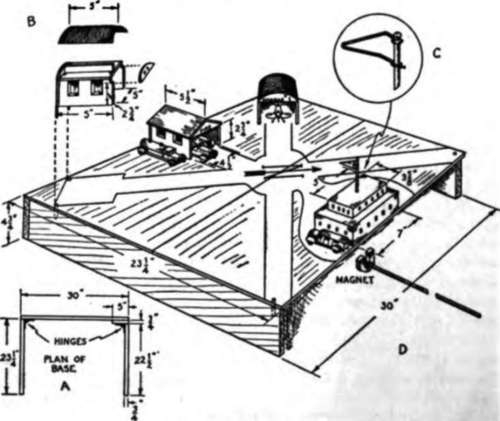
Fig. 4.21. Skyville airport.
As indicated in the drawing, the hardboard surface of the flying field is fastened to the hinged corners of its three-sided base by dowel pegs extending below the rear corners of the back sections of both hangars, through holes in the field, down into corresponding holes in the edges of the base. Two short dowel pegs are glued into the ends of the short sides of the base to fit through holes in the open corners of the field. The other two buildings have shorter pegs to keep them in position. All pegs should fit closely but be loose enough for easy removal.
If the buildings are to be removable, their construction should be fairly rugged. To accommodate the 1/4-in. dowel pegs which steady the outer corners of the field and base, the back sections of both hangars should be at least 1/2 in. thick; the same is true of the garage or fire department, which has dowel pegs in its rear corners which penetrate into holes in the edge of the front base section, to resist the impact of carelessly chauffeured vehicles. All three of these hollow buildings are constructed with flat roofs reinforced with corner blocks to compensate for their open ends. The thicker rear sections include gables, rounded in the case of the hangars, and triangular for the garage-fire department; individual front gables are lapped into place against a ridge piece, as shown in detail B. Corrugated cardboard makes realistic metal roofing for the rounded hangar roofs, especially after aluminum paint has been applied. Windows of celluloid or clear film can be cemented in place from the inside, if desired.
The ground floor of the administration building is a solid piece 2 in. by 6 in. about 7 in. long, with a smaller piece of 11/8-in. scrap for a second story. Doors and windows are painted or inked on. The cloth wind sock is a cone sewn to a wire frame bent around a 1/4-in. dowel post, as illustrated in C. A shortened glass-headed pin serves as an ornamental knob, and the wire frame is kept aloft by a tiny brad in the pole.
The flying field may be painted green or left bare brown, with cement runways and roads painted in gray. Paint the base the same color as the field.
The planes and vehicles are motivated by a horseshoe magnet bound to an 18-in. length of dowel, as in D. Small rectangles of iron, or metal washers are cemented to the undersides of the toy planes and various vehicles to attract them to the magnet when the latter is quietly moved by the "manager" of the field, unseen by the mystified audience in front. Once the young operator becomes familiar with the capabilities of his magic wand, he can drive a limousine of passengers to the administration building, park it at the side after unloading, then taxi a plane from its hangar and have it serviced by the gas and oil truck, put out an incipient fire, and back an ambulance to a plane for unloading a stretcher case.
Continue to:


My Books

