


Harbor
Description
This section is from the book "How To Build Games And Toys", by B. W. Pelton. Also available from Amazon: How To Build Games And Toys.
Harbor
And now comes the turn of the junior ships' captains, dock-masters, and marine superintendents. The "dry" harbor pictured in Figure
4-22 may be assembled on a single piece of wallboard or plywood, or hinged as indicated. It will be much easier to paint the protected water within the harbor before the dock sections are nailed or cemented in place. These may be of wood strips 3/4 to 1 in. thick, or of two 1/2-in. layers of light, thick wall-board such as Cellotex. Whatever the thickness or height of the dock, it should correspond to the draught of the scow and ferry boat (B and C, Figure 4.23), which in this case are 1 in. Bollards to hold the cord mooring lines are whittled from 1/4-in. dowels glued into conveniently located holes.
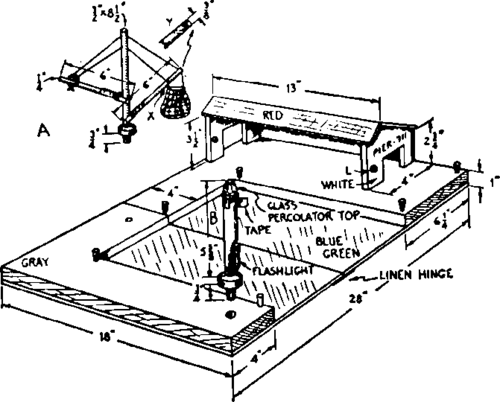
Fig. 4.22. Dry harbor.
The pier shed or warehouse is butt jointed from thin wood of available dimensions. If the end sections which contain the doors are cut from 1/2-in. or 3/4-in. stock, they can be securely screwed or nailed from underneath. A narrow cleat, not shown, fastened along the inside lower edge of the windowed rear section, will insure greater rigidity when the pier is stored away. L is a white candy life preserver.
The lever operated crane, illustrated in the detail, revolves in holes bored at strategic points in the dock. As indicated, the upright mast is an 81/2-in. length of 1/2-in. dowel extending 3/4 in. below a 1/2-in. collar cut from a curtain pole. The boom is a 6-in. length of f-in. dowel, and the lever is an equal length of 1/4-in. dowel. Both boom and lever are whittled flat on the sides of their mast ends to take the spur-like pairs of thin brass or tin which straddle and are pivoted to the mast as indicated. The lever actuates the boom by means of a fishline passing through a hole in the mast.
The cargo net is made up of two net bags in which agate marbles are purchased at the dime store. The average bag is 3 in. wide and 7 in. long. A simple, yet practical net can be quickly rigged by snipping off the closed end and tying the center of the long seam directly to the end of the boom. The net shown in the detail is made from two bags with 1 in. of the open ends cut off. Get some feminine member of the family to remove the green or red binding seams along the sides, and refasten them to form a bag 6 in. wide. Then soak the bag in water and rinse carefully to remove the stiffening. The upper end of one side seam is then fastened to the boom at X, and the opposite seam attached to the strong, waxed carpet thread which passes through the loose, slanting hole at Y, then through the upper hole in the mast to a small brass curtain ring which fits over the end of the hand lever when the operator wants the net to remain closed. Detaching the ring and letting it fly up toward the mast will release the mouth of the net. Small wooden blocks and short lengths of f-in. dowel rod make cases and barrels which can be hoisted from the scow or from the holds of a freighter, and vice versa. Mother or sister can probably be induced to sew small bags from white remnants or the ends of tobacco sacks, which when filled with sawdust, breakfast cereal, or crumpled tissue paper, will represent bags of cement, sugar, or other commodities.
An electric beacon or lighthouse can be assembled from a "pencil" flashlight, a glass percolator top, and a cardboard tube, as indicated in Figure 4.22 B. The average dime store flashlight of this type has a f-in. diameter and is about 53 in. long. The switch is either attached to a clip on the side or is actuated by a rotating band near the bulb end. In either case an opening or openings must be provided in the cardboard tube enclosing the flashlight, to permit manipulation of the switch. In addition, these openings must be cut in such a manner that the entire flashlight can be withdrawn from below, for battery or bulb replacements.
Like the crane, the beacon extends into a hole at least 3/4 in. deep in the dock, under a supporting wooden collar about f in. thick. A close fitting outer tube can be glued up from two or more pieces of white bristol board, or may be soldered from tin can stock, so that it fits snugly against the circular base or collar. Since the dimensions of glass coffee percolator tops vary with availability, their interior diameters will determine whether the top edge of the tube will fit inside or outside, flush with glass collar of the percolator top. The type illustrated has an interior diameter of in. which increases to about 7/8 in. on the outside. This will fit over a thin tube or, as pictured, may be fastened to a thick, flush tube by means of narrow adhesive tape. Those who are adept at making parting molds with plaster of Paris can cast a sturdy, sloping lighthouse which will house the flashlight and can be joined to the glass dome with an all-purpose adhesive. Paint the slim beacon aluminum, and the lighthouse white.
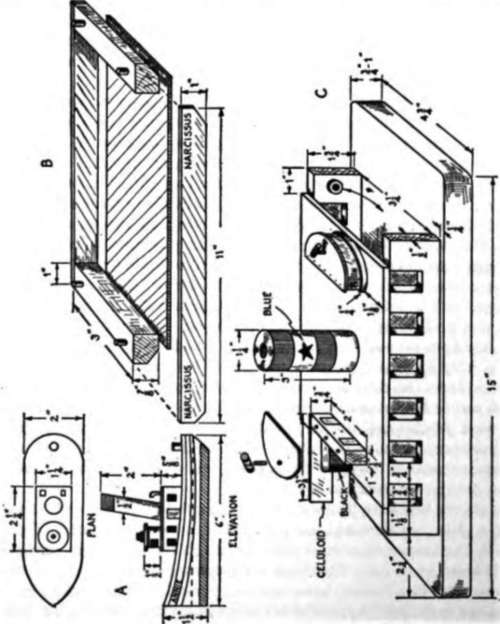
Fig.4.23. Marine transportation.
The elementary tugboat and scow, described among the Tub Toys in Chapter 2, should be enlarged for the more exacting demands of older harbor masters. The hull of the tug is a piece of soft pine 6 in. long, 2 in. wide, and 15/8 in. thick. It can be rough shaped with a drawknife, then whittled and sanded to the approximate profile indicated in the elevation of A, Figure 4.23; the bottom is left flat. For non-whittlers, it is a simple matter to cut a combing from bristol board, and tack or glue it to a flat piece of f-in. stock, as indicated by the dotted line in the elevation. The cabin or superstructure is a solid block of wood 5/8 in. thick, 11/4 in. wide, and 21/4 in. long, with windows and doors painted on. A separate round pilot house can be made from a 1/2-in. section of spool, with a large bead or dowel section threaded under the supporting screw, to represent a searchlight. For the smokestack, a 2-in. length of 1/2-in. dowel is cut to provide a slight "rake." Whittled ventilator tubes over the engine room are added luxuries. A single towing bitt at the stern is represented by a 1/4-in. dowel. Paint the water line red, the hull brown, the cabin and pilot house white, the deck gray, and the stack yellow with a red band.
The scow or barge is glued up from three sections of cigar box wood separated by two beveled end pieces of 7/8-in. stock at bow and stem. Add four 1/4-in. towing posts and paint the barge a medium red. Appropriately lettered names add interest to the vessels.
For youngsters who like to ride on ferry boats it should not prove a difficult project to assemble the stylized "Faerie Queene" illustrated in 4.23 C. The 15-in. base is cut from a 1-in. (or f in.) piece of wood 43/4 in. wide. The superstructure is built upon two pieces of 1/2-in. stock, 13/4 in. wide by 101/2 in. long, with windows cut as indicated; the upper deck is of f-in. material.
The easiest method of fashioning the twin pilot houses is to cut a disk 3/4 in. thick having a 3-in. diameter, and then bisect it. The more realistic version indicated in C, has a piece of celluloid bent around a T-shaped form to provide 180-degree vision for the pilot. The interiors of the "shacks" should be painted black before the celluloid is cemented into place, and f-in. strips of bristol board footings cemented on after the windows are firmly fixed. The cigar box roofs should overlap about 1/8 in.; whittled dowels ends on wooden match sticks make recognizable searchlights. To satisfy the Steamboat Inspectors, a half dozen or so of tiny whittled lifeboats can be sprung from wire davits on the top deck. However, since they are apt to become the first casualties under enthusiastic handling, they have been omitted in the drawing. Instead, white Lifebuoy candy "preservers" can be hung or glued at strategic points. Paint the hull red, the decks gray, the cabin and pilot houses white, and the "stack" yellow, with colorful stripes.
For additional variety in the matter of marine transportation, the freighter and liner shown in the Figure 4.24, can be enlarged to test the flexibility of the pier's facilities. It may be decided in the case of these larger craft that their deep draught will prevent them from entering the shallow harbor, so that they will be forced to tie up to spool buoys outside and lighter their supplies and passengers to shore.
To convert the pier into a less formal coastal harbor, the outlines of peaked and shed-like buildings can be cut from 3/4-in. stock, and pairs of dowels glued into their bases to fit into holes drilled near the rear edges of the pier or dock. Appropriate structures might include an office for the Marine Superintendent, Smith Bros.—Ships' Chandlers, a marine gas station with pumps, a Boats for Hire shed, a fish warehouse and store, and a lighthouse.
Continue to:


My Books

