


Animals
Description
This section is from the book "How To Build Games And Toys", by B. W. Pelton. Also available from Amazon: How To Build Games And Toys.
Animals
For very young owners, pairs of animals are apt to render longer service when cut from 3/4-in. stock. By stylizing the designs as in the case of the examples presented in Figure 3.4, the cutting procedure will be simplified, to the benefit of tender young skins. A dozen or so pairs of animals can be accommodated in this size ark, so long as a maximum height of about 41/2 in. is maintained (except for the giraffe or ostrich), with an average length of not to exceed 53/4 in. Bases 1 in. wide can be cut from any scrap material of from 1/4- to 1/2-in. thickness, to which the animals are glued and bradded from the under side.
For older and presumably less destructive children, cutouts from 1/4-in. plywood slipped into slotted bases of 1/2-in. material, will permit a larger population for the ark and simplify the sawing process. At any rate, it will be a good idea to cut Captain and Mrs. Noah from 1/4-in. stock (Figure 3.5), so that they can slide into the many complicated situations which will confront them without causing too much commotion.
Practically all the animals can be cut out in identical pairs, with the females of the species differentiated from their stern consorts by coy smiles and long eyelashes, as in the case of Mrs. Tiger, or by means of slight changes in the hairdo such as the one displayed by Mrs. Lion. They can be colored with such simple, basic shades as tan, brown, gray, white, and black, with a few darker fines for interior outlines, as in the case of the monkey. If the latter is housed in the deck cage, by the way, he or she should be supplied with a light trapeze to hang from, by means of Scotch tape. To make zebras, cut out the circus horses shown in Figure 3.9 (omitting their pompons), and add black stripes.
The giraffe shown in Chapter 5 (Figure 5.1), as the pin or target for ring toss, can be reduced to fit comfortably into the ark's complement of animals. Tails for a variety of animals can be realistically simulated by inserting pieces of cord into holes drilled for the purpose, containing glue. Some tails look well finished off with a small knot at the end; others should be unraveled part way and bound with thread. A drop of shellac at the end will prevent undesired unraveling.
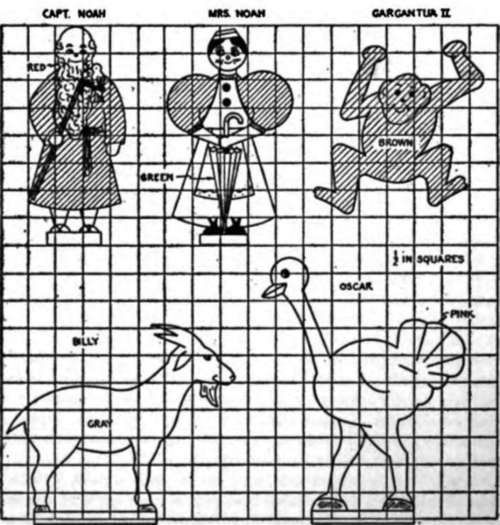
Fig. 3.5. Animal cutouts from thin material.
Performing Bear
An easy first project is an articulated polar bear composed of a body and four legs of simple outline, as diagramed in Figure 3.6. The thicker the wood composing the parts, the wider and consequently more satisfactory will be the finished toy.
The body should be painted white before the legs are attached, so that no unpainted spots will be uncovered when the legs are moved. The monotony of the white paint should be relieved by cooling splashes of gray wherever shadows would naturally occur.
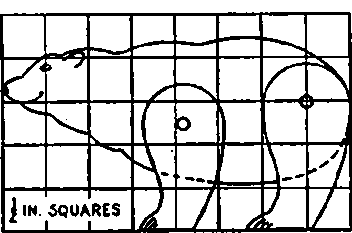
Fig. 3.6. Polar bear.
If the joints are not too loose, the bear, when properly assembled, should be able to stand or sit up and beg, or wave its hind legs in the air. When standing or sitting it may be given a small ball or a large marble to "juggle."
Continue to:


My Books

