


Noah's Ark
Description
This section is from the book "How To Build Games And Toys", by B. W. Pelton. Also available from Amazon: How To Build Games And Toys.
Noah's Ark
A traditionally popular toy with crawlers, toddlers, or sprinters is a completely equipped Noah's Ark. It invariably receives a warm reception because of the removable and maneuverable pairs of "Mr. and Mrs." animals which bulge from its bulwarks. It is therefore highly desirable to construct the ark so that there will be easy access to its uncomplaining cargo. In the model shown in A of Figure 3.3, this is accomplished by means of two hinged ramps on opposite sides of the hull, fore and aft, plus two small doors in the deckhouse. An equally practical method would be to cut out the floor of the deckhouse and make the latter removable, or to put on a hinged roof, like some doll houses. It is believed, however, that the extra work involved in fitting the ramps and doors will be more than compensated for by the young owners' satisfaction in manipulating them.
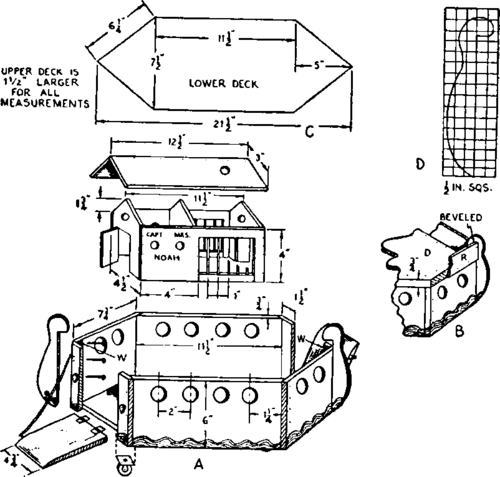
Fig. 3.3. Noah's mobile ark.
Because the ark will be subjected to innumerable loadings and unload-ings, the type shown in the drawings is constructed from 3/4-in. stock.
Those who prefer to work with thin plywood, which can be bent or steamed into shape, will encounter little difficulty in constructing a rounded hull, tacked to 1/2-in. or 3/4-in. decks. The design shown is angular in order to simplify construction with thick wood. Using the dimensions indicated, the hull will have an overall length of about 281/2 in. from stem to stern and be 6 in. high, with a beam or breadth of 9 in.; the deckhouse, or combination cabin and cage, is 53/4 in. high at the ridge, making a total overall height of 13 in. exclusive of wheels. The deckhouse is if in. narrower than the deck to permit space for a daily promenade by selected animals. That is why a thin piece of plywood is bent or sweated around the edge of the upper deck as a railing, as indicated in B.
The hole in the roof for the giraffe's head, while unnecessary if "Mr. G." is portrayed with his neck down in a running or grazing position, will prove to be a popular bit of realism. Likewise "Capt. and Mrs. Noah" will find themselves continuously hailed from their snug cabin to supervise many important situations. Mobility for the ark is provided by three small pivoted furniture casters screwed to the bottom of the lower deck. A hole for a pull cord may be bored in the forward stem, nearest the single caster, as indicated.
As diagramed in detail C, the dimensions of the lower deck are 3/4 in. less all around than those of the upper deck, to allow for the thickness of the sides of the hull, which are nailed to the edges of the lower deck flush with the bottom, whereas the upper deck is nailed to the top edges of the hull pieces, which it overlaps. Portholes are bored with a 1-in. bit.
The fancy bow and stern posts or stems can be simplified, if desired, and should be "dry fitted" to the beveled ends of the hull before the narrow, 11/2-in. uprights are permanently fastened into position. Tall, triangular corner blocks (W) are glued inside the bow and stern angles, and the curved stems attached by screws from the insides, as indicated in A. A good gluing job at all joints prior to nailing or screwing will afford added strength.
Ramps 3/4 in. thick with beveled outer edges are fitted into place with small brass hinges and lengths of small-linked keychain from the dime store. To secure them in their closed, vertical position, small turnbuttons or butterfly latches whittled from scraps of wood are pivoted on tiny screws in each doorpost.
The cabin-deckhouse is simply constructed from 1/2-in. material with a center partition which affords added strength to the sloping roof. To facilitate insertion of the 1/8-in. dowel bars in the cage end, three-sided openings are cut as indicated, and the upper holes bored with the cage held upside down; the lower ends of the bars will fit into perforated 1/2-in. by 1/2-in. lengths glued to the deck. The 2-in. doors at both ends of the structure can be attached with small brass or leather hinges, and held shut with wooden turn-buttons. Not shown in the drawing are two 1/2-in. by 1/2-in. cleats along the inside of the long edges, by which they can be fastened to the deck. It is felt that the difficulty of attaching the deckhouse to its deck by means of small interior angle irons will be compensated for by the additional room afforded to deck "cargo" inhabiting the two compartments.

Fig. 3.4. Stylized animals from thick stock.
Before enamel is applied, all nail holes are countersunk and filled with plastic wood or water putty, and all sharp corners rounded off with sandpaper. An interesting color combination would be a white hull with blue waves, a green deckhouse with a red roof, a red deck and railing, and yellow interiors.
Continue to:


My Books

