


The Diligent Workmen
Description
This section is from the book "How To Build Games And Toys", by B. W. Pelton. Also available from Amazon: How To Build Games And Toys.
The Diligent Workmen
One of the earliest types of animated toys was activated by the horizontal push and pull method of applied leverage illustrated in Figure 3.1. Down through the centuries attempts have been made to replace the figures of the two laborers with pecking birds, bowing gallants, cats leaping at retreating mice, and the like, but it would seem that the heedless robustness of small children to whom the toy is attuned, demands hardy toy actors for the simple movements which the young operators are apt to exaggerate both in tempo and force.
The two workers in Figure 3.x are identical in outline, each consisting of two outer bodies separated by an inner body (X) and an inner hand (Y). With a power jigsaw all four outer bodies can be cut at one time from i-in. plywood; the inner bodies and hands are cut from 1/2-in. material to straddle the horizontal push-pull bars, which are 1/2 in. thick, 3/4 in. wide, and 14 in. long. Scant holes for the 3/16-in. dowel pivots are drilled in the legs as indicated, before the figures are cut out. The holes drilled in the horizontal handles should be loose, for easy pivoting. The insides of the legs and the adjacent sides of the horizontal strips should be sanded smooth for minimum friction. Both the strips and the insides of the legs should be shellacked and sanded, rather than painted.
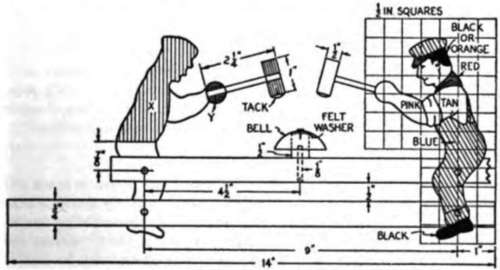
Fig. 3.1. Hand activated figures.
The sledgehammers consist of 1-in. lengths of 1/2-in. dowels bored to take 1/8 -in. dowel handles which pass through scant holes drilled in the hand separator blocks (Y). Large headed tacks are embedded in the faces of the sledges as shown in the drawing. The sledge handles should be cut long to allow for adjustment.
In place of the traditional spike or tree stump, a small bell from a discarded alarm clock is mounted on the chamfered end of a short length of 1/2-in. dowel. Under the bell a felt or thick cloth washer rests on top of the dowel post to which the bell is screwed. The dowel post is glued in place atop a length of 1/3-in. dowel which penetrates the entire width of the upper horizontal strip at its center, to avoid splitting under the rain of blows.
If a small bell is not obtainable, a narrow iron mending plate can be hacked off to a suitable length which will leave a central hole for fastening it flat to the center dowel post. In this case the latter need not be chamfered, but the felt washer is retained to prevent dampening the metallic vibrations or ringing caused by blows from the tack-faced sledgehammers.
After the figures have been tried out for fit and glued up, they can be painted or enameled in bright colors. The suggested color combinations of the figure on the right can be varied by giving his "opposite number" tan overalls and cap, a light blue or white shirt, and a dark blue bandana neckerchief. When properly assembled, the young operator, by alternately pushing and pulling the horizontal handles, will become the straw boss of a pair of workmen whose diligence will keep pace with the Boss' own efforts.
Continue to:


My Books

