


Finger Puppets
Description
This section is from the book "How To Build Games And Toys", by B. W. Pelton. Also available from Amazon: How To Build Games And Toys.
Finger Puppets
Sometimes called Finger Jiggers because of their dancing abilities, an elementary type of puppet consists of a cardboard figurine with two holes at the thighs through which the operator's fingers are thrust to provide animated legs. Since the action will consist of dancing, without gestures, it is a good idea to endow the puppet with a happy, laughing expression. An illustration from a magazine, or a figure cut from a large comic page can be pasted on cutout cardboard to make the Jigger, or the one illustrated in A of Figure 7.3 can be enlarged by squares. Tight fitting peanut or hazelnut shell shoes will add to the illusion.
The alternate type of finger puppet, illustrated in B of the drawing, makes use of the fingers solely for arms. Since in this case the action will be stationary, an orator will probably make the best subject. Unlike the Jigger, the more serious the speaker's facial expression, the more humorous will be the contrast of his frantically waving arms. If no suitable bust is found in a magazine or newspaper, snip out a large-sized head of some public figure and sketch in the body behind a speaker's rostrum. Instead of showing him fully clothed, draw him in vest and shirt-sleeves, so that the animated pink fingers will appear to emerge from rolled up sleeves. Then have the serious minded statesman deliver an impassioned address upon the benefits of hanging up one's clothes, or being on time for meals, with impassioned gestures.
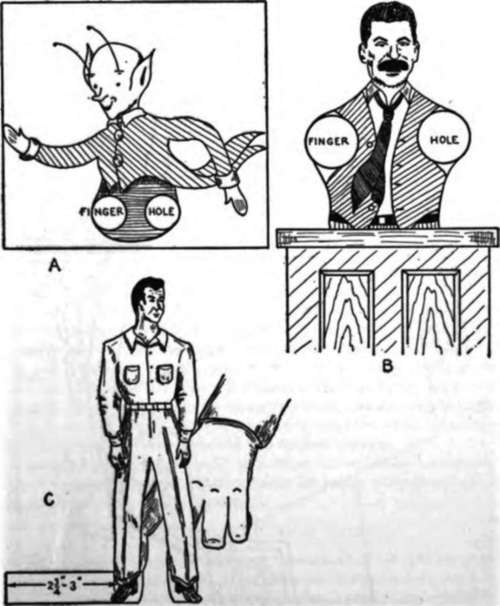
Fig. 7.3. Finger puppet.

Fig. 7.4. Ceiling entertainment for the bedridden.
Walking Figures
Less vivacious than the finger "jiggers," yet more puppet-like in their freedom of action are full length paper cutouts which can be made to walk by attaching their feet to the operator's fingers. As indicated in C, this is accomplished by leaving or attaching paper tabs near the feet. These are rolled into tubes at the back, and after fitting them to the operator's first two fingers, are closed with Scotch tape or paste. The figure should be pasted to light cardboard for rigidity.
A little patience and practice will enable the young puppeteer to cause his or her favorite movie character to stalk about in an interesting manner. Both hands may be employed to animate a pair of figures during imaginary situations complete with dialogue.
Ceiling Entertainment
When the patient is unable to sit up, the means for amusement become necessarily limited, with chief reliance on reading aloud, and the radio. Where a home movie 16mm. projector is available, a welcome change can be engineered by projecting movies on the ceiling (Figure 7.4).
To accomplish this, it is necessary to set a mirror at a 45 degree angle in front of the projector. This will require a bit of jockeying back and forth until the proper focus is secured on the ceiling, and will be facilitated greatly if an adjustable music stand can be obtained, upon which the mirror can be properly adjusted and locked into its final position.
A similar setup will throw "still" pictures on the ceiling from a mirror-scope or postcard projector. Shadowgraphs for young patients will also help to while away the tedious hours.
Continue to:


My Books

