


Indoor Structures
Description
This section is from the book "How To Build Games And Toys", by B. W. Pelton. Also available from Amazon: How To Build Games And Toys.
Indoor Structures
Conditions which preclude outdoor activities do not, however, hamper pent-up youthful imaginations. At some time or another ordinarily sedate furniture will be found upended or tilted into bizarre positions representing caves, rafts, wigwams, forts, trains, castles, and other imaginary structures or conveyances. Aside from the inconveniences these improvisations may cause grownup members of the household, it is axiomatic that greater satisfaction and, hence, a more sustained interest will be derived from small, sturdy structures especially designed to meet the personal preferences of their young proprietors. The fact that substantial appearing edifices can be constructed to be folded flat when not in use should render them worthy of consideration.
Card Table Teepee
Presently popular among the small fry are cloth structures which can be supported upon the framework of ordinary folding bridge tables. Based on the average measurements of a 30-in. square top set on legs 28-30 in. high, B of Figure 4.1 shows how to cut one out of four segments from an old sheet, tablecloth, or unbleached muslin. All cut edges are hemmed to prevent raveling, and the four triangular ridges are stitched together and then turned inside out. The ridge framework is cut from wall-board into two triangles which are center lapped, as indicated in C, so that they can be separated for storage.
Snaps or zippers will insure tightly closed corners but may not withstand the wear and tear of youthful impatience. As indicated in A, three pairs of tape fastenings sewed to the inside at each corner will last longer and permit "peepholing." No tape ties are provided for the door slit, since the latter cannot be closed tightly because of the material lost in hemming. If preferred, the front slit can be omitted entirely, and a corner left open to serve as an entrance and exit.
The decorations on the teepee may be selected from the examples illustrated in Figure 6.18, and applied with wax crayons. An easy way to "set" the designs is to melt the wax into the fibers of the cloth by pressing it between newspapers with a very hot iron.
If the young Sir Knight is temporarily under the spell of stories of chivalry, it is a simple matter to decorate the cloth sides with heraldic devices and prop the front open with two sections of bamboo pole or broom handles to form a marquee, as in D. Grommets sewn into the two front lower corners can be slipped over nails driven into the upper ends of the supporting "posts," whose lower ends can be lashed to the feet of the table legs by means of a pair of short, buckled straps, or with cord. An extra piece of cloth cut to form a valance or frieze, and stitched around the eaves and the edges of the front awning, can be bound with colored tape or outlined with crayon. A metal skewer can be thrust into the roof support as the staff for a small pennon.
Instead of a teepee, little girls will probably prefer to set up housekeeping in more civilized surroundings. Without changing the overall measurements, a rectangular doorway can be cut in place of the slit, with smaller window openings in the two sides, and also the back, if desired. A roll-up door can be provided consisting of a hemmed piece of cloth 3 in. wider and about 4 in. longer than the doorway. This is stitched about 3 in. above the top of the doorway, on the inside, so that it can be rolled up and tied with tapes as shown in E. Muntins for the windows can be realistically simulated by lengths of crossed tape sewn to the inside. Pieces of broad white cotton binding tape stitched along the outside edges of the door and window openings will carry out an illusion of three-dimensional casings. Shingles can be drawn on the roof with crayon, and clapboard siding or bricks outlined on the walls. If the house is set up near a base outlet and a durable electric lamp is available, the young housewife will enjoy illuminating her home at will.
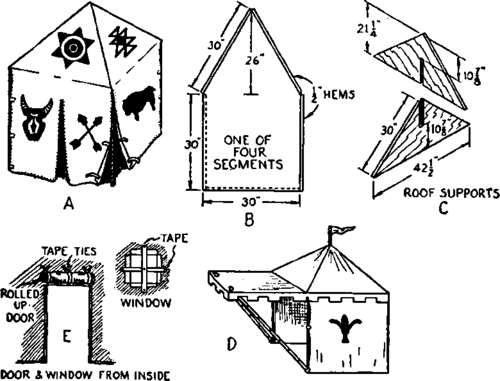
Fig. 4.1. Card table playhouses.
Continue to:


My Books

