


Midget Mower
Description
This section is from the book "How To Build Games And Toys", by B. W. Pelton. Also available from Amazon: How To Build Games And Toys.
Midget Mower
The crawler who needs additional stability during the early toddling stage will be encouraged to forget his uncertain footing while pushing this colorful toy. Although assembled from light materials it should prove strong enough to support its faltering operator during early attempts at erect locomotion. Later, if it survives the fate of most toys, its young owner will enjoy imitating Dad's weekly bouts with the big mower.
In order to provide motive power for the "blades" the usual positions of the wheels are reversed, with the larger driving wheels located on the inside. These are cut on 5-in. diameters from 3/4-in. stock or, if preferred, can be glued up into laminated wheels from layers of 1/4-in. plywood disks. If the latter method is used, 4 slots 1/4 in. wide and 1 1/4 in. long can be cut at right angles to each other in the circumference of each inner lamination to serve as mortises for the four 1/4-in. blades indicated in B of Figure 2.13. The blades are 5 1/4 in. long, and have eight 1/4-in. dowels inserted in pairs between them, set in holes bored at even spaces around the circumference, as in C. Before the blades and dowels are glued into place, a half dozen or so white and colored ping-pong balls are inserted in this cage between the driver wheels.
The two outer triangular sections which support the handle and roller are cut on a 2 1/3-in. radius to provide a 3/8-in. clearance around the driver wheels. The roller can be a 6 1/4-in. length of 1-in. dowel or closet rod which is provided with two screws as axles which pass through loose holes drilled in the rear extensions of the triangular supports, as indicated in A.
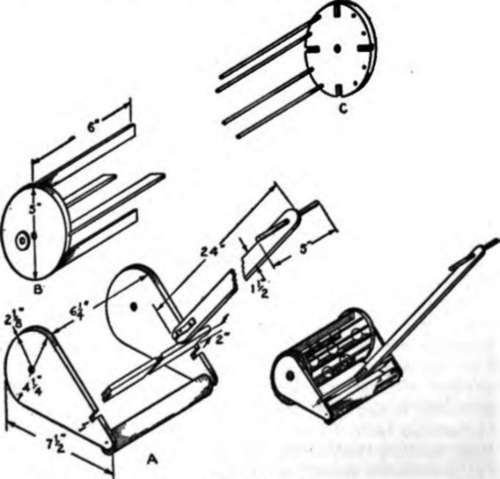
Fig. 2.13. Push mower.
The brace for the handle is a piece of i-in. stock 7 3/4 in. long and 2 in. wide. As shown in A it is half-lapped across the triangular supports and has a cogged notch in the center for the slit in the lower end of the handle. The position of this brace can be varied to suit the height of the young operator, so long as it clears both blades and roller; the same is true of the length of the handle.
The latter is of 1/2-in. material in. wide and about 24 in. long. Both ends are rounded, with a 1/2-in. slot 2 in. long cut in the bottom, and a 3/4-in. hole bored near the top for the 5-in. length of dowel handlebar. If there are wooden balls available which can be drilled to fit over the ends of the handlebar, additional safety will be provided for the toddler during tumbles; otherwise both ends should be chamfered and well sanded. A pair of small angle irons screwed on either side of the bottom of the handle along the top of the separator or brace will prolong the life of the toy.
Before cutting the separator-brace and the roller, the supports should be fitted against the assembled cutter-cage, with due allowance for the two washers which are necessary for the frictionless rotation of the cutter cage. The axle is a 7 3/4-in. length of 1/2-in. dowel rod glued firmly into the outer sections. The holes drilled through the driver wheels should be slightly oversize, so that the cutter cage will rotate freely between the washers.
Paint the wheels and roller red, the triangular supports and their brace red, and the blades, dowel cage, handle, and handlebar yellow.
Continue to:


My Books

