


Nine Holes
Description
This section is from the book "How To Build Games And Toys", by B. W. Pelton. Also available from Amazon: How To Build Games And Toys.
Nine Holes
Originally an outdoor game of Elizabethan origin and several names, the game now known as Nine Holes can be easily adapted to indoor rolling over a smooth floor of almost any size. Six uncut golf balls are a good size for the indoor game, although handballs may be substituted.
As illustrated in A of Figure 5.5, the target surface is 131/2 in. square plus an additional inch to absorb the bevel in front. The decision as to whether this front bevel shall be abrupt and on top, in order to give a decided jump or bounce to a rubber handball or lacrosse ball, or whether it shall be underneath to provide a smooth approach for a golf ball, will more or less decide the basic characteristics of play. Because the smoother approach for golf balls will permit the use of a putter by older players, it is so indicated in the diagram. For the same reason the side fencing is shown as consisting of two triangles permanently attached to the edges of the target board, so as to raise the rear edge about 3 in. from the floor. A strip of lattice or sanded lath across the back completes the fence, which is 7/8 in. high. For more compact storage, however, lattice fences can be substituted for the triangular sides, and the board propped on books or scrap lumber against a wall; or it may be attached by hooks and eyes to the wall of the game room.
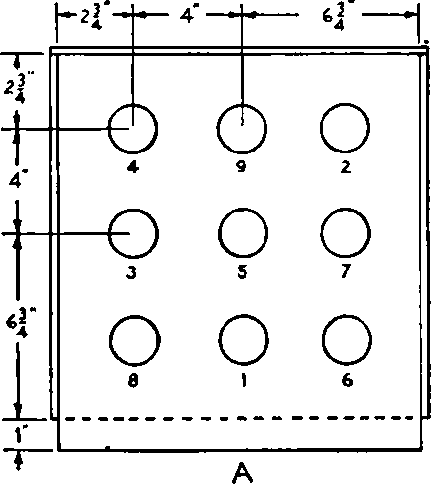
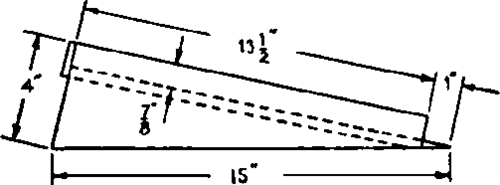
Fig. 5.5. Indoor nine hole game.
The board itself may be of plywood or of odd pieces of 1-in. stock cleated together underneath, so that the 1 13/16-in. holes can be cut in it according to diagram A; holes should be slightly larger for handballs, about 19/32, but small enough so that balls cannot pass through. It is a good idea to prop the board up at various heights and try it out before deciding on a permanent 3-in. height. Shellac or paint the board and number it as shown.
Rules. Chalk a bowling or foul line about 6 ft. away from the target, if possible. Each of two players bowls three (or two) balls alternately.
1. The balls score according to their position at the end of the inning (frame, or round), that is, an opponent may be able to knock the previous player's ball from one hole to another, or completely out of play.
2. Any player who steps over the line or tosses his ball instead of rolling it, commits a foul, and his ball is dead, and if resting in a hole is removed at once.
3. The winning score is 100 or any predetermined total.
4. Three or more players roll all six balls in succession, then compute their scores before the next player rolls. Partners may be played by four or six persons.
5. In Sequence Golf, the balls must score from 1 to 9 and back to 1 again. The player who completes the "course" first is the winner. A score does not count unless it is in proper order; at the end of a player's turn, however, a ball which is in the proper order may be counted, regardless of whether it was rolled before or after the ball preceding it in number.
Continue to:


My Books

