


Ski Ball
Description
This section is from the book "How To Build Games And Toys", by B. W. Pelton. Also available from Amazon: How To Build Games And Toys.
Ski Ball
An adaptation of the once popular alley game of ski ball makes use of a series of triangular targets instead of concentric circles. The rolling game can be played with a tennis ball, lacrosse ball, or handball, on any smooth surfaced floor.
In order to insure an accurate assembly, lay out the plywood bottom first. From the center of a 36-in. base line, erect a perpendicular 31 in. high. Join the top of the perpendicular to the ends of the base line, and the result will be an equilateral triangle with 3-ft. sides. Cut out the plywood triangle for use as a pattern.
To locate the second or middle triangle, draw three lines inside of the outer edges, parallel and 43/4 in. distant from them. In like manner draw the inner triangle so that it is spaced 31/2 in. from the middle triangle. These lines represent the outer edges of the two inner triangles, as indicated in the plan, Figure 5.6.
Whether using power tools or a hand saw, a sliding T-bevel will be invaluable for laying out the miters. Once the outer (f-in.) legs or sides are cut, their mitered ends can be used as quick templets for marking the 1/2-in. material comprising the smaller triangles.
Lumber List
Pieces | Thickness, in Inches | Width, in Inches | Length, in Inches | Description |
2 | 3/4 | 53/4 | 46 | Legs, outer triangle |
1 | 3/4 | 53/4 | 36 | Base, outer triangle |
1 | 3/8 | 31 | 36 | Back, plywood |
3 | 1/2 | 53/4 | 191/2 | Middle triangle |
3 | 1/2 | 53/4 | 71/4 | Center triangle |
1 | 1/2 | 6 | 46 | Jump board |
1 | 3/4 | 4 | 40 | Separator |
1 | 3/4 | 15/8 | 15 | Leg |
The take-off or jump board is 1/2 in. thick and 6 in. wide, and is beveled underneath so that its top front edge will be flush with the floor. As shown in the elevation, the front ends of the outer legs of the target are sloped down about 11/2 in. so that when the jump board is lapped flush with their upper edges, it will be 4 in. distant from the base of the outer triangle. The double dotted lines in the elevation indicate a f-in. separator which not only adds strength to the front part of the assembly, but prevents short shots from inconveniently rolling under the jump-off board. Another worthwhile reinforcement is the corner block inside the apex of the outer triangle.
After the plywood bottom is nailed across the edges of the large triangle, the target box is turned upsidedown, and the inner triangles marked off on the back. An additional 1/4 in. must be added to the spacings so that the wire nails through the bottom will enter the center of the 1/2-in. edges of the smaller triangles.
The leg is 15 in. high at its outer or rear edge, and is hinged to the underside of the apex of the triangle. A long hook and eye, or the support from a hinged desk lid, should be used to keep the target from "creeping" the leg shut. Shellac and wax will make a satisfactory finish, or each triangle and its interior can be enameled a different color. For an easier game use a handball.
The triple triangle box is equally effective as a target for bean-bags, or for balls which must be first bounced on the floor in front of the target. This type of play will eliminate the necessity for the jump board, and the long sides or legs can be cut off at 3 ft.
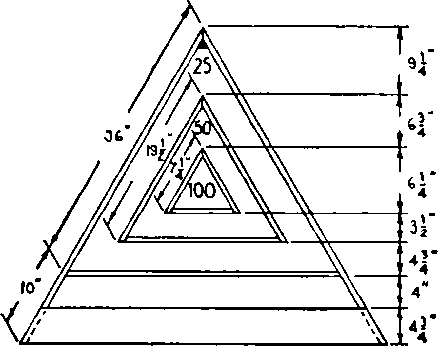
PLAN
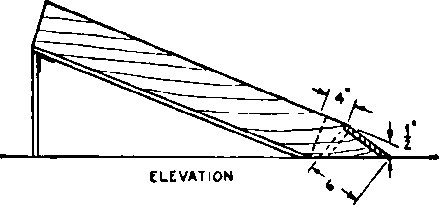
Fig. 5.6. Ski jump target.
Continue to:


My Books

