


Rockers And Bouncers
Description
This section is from the book "How To Build Games And Toys", by B. W. Pelton. Also available from Amazon: How To Build Games And Toys.
Rockers And Bouncers
The urge to rock or ride some sort of vehicle or steed is an early childhood impulse. Obviously, the smaller the rider the more safety must be built into the device, usually commencing with an enclosed seat on fairly large rockers. In harmony with modern trends, the rocker described below can be upended to serve as a desk during its owner's later years.
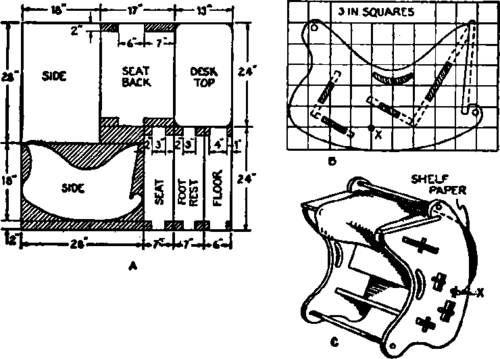
Fig. 2.17. Rocker desk.
Combination Shoofly And Desk
As indicated in A, Figure 2.17, the parts for the dual purpose rocker-desk can be cut from a sheet of plywood 4 ft. square. For long life, five-ply material 3/4 in. thick is recommended, although parts cut from a thinner, three-ply sheet will render good service if tightly assembled. As shown in the drawings, tenons 2 in. long are cut in the backrest, seat, and in the two foot boards to extend through corresponding mortises in the curved side pieces. The rocker or shoofly should then be assembled before marks are made for the 1/2-in. dowel holes, which should be close against the outer faces of both side pieces. To draw the sides up tightly, bore the holes a trifle farther in than the marks indicate. Each 2 3/4-in. length of dowel can then be sanded lightly on its inside face. For additional security, screw the bottom edge of the back rest to the rear edge of the seat, and the meeting edges of the right-angled floor and footrest. The desk top, after its edges have been rounded and sanded smooth, is screwed into position with an overhang on its three edges. Unless the reader is able to visualize and paint the assembled rocker to represent some form of recognizable animal or household pet, the most satisfactory finish will be a simple stain, size, and shellac job, or merely a coat of shellac heavily waxed.
As the small owner grows in size and skills, crayon drawings and finger painting will lift the rocker into its more or less permanently upright position as a desk, with the foot rest or floorboard ensemble acting as a safely inclined trough for the storage of books and writing or drawing materials. A 1/2-in. dowel is inserted in front of the trough edge as a protective footrest. This and other dowels can of course be glued into blind holes bored while the side pieces are disassembled, or be split wedged from the outside, if preferred.
Since the construction plans call for separators 20 in. wide between the curved sides, a roll of white shelf paper 18 in. wide will have plenty of clearance after it is mounted on a dowel roller fitted loosely in the holes at X. A button mold or checker is screwed to one end of the roller, which extends 3/4 in. beyond the opposite side piece, so that a cotter pin or wire nail can be inserted as a keeper, easily removable when a new roll of paper is required. The free end of the paper passes over the rounded rear edge of the desk top, and under a dowel permanently fixed above it.
Continue to:


My Books

