


Peg Games And Puzzles
Description
This section is from the book "How To Build Games And Toys", by B. W. Pelton. Also available from Amazon: How To Build Games And Toys.
Peg Games And Puzzles
If Dad is a golfer those little wooden tees from his bag will make ideal pegs for indoor games and puzzles. Even if there is no golf enthusiast nearby, small bags of tees are very inexpensive and come in various colors, which is a valuable asset for games involving more than one player. Otherwise it is easy enough to cut pegs 11/4 in. long from a length of 1/4-in. dowel. Chamfer both ends and sand them well; a short saw cut in the "buried" end will insure its easy removal from the hole. Do not paint these pegs, but dip them in colored ink instead, so they will not stick.
Solid stock i or J in. thick is best for the board, because ordinary fir plywood is likely to splinter. For the larger games which may require one or more widths of board battened together underneath, make a preliminary layout of the pattern for the holes on one of the boards first, to make sure that no holes will fall on the crack between the boards.
After laying out the diagram it is a good idea to tap a nail hole in the exact spot where each hole is to be drilled, in order to insure accuracy of alignment. To keep from boring a series of holes all the way through the base, a simple bit gauge or stop can be improvised by cutting off a spool or spools and threading them over the bit so that not more than 1/2 in. protrudes when drilling a 3/4-in. wooden base. Sand the board after all holes have been bored, stain it if desired, then shellac and wax it.
Fox And Geese
An old-time favorite for two or more players, Fox and Geese requires a peg board as shown in Figure 5.19, and seventeen pegs or golf tees of one color, representing the geese, and a single peg of a different color for the lone fox. The pegs are set up for play as shown in the diagram, the fox being the center peg.
The fox may move along any line in any direction, one hole at a time. He can "take" or remove the geese by jumping over one into an empty hole, as in checkers. The geese, on the other hand, manipulated by any number of players in succession, may only move forward or sideways, never diagonally, and they cannot jump or "take" the fox. Their strategy is to pen up the fox by sheer weight of numbers so that he cannot move, thus winning the game.
Should the geese demonstrate overwhelming skill, their numbers may be lessened to add difficulty to the game.
Fourteen Peg Puzzle
An interesting puzzle can be played on the Fox and Geese board by turning the board halfway around so that the design is in the form of a St. Andrew's cross or "X." The only holes used are the fifteen included in the triangle ABC, which has its apex at B (see Figure 5.19). All holes but D, the center one in the base, are filled with fourteen pegs of any color.
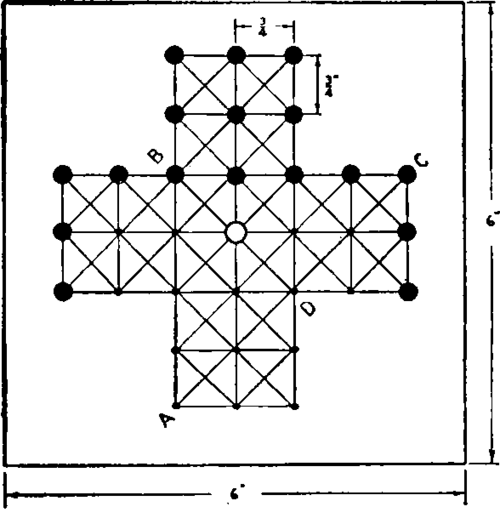
Fig. 5.19. Peg board.
The object is to remove all pegs from the board except one, by jumping along the lines as in checkers. The remaining peg must end up in the hole which was left vacant at the commencement of play. Par for the course is thirteen moves.
If players become too proficient too soon, there are a number of variations which may be adopted. Color or blacken one peg and amend the game to require that the colored peg shall be the solitary survivor—and in the center hole!
Continue to:


My Books

