


Anagram Blocks And Paddle Golf
Description
This section is from the book "How To Build Games And Toys", by B. W. Pelton. Also available from Amazon: How To Build Games And Toys.
Anagram Blocks And Paddle Golf
Anagram Blocks
Closely allied to the still popular game of Anagrams are lettered blocks rolled from a cup. Their three-dimensional nature, coupled with the obvious element of chance, attracts all ages of players. Furthermore, at the conclusion of play it is easier to pick up and store away six relatively large cubes than it is to account for handfuls of cardboard squares or cards.
Although a 41/2-in. length of f-in. square stock will do for the six cubes, 11/8-in. cubes cut from 11/8-in. stock will prove more satisfactory for youthful players. After a thorough sanding, on each of the six faces of each cube, mark a letter in India ink from a six-letter word which has no duplication of letters. Shellac each side when the ink is dry, or paint the various faces in contrasting colors before marking the letters. For the cup, use any conveniently sized tin can with smoothly filed edges.
Rules
1. Roll the six blocks out of the can and form words from the letters showing only on the block tops in three rolls.
2. For each letter used in a word, 5 points are scored. No letter may be used more than once.
3. Deduct 10 points each time three letters of a kind are thrown.
4. Game may be 100 or any predetermined total.
5. For very young players, reduce the number of blocks to five, four, or even three.
Paddle Golf
When assembling paddles for a game like Tether Ball, make an extra one with a paddle surface about 6 in. by 8 in. as the basis for another skill game. The preparations are simple.
For a wooden ball with a 11//2-in. diameter, bore nine 1/4-in. holes in the paddle as indicated in Figure 5.18. Paint numbers above the holes in any broken sequence, and drill a small hole at the top for the knotted end of a 2-ft. length of plumbline or other strong, thin cord. The latter is knotted to a screweye in the ball.
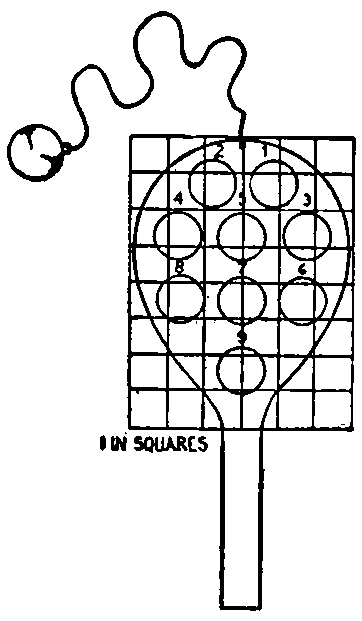
Fig. 5.18. Paddle golf.
The diameter of the available ball will determine the size of the holes in the paddle, for the object of the game is to jerk the ball from the floor into No. 1 hole, then into No. 2, and so on, in sequence, to No. 9. The number of times it is necessary to lift or jerk the ball up before a hole is made are the number of "strokes," the total being the score for the nine holes. To play an eighteen-hole "course," play No. 9 twice, then return in sequence to No. 1. It's not as easy as it looks.
Continue to:


My Books

