


Tether Ball
Description
This section is from the book "How To Build Games And Toys", by B. W. Pelton. Also available from Amazon: How To Build Games And Toys.
Tether Ball
The two-handed outdoor game of tether ball can be easily scaled down to an indoor table game which will provide plenty of fast action. The ball may be a cotton practice golf ball or can be made from yarn. It is batted with table tennis or ping-pong paddles, which are easy to make.
The "pole" is a 30-in. length of broomstick or 3/4-in. dowel set in a 4-in. length of 2 x 4, which is nailed to the center of a 2-ft. square of 3/8- or i-in. plywood, as shown in Figure 5.17. The foot of the pole is whittled so that it will fit snugly into a i-in. hole bored through the center of the block.
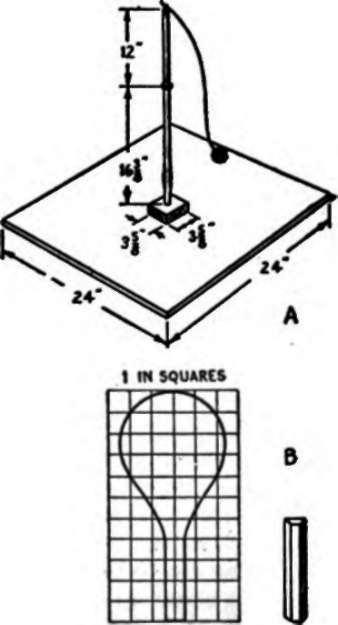
Fig. 5.17. Table tether ball equipment.
The ball is fastened by a length of strong cord such as a carpenter's or mason's chalk line, to a small screweye, staple, or nail in the top of the pole, so that it will clear the base block by 2 in. A narrow piece of adhesive tape is wound around the pole 12 in. from the top.
A strong pair of paddles can be made from two 11-in. lengths of f-in. plywood about 6 in. wide, cut as shown in B. The outer handles can be made from a 9-in. section of f-in. by 1-in. pine with its edges planed off to form a "thick" octagon before it is ripped down the center of its narrow edge. Cut into 41/2-in. lengths, two sections are glued, bradded, and clamped to each side of a plywood tongue or handle. After the glue has set, countersink all brads and sand smooth; do not use varnish.
The object of the game is to wrap the tether cord around the pole above the taped line, one player trying in one direction while his opponent tries the opposite direction. The winner is the first player to wind the cord completely around the pole above the tape in his chosen direction. Players toss for serve and the loser chooses the direction of play.
Continue to:


My Books

