


Table Hockey
Description
This section is from the book "How To Build Games And Toys", by B. W. Pelton. Also available from Amazon: How To Build Games And Toys.
Table Hockey
The standard game of Box Hockey is a rugged contest played in a sturdy box about seven feet long, set firmly on the floor or on the ground outdoors. An equally fast contest, however, can be scaled down to table size.
For the bottom of the box cut a sheet of smooth hardboard 18 in. wide by 36 in. long. This is shingle-nailed to the bottom edges of a rectangular frame of 1-in. by 4-in. material. As is indicated in Figure 5.16, a single gate 1/4 in. wide is cut in each of the end pieces of the frame. The middle fence with its two gates is nailed to the centers of the long sides.
The dimensions of the gates in the sketch are predicated upon the use of a 1-in. puck about 7/8 in. thick cut from a broomstick or drapery rod. A faster, field hockey type of game results when some sort of ball is used, which may require larger gates. If a ball is to be used, bore a slight depression in the center of the top edge of the middle fence, for the face-off.
For hockey sticks, 20-in. lengths of f-in. dowel rod will be suitable for accurate play. Less accuracy but more fun will result if the sticks are bent up at the ends. This will require the steaming or boiling of about 8 in. of the end of each stick, which should be lengthened to about 23 in. to make up for the curve. While the end is steaming, drive heavy nails into a thick plank as in B. When the stick has been stewed enough to become pliable, bend it in the impromptu curved vise and let it set overnight until thoroughly firm and dry.If 3/4-in. by 1- or 11/2-in. stock is used instead of maple or birch dowel rods, plane off the sides of the curves, and sand the handles smooth.
Rules. The game is usually played with only two players, because otherwise, two will have to play left-handed. Goals are chosen by lot, and the puck or ball is balanced atop the center fence for the face-off.
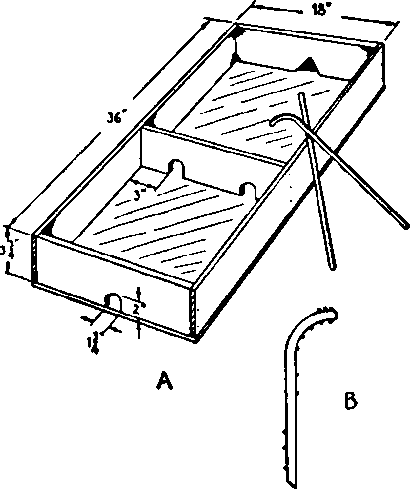
Fig. 5.16. Miniature box hockey.
1. For the ritual of the face-off, the two contestants face each other across the center fence, tap the floor of the box with their sticks, then the opponent's stick above the ball, alternating three times. After the third time each endeavors to strike the puck into his opponent's court. If one of the players "jumps the gun" before the third tap, repeat the entire process.
2. For small players the less rules the better; let each one try to force the puck through the end gate (goal) which is hotly defended by the opponent.
3. Refinements of the rules may be applied in direct proportion to the age of the players, such as designating fouls (a) for pushing instead of striking the puck or ball, and (b) for raising one's stick above the edges of the box frame, except when facing-off or when moving across the center fence into opponent's court.
4. The penalty for all fouls permits opponent a free hit from the spot where the puck is at rest; the player who committed the foul must remove his stick from the line of the free hit. Neither player may strike the puck after a free hit until it has come to rest or has struck a fence.
5. Should the ball or puck fly out of the box, it is put back into play at the nearest point to where it went out, without a face-off.
6. A goal through opponent's fence counts one point, and five points to a game are plenty; for young players three will prove an "ample sufficiency," at least until time out is taken for a short rest.
Continue to:


My Books

