


Plunging Whale
Description
This section is from the book "How To Build Games And Toys", by B. W. Pelton. Also available from Amazon: How To Build Games And Toys.
Plunging Whale
The employment of an eccentric ramming action to activate a pivoted figure in a pull toy is illustrated in Figure 3.8. As shown in the elevation, the silhouette cutout of Moby Dick, the white whale, is loosely pivoted at the rear (X), leaving the front end free to ride up and down upon cam Z, which is mounted off center on the forward axle. Because the wheels are mounted inside the platform or float, cam Z, instead of being fixed to the front axle, is nailed to both front wheels, as is shown in the plan. This permits both front and rear wheels to rotate freely on their axles.
The float is butted together from 1/2-in. stock which is if in. wide, to make a rectangle 2 3/4 in. wide and 8 in. long. The last operation in assembling the toy will be to deck the float with a piece of 1/8-in. veneer in which a center slot is cut a scant in. wide, as shown in the plan. The figure of the whale not only slides freely up and down through this slot, but is partially supported by it at times.
The wheels are of 1-in. material cut to the standard 2-in. diameters and drilled to rotate easily on 1/4-in. dowel axles. The cam is a wheel also cut from J-in. stock, with its oversize J-in. hole drilled 5/16 in. off center. Cardboard spreaders are placed between the cam and the wheels before they are fastened together with thin finishing nails. All four front and rear wheels are mounted with thin washers to reduce friction against the inner sides of the float. The rear wheels can be kept separated by means of a loosely riding section of spool (Y) cut a scant 9/16 in. long.
The axle ends fit into scant holes in the sides of the float, as does the 1/8-in. dowel which serves as the pivot through a loosely fitting hole in the rear of the whale. After the axles have been glued into place, upholsterer's tacks can be used to finish off the ends. An even more craftsmanlike procedure is to fit them into blind holes drilled only halfway through the sides of the float.
The figure of Moby Dick is cut from 1-in. stock or glued up from thinner jigsawed sections. A short piece of wooden match stick or dowel end can be let into the top edge to represent his "blow hole." He can be painted all white or shaded with a bit of light gray or light blue as indicated in the elevation. The simple waves on the sides of the float are of course subject to such artistic interpretations as the builder can produce. A screweye in the front anchors an end of the pull cord.
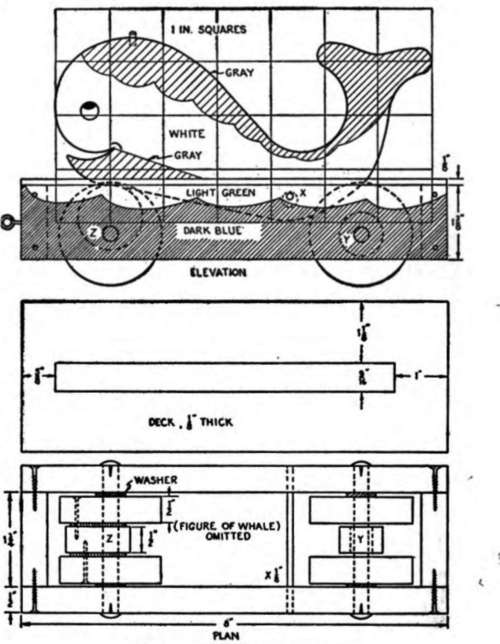
Fig. 3.8. Moby Dick in motion.
Miscellaneous Effects
The same principle can be used to animate various forms of hopping, bobbing, or pitching figures, such as the kangaroo, for example, illustrated in Figure 2.9. In order to make use of this type of figure the only amendment required would be the lengthening and widening of its tab (C), to form a base which will extend the proper distance beyond cam Z and pivot X in Moby Dick's assembly (Figure 3.8).
For the nautically minded youngster a boat can be made to pitch realistically by pivoting it in the center and providing opposing eccentric cams on both front and rear axles.
If preferred, the four wheels can be mounted on the outside of a base of J-in. stock by bradding sections of 1/8-in. or 1/4-in. material to the outside long edges to serve as housings (see Figure 3.11). In this case the front (or rear) wheels and cam must be fixed to their axle, which rotates in its bearings. It is good practice to cut the cam slightly wider than the thickness of the figure to prevent it from riding off, unless spool sections are located on either side of the pivot to prevent undue looseness.
Continue to:


My Books

