


Circus Parade
Description
This section is from the book "How To Build Games And Toys", by B. W. Pelton. Also available from Amazon: How To Build Games And Toys.
Circus Parade
With the average American, the lure of the Big Top persists as long as the heart functions. In boys it is rooted deep in those early hours before dawn, when shadowy figures stole forth from sleeping households to witness the unloading of the circus at the railroad yards, or out at the Fair Grounds. This self-appointed welcoming committee later viewed the traditional parade with proprietary eyes, commenting upon the makeup of the various features with a latent enthusiasm which easily shattered their pseudo-sophisticated masks to kindle the ready spirits of spectators, both young and old alike.
If some of the animal cargo of a toddler's Noah's Ark remains intact, it will require no special skill to render selected specimens mobile for a Circus Parade. Animals having fairly thick bases can be equipped with four wheels moving freely on pairs of thin nails driven horizontally opposite each other at the ends of the long edges of the base. As previously mentioned, the wheels may be of laminated cardboard, wooden desks, wooden button molds, checkers, slices of broom handles or 1-in. dowel rod, clothespin heads, or a variety of available household materials. The main requirements are that the holes drilled in the wheels will be sufficiently oversize for smooth functioning, and that washers are inserted to prevent binding. For the sake of uniformity, the wheels of units in this Parade will be presumed to be of 2-in. diameter, except for those of the animal cages, which are 2 1/2 in. to provide clearance for their cantering steeds.
In the case of wooden bases which are too thin to receive nail or screw axles, bearings can be provided by bradding and gluing thin side pieces of wood or cardboard, through which the dowel or pencil axles can be thrust. Provided the base does not exceed 13/8 in. of width, it will house the ordinary 1 1/4-in. wooden spool through which a J-in. dowel has been jammed to form an axle, leaving sufficient play for 1/16-in. washers, as in Figure 3.9. If the decision is to provide a stationary axle, then the wheel must be kept from revolving off the axle by means of a cotter pin in the form of a headless brad, if the axle is thick enough; wire axles may be bent up, and bolts have heads and nuts to retain the wheels. In any event, an extra washer should be provided to prevent undue chafing and binding.
Although animal cages seldom head the parade, they might as well be constructed first to receive existing toy animals which can thus be acclimated to their confined quarters while other units of the parade are under construction. As indicated in the dimensions of Figure 3.9, the single-cage wagon is designed to hold an animal whose maximum height and length are 33/4 in. by 43/4 in., including base. These dimensions will take care of the examples pictured in Figures 3.4 and 3.5, exclusive of the giraffe or the ostrich, when standing erect. If the latter are to be caged, a hole or holes can be bored in the top of the wagon cage similar to the one provided for the giraffe in the roof of the Ark.
The top, bottom, and front of the cage are nailed together from 1/2-in. stock in the indicated dimensions. The back has a hinged ramp like the Noah's Ark, which fits between two corner posts of J-in. by J-in. material which are lapped into the top and bottom pieces as shown in the drawing. A small butterfly latch at the top holds the ramp shut when it is vertical.
The ornamental side pieces can be cut from any wood which is thick enough to receive the ends of the J-in. dowels used as cage bars, but should not exceed | in. Straight lengths of wire will present a strong, metallic appearance and require very thin sides, such as cigar box wood. If preferred, the sides may be cut from single pieces of stout cardboard, and the wooden dowels or skewers halved into place by whittling their ends half-flat for gluing from the inside.
The wheels of 2 1/2-in. diameter are mounted on 1/4-in. dowels through bearings bored slightly oversize in the ends of the lower side pieces, as indicated. If these dowel axles are measured and carefully marked after the washers and wheels are in place, they can be cut off flush and covered with polished metal furniture glides for ornamental hubs.
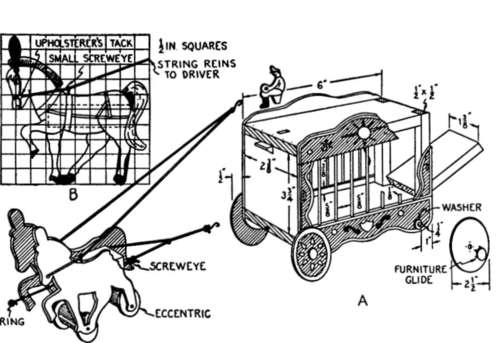
Fig. 3.9. Circus cage.
A triangular foot-rest is glued near the top of the front section, for the removable cutout figure of the driver. The latter wears a red, brass-buttoned uniform, or may be in clown dress. He has a hole drilled through his hands to receive the hook at the end of the looped reins.
The horses are duplicate cutouts from J-in. plywood in a pattern similar to that pictured in B of Figure 3.9. They are glued in parallel to both sides of a separator 3/4 in. thick, 13/8if in. wide, and 3 in. long, as indicated in the dotted lines shown in B. As will be noted by referring to the pattern, the natural thinness of the shanks and fetlocks of the hind legs are compensated for by material which is not cut out, but is painted black instead. So, too, the fore and rear off legs are left joined to a strip painted black, which acts as a bearing for a 11/4-in. spool. The latter has a J-in. dowel forced through its hole and cut off flush with the outer faces of the spool so that thin nails can be centered in it from both sides, to serve as axles. The rear spool is pivoted eccentrically to the hind legs, as indicated in A, imparting a trotting motion to the horses as they are drawn forward.
A short length of closely wound white cord ending in a small ring leads from a small screweye at the front of the separator block between the horses as a forward hitch. In the rear, two short lengths of cord from two screweyes lead to a single length which ends in an S-hook bent from a piece of hairpin, to fit into the screweye in the undercarriage of the cage, as indicated in Figure 3.9 A. Small-linked lengths of keychain from the dime store will present an even swankier appearance.
The reins, starting from upholstery tacks in the bridles of both horses, pass through miniature screweyes in the edges just forward of the horses' girths to another S-hook which can be inserted into the hole drilled in the driver's hands. Red, white, and blue or tinseled candy box cord will make a colorful harness and reins.
The horses can be painted any preferred color, so long as their harness is painted to contrast, such as red on white, and white on black. Since at least two teams of horses were generally employed to haul even the lightest of cages, it is a good idea to cut out four pieces of plywood at a time, brad-ding them together through the waste sections around the outside of the pattern.
Paint the cage scarlet, splashing it boldly, after it is dry, with gold or bright yellow. Don't worry about an exact design, just slap on the brightest of colors with a lavish brush, for remember, circuses to be gay must be colorful.
If the assembled cage finds favor with P. T. Bamum, Junior, and it is not deemed desirable to go into mass production to house all available animals, a double cage (in length) can be constructed to house two different animals, with a sliding partition between. Such a partition is easily adjusted by cutting the wire or dowel bars so that they will extend through a series of holes on 5/8-in. centers, bored across the center of the narrow part of the roof. The lower ends of the bars are sunk in a strip of wood across the floor of the cage, and the upper ends in a strip lying across the roof. To admit the first or forward animal, the upper strip of the separating set of bars is lifted gently until the lower strip of wood is in contact with the ceiling of the cage. In order to house such violently antagonistic specimens as the lion and the tiger shown in Figure 3.4, the double cage would have to be constructed with an overall length of 11 in.
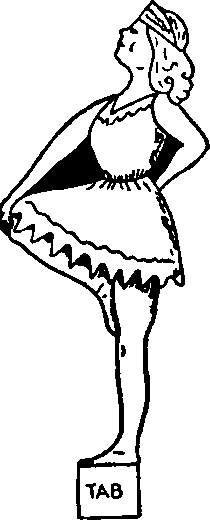
Fig. 3.10. Bareback rider.
Assemble an extra pair of horses and cut a slot in the top of the separator block to house a tab extending from the foot of the bareback rider shown in
Figure 3.10. Narrow ribbon spools will give the effect of a single horse, and with a little experimentation, the daring equestrienne can be pivoted on a long tab so that she will remain erect as her steed prances.
Continue to:


My Books

