


Stuffed Toys
Description
This section is from the book "How To Build Games And Toys", by B. W. Pelton. Also available from Amazon: How To Build Games And Toys.
Stuffed Toys
Dear to the hearts of most babies are soft stuffed dolls and animals of various descriptions, which can be cuddled, squeezed, mauled, thrown, or sat upon with a minimum of permanent damage. In fact, the essential element in toys of this kind is durability, for babies and very young children are not critical of subtle artistic effects, lavishing the same warm affection upon a homemade handkerchief doll as is often displayed over an expensive commercial product.
From the distaff side comes the admonition that this display of moist affection will dictate the practical selection of materials which are not only easily washable, but whose colors are dyefast when subjected to the chewing test. Furthermore, it is pointed out, anxious mothers often become concerned about the alleged sanitary condition of the stuffing in toys of this type, hence a homemade product affords them assurance on this point, as well as an opportunity for individual creative design.
Many are familiar with children who, in spite of elaborate, expensive additions to their doll families, continue to cling to their first beaten-up rag doll with the unswerving loyalty of a mother for her first-born. It may be that the object of this intense mother-love is nothing more than a hastily contrived stocking doll, with its features entirely obliterated by excess affection, and with arms and legs hanging by threads, if at all. But it represents a symbol and is still beautiful in the eyes of its fond mother.
Stocking Doll
While it is true that stuffed stocking dolls are usually manufactured at home as quick substitutes, they can be made quite presentable and, when outfitted with suitable clothes, need take no back seats in the doll world. A black cotton or mercerized stocking will form the basis for an Aunt Dinah, a white one for a clown, and one of the nude shades for a Caucasian doll. The toe of the stocking is cut off at the shaded area in B, Figure 2.2, and sewed together on the wrong side. Now turn the stocking inside out and stuff the head tightly with cotton or kapok, and below it, wind carpet thread in two places to form the neck. For a chubby doll with an undeveloped body, the torso can be packed firmly with padding down to the hip joint, which is then stitched all the way across. To provide a more mature trunk, insert a rounded piece of orange crate or cardboard below the neck to mold the shoulders. It should have holes punched in it so that it can be sewed in place; then stuff to the waist. A waist joint narrower than the shoulders is double stitched. The remainder of the trunk is then stuffed and the hip joint double stitched.
To make the legs, slit the stocking up the center and sew up the seams of the two tubes thus created. Stuff each upper leg and secure it with a double-stitched knee joint, then stuff the lower legs. Double stitch the ankle joint and pad the feet tightly. Separate, padded feet can be cut from different material, if preferred, and attached to the ankle joint.
Thus far, no dimensions have been mentioned in order to allow a maximum leeway in the matter of overall size. If an adult's stocking is being used, there should be sufficient material remaining to cut out a pair of tubes for the arms, of diameters slightly less than was used for the legs, if not, another stocking must be requisitioned. The arms should be long enough so that when attached to the shoulders, the hands will extend to a point halfway between the hip and knee joints. After stitching the tubes and turning them inside out, sew up the shoulder ends and stuff them tightly, tapering off at the double-stitched elbow joints; then stuff down to the wrist joints. Like the feet, the mitten-like hands may be well-padded additions cut separately from other material and attached to the wrists. Finally, sew the arms firmly to the shoulders.
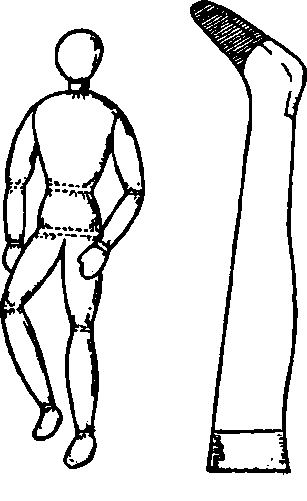
Fig. 2.2. Articulated stocking doll.
To mark the features, colored embroidery floss will stand up under considerable punishment if small stitches are used. The doll's "personality" will determine whether small shoe-button eyes are desirable. Hair of almost any shade can be darned into a suitable hairdo with rug yarn. The whole matter of features and hair can of course be quickly solved by substituting a china or plastic head for the stuffed stocking knob.
Waterproof toys. Stuffed figures, made from bright oilcloth or some of the newer plastic films, are not only highly resistant to their owners' damp embraces but, when filled with cut sponge, will float in the bathtub. A green plastic or oilcloth frog makes a satisfactory all-purpose project.
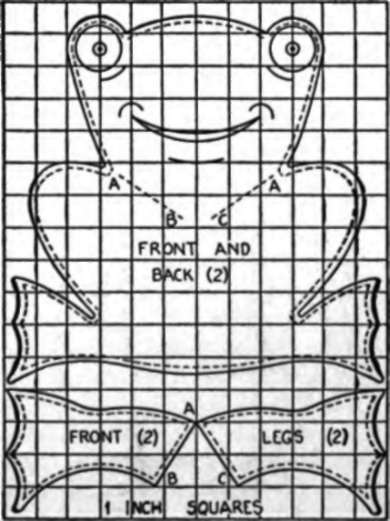
Fig. 3.3. Waterproof frog.
For a figure the size of the one illustrated in Figure 2.3, about a yard of green plastic material will be required. Cut out the identical front and back bodies so as to leave material for the four identical pieces which are required for the front legs. A good grade of yellow enamel can be used to paint in the eyes, which have black shoe-button or bead pupils sewed in place. The mouth may also be outlined in yellow, or may be red, if preferred. Black lines below the eyes and mouth suggest characteristic pouches.
Rather than attempt to sew the pieces of plastic or oilcloth together on the wrong side and then turn them inside out, use a fine needle (about No. 11 on the sewing machine), and join the various pieces together with a top stitch, allowing a 3/5-in. seam which can be trimmed off later close to the stitching. For a finished job, trim the cut seams with embroidery floss in a blanket stitch. Through unfinished openings in the seams, fill the body and the front legs with rubber sponge cut into small pieces, or chopped up corks. If sponge is used, allow for its expansion when wet. Sew up the openings and watch it float.
Continue to:


My Books

