


Wheeled Trains
Description
This section is from the book "How To Build Games And Toys", by B. W. Pelton. Also available from Amazon: How To Build Games And Toys.
Wheeled Trains
It will seem no time at all before young Casey Jones' interest will be attracted to trains and toys with real wheels that turn. Although he still prefers them brightly colored, he is now more intrigued with their loading and unloading possibilities. He is also apt to prefer them larger.
For a quick, intermediate changeover, the Tiny Tots' Train previously described will be easy to mount on wheels if its bases were cut from J-in. stock. When this is the case, all that is necessary is to drive wire nails into the edges of the base through holes drilled in checkers, plywood, or cardboard disks, button molds, or slices cut from broom handles or dowels. Small washers on both sides of each wheel will eliminate binding.
A young railroader who is a little older and more observant may hold out for a more approximate reproduction; he may, in fact, have become aware of the encroachment of the Diesel engine upon its manfully puffing steam predecessor. For the young realist of this type it is a relatively simple matter to assemble a speedy looking streamliner, as will be described later.
The overall size of the project will naturally be affected by various factors, not the least of which are the dimensions of the available play space. Taking the bull by the horns, or in railroad parlance, the "jack by the stack," the dimensions which follow, while intended only as guides, will nevertheless permit the loading of the circus menagerie cages previously described, as well as some of the smaller animals.
In the interests of semiproduction line assembly, the following dimensions are common to all cars:
(1) All underframes or bases are 1/2 in. thick and 9 in. long with the exception of the tender, which is 61/2 in. long. All bases are 41/2 in. wide except for the locomotive, which is 33/8 in. wide.3/8
(2) All wheels are 1/2 in. thick, and exclusive of the four large locomotive drivers, have a diameter of 1 in.
(3) All 1-in. wheels axe mounted on axle housing blocks or trucks which are 7/8 in. thick, 2 1/4 in. wide, and 33/8 in. long.
At this point a decision should be made as to whether or not it will be feasible to pivot the front trucks of the various cars. While it is true that pivoted front trucks will provide flexibility for the long train which the home toymaker will probably be persuaded to construct, on the other hand they are apt to cause frequent "derailments" when the train is habitually drawn over wrinkled rugs or other obstructions, particularly if the pivot works too loosely. The latter can be a short screw with a smooth upper shank which can be driven in far enough (without benefit of a washer), to provide resistance against excessive swiveling.

Fig. 3.13. Locomotive and tender.
As indicated in Figure 3.12, the "battleship" or freight locomotive is assembled on a base which is only 33/8 in. wide, with a hollow cab butted together from J-in. stock cut to the dimensions shown, and roofed with a J-in. slab. The sides of the cab are glued and bradded flush with the front edges of the base, which is mortised at the rear to receive them. The boiler is a 6-in. length of 21/2-in. or 2 5/8-in. round stock beveled lengthwise to a height of 2 in. Lengths of 1-in. dowel or mop handles are whittled and glued into holes in the top of the boiler as indicated, and the stack is a 1-in. length of dowel or spool; a 1/2-in. length of 3/8-in. dowel or round pencil serves as a headlight. A polished metal furniture guide or a wooden checker embellishes the head of the boiler. The cowcatcher, because of its perilous position during collisions, is reinforced by a pair of angle irons underneath. If the front truck is not pivoted, it will be a simple matter to saw two mortises in its top for the horizontal portions of the angle irons; otherwise the underside of the base must be well mortised, and small-headed screws used to attach the angle irons.
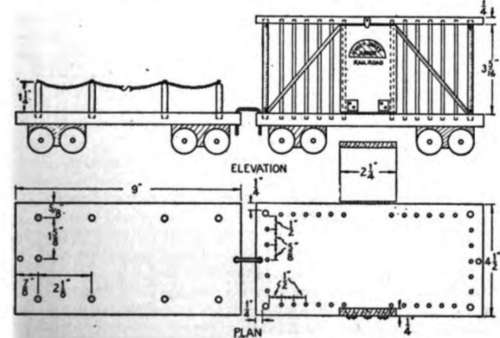
Fig. 3.13. Flat and stock cars.
The driver wheels of 2 1/2-in. diameter are cut from 1/4-in. scrap and pivoted with nails or screws directly to the edges of the base, using tiny washers for easy movement. The small wheels are attached to their trucks in like manner.
Like the cab, the tender is butted together from 1/2-in. material to form a hollow shell; an optional semi-roof of J-in. stock is shown in the diagram. An easy method of attaching it to the base is to cut a piece of J-in. wood 2 1/2 in. wide by 5 1/4 in. long and nail it to the top of the base in the position indicated; the front and sides of the tender can then be glued or bradded to the edges of this sub-base.
Couplings may be either of the screweye and L-hook type illustrated in Figure 3.12, or a staple bent from suitable wire to fit through holes drilled in the front and back platforms, as shown in Figures 3.13 and 3.14.
If the circus is to be transported by rail, Figure 3.13 shows two important pieces of rolling stock. The flat car is easy to make, with ten removable J-in. dowel "stakes" chamfered at both ends and fastened together with small-linked key chain. The dimensions given will accommodate the circus menagerie truck previously described, and to that end a removable ramp of 1/4-in. material should be provided for loading.

Fig. 3.14. Gondola and caboose.
The stylized cattle or stock car is reminiscent of the menagerie cages, with J-in. dowels at the four corners and 1/8-in. vertical bars. To avoid the drudgery of boring twenty small holes at an angle, the diagonal members can be cut from 1/8-in. veneer or stout bristol board and glued to each upright. Instead of sliding doors, hinged ramps are provided so that animals can be loaded expeditiously. The latch is of the familiar turnbutton type pivoted to the edge of the car top. Bars are spaced as indicated in the plan.
A tank car or "oil can" is easy to make from an 8-in. section similar to that used for the engine boiler, with a 1-in. rounded dowel section set into the center of the top, as in the case of the Tiny Tots' Train: A mailing tube with its ends plugged will also look like a metal tank after it has been properly filled and enameled black. A short ladder to the filling cap or dome can be glued together from match sticks.
Figure 3.14 shows a simple method of constructing a sturdy "cradle" or gondola. The edges of the base are mortised to the depth of J in. on side so that the 2-in. side members of the gondola can be bradded flush. The ends, of 1/8-in. scraps, are then butt jointed into position and may be further strengthened by nailing them from underneath the base.
The stylized caboose, known variously as the "clown car" or "dog house," has sides of 1/2-in. material let into mortises in the base. Like the locomotive cab, its windows are square openings cut from the top down and closed by the roof. The latter is of J-in. stock with rounded ends which overhang the structure 1 in. at both ends. A 2-in. by 2 1/4-in. block of 3/4-in. scrap is glued to the center of the car's roof and roofed in its turn, with 1/8-in. veneer. Observation windows can be painted on. It will be noted that because of the wider platform of the caboose the trucks are located J in. farther back at both ends. Doors of the "buggy" are left open so that the crew can bail out quickly in an emergency.
Continue to:


My Books

