


II. Book Problems
Description
This section is from the book "Paper and Cardboard Construction", by G. F. Buxton, F. L. Curran. Also available from Amazon: Paper and cardboard construction.
II. Book Problems
Problems in the making of folders, small pamphlets, portfolios and bound books are described on the following pages and arranged in a sequence representing work of increasing difficulty for each of the first four grades of public schools. The first figure of each problem number indicates the grade in school recommended as suggested on page 12 of the introduction. The sequence is more noticeable in some places than in others, but in general it will be found that the work meets well the abilities of the children. It is within the range of successful handling and yet requires a real concentration of effort thruout the course. While sequences and definite steps are given emphasis, it will be found possible to vary considerably from the outline, and many supervisors will want to do this. It may seem best in teaching, not to give such detailed information to the children, but to assign a problem and allow the children to find out for themselves how to make it. Even here, however, the teacher must have in mind a definite line of processes in order to properly describe each problem and to be of help to each child, and the steps suggested will be found at least typical.
While the idea back of the choice of book problems has been the manipulation of material for the training of hand and eye and for an acquaintance with basic processes in the making of books by hand, there is no limit to the use which may be made of the articles made in correlation with other school subjects. Many uses of booklets for gathering notes and illustrative material will occur to the teacher. Where the making of books is incidental to the using of them, the outlines will only be used as hints. It is believed that the book problems will furnish to many teachers the directions they have been wanting in handy form for the natural correlations between construction and other school subjects.
An especially valuable feature of the book problem is the opportunity it furnishes for the mounting of illustrations cut from old magazines, and of free cuttings; and much may be made of the use of books for drawings and designs, either made directly in the book or cut and mounted. Cover designs offer another attractive field for crayon and water color as well as for pencil and pen and ink work. In some cases it is possible to have the children make fairly attractive lettering upon the covers. In all cases the choice of proportions in the making of booklets is important and may be an attractive field for the art teacher. In the books suggested, the limitations due to size of stock should be obvious, as a standard size of 9"x12" for all problems has been selected. Books of larger size can be made only if extra paper cut from the full stock sheet be supplied. A list of some of the full sizes of paper is given in chapter VII, which will be found convenient for reference. If larger sheets than the 9"x12" be used, the binder's typical methods of folding may be employed and one sheet folded so as to make eight or sixteen pages of fair size. It will be noted also that if funds permit, some of the higher grades of paper may be used and better products obtained. If a printing press be available, very pleasing announcement folders and booklets for special occasions may be made and the use of type in page design be illustrated. Printing is especially desirable in upper grades and in high school classes but it does not come within the scope of this book.
The arrangement of book problems by grades is given below to enable the teacher to determine at a glance the place of a particular piece of work in the series of book problems.
111 Mounting folders (Rough cover paper).
112 Booklet folder (Rough cover paper, - book paper).
113 Pocket note-books (Rough cover paper, - print paper).
114 Book of color schemes (Colored and gray rough cover paper).
115 Drawing-book (Cover paper, - book paper).
116 Laundry list (Manila paper).
211 Paper portfolio (Cover paper or press board, - stay tape).
212 Paper portfolio with laps (Heavy cover paper, - stay tape).
213 Book of designs (Cover paper and book paper).
214 Weather record (Book paper).
215 Receipt book (Cover paper, - bond paper, - binders' cloth).
216 Note-book (Cover paper, - manila paper).
217 Paged blank book (Cover paper, - book paper).
311 Scrap-book (Colored and gray cover paper).
312 Sewed pamphlet (Cover paper, - book paper).
313 Pamphlet with reinforced back (Cover paper, - book paper, - binders' cloth).
314 Cloth covered portfolio (Strawboard, - binders' cloth, - marble paper).
315 Glued booklet (Cover paper, - book paper).
316 Cloth bound book (Cloth board, - binders' cloth, - cover paper).
Fourth Grade
411 Pocket paper file (Manila tag board).
412 Desk paper file (Heavy tag board).
413 Note-book, covers (Strawboard, - binders' cloth, - cover paper, marble paper).
414 Portfolio with cloth corners (Cloth board, - binders' cloth, - cover paper, - marble paper).
415 Bound scrap-book (Strawboard, - binders' cloth, - colored and gray cover papers).
416 Bound drawings (Heavy cover paper).
417 Rebound book or bound magazines (Material depends upon problem).
It is to be understood from this list that other problems such as boxes, envelopes, and card mounts, are given in each grade following the book problems.
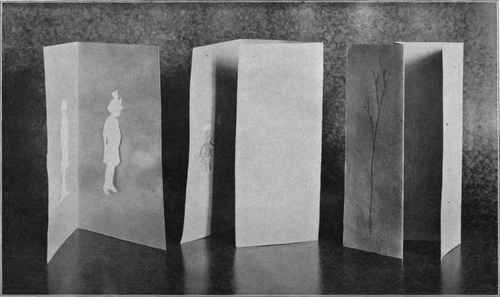
Mounting Folders. Book Problems Rough gray cover paper, 3 pieces, 6"x 9" White book paper, 3 pieces, 6"x 9" Paste Scissors.
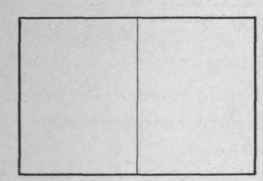
Cover Stock - 6"x 9"
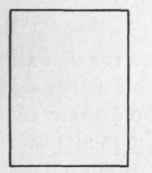
Folded - 4 1/2"x 6"
Directions for Two-fold: a. Fold upper left corner to upper right corner and crease.
Continue to:


My Books

